Naṭarāja at the Gate of Matter
A Transmission in Bronze
Abstract
This essay invites the reader to look at Śiva beyond image, beyond movement, beyond the drama of the dance itself. Naṭarāja is approached here not as a deity to be worshipped, nor as a symbol to be decoded, but as a way of perceiving the cosmos in motion. Beyond form, beyond gesture, beyond myth and ritual, the dancing Śiva opens into a vision of reality in which creation and dissolution, stillness and movement, matter and awareness are not separate events but a single, continuous process.
What appears as dance is examined as cosmic rhythm; what appears as icon is read as intelligence held in plain sight. The fire, the drum, the lifted foot, the grounded dwarf, the two distinct kuṇḍalas… each points beyond itself, training the eye and the mind to perceive balance where chaos is assumed, and unity where opposites are named. The image does not reveal secrets by explaining them. It reveals by teaching how to look.
Drawing from Śaiva metaphysics, classical iconography, Nāṭyaśāstra theory, Śilpaśāstra prescriptions, and carefully resonant strands of modern scientific thought, this essay suggests that Naṭarāja holds the space outside CERN not as ornament or homage, but because it speaks to something universal and ongoing… the living order of the cosmos, dancing openly before us, waiting not for belief, but for recognition.
Why Naṭarāja Stands at CERN
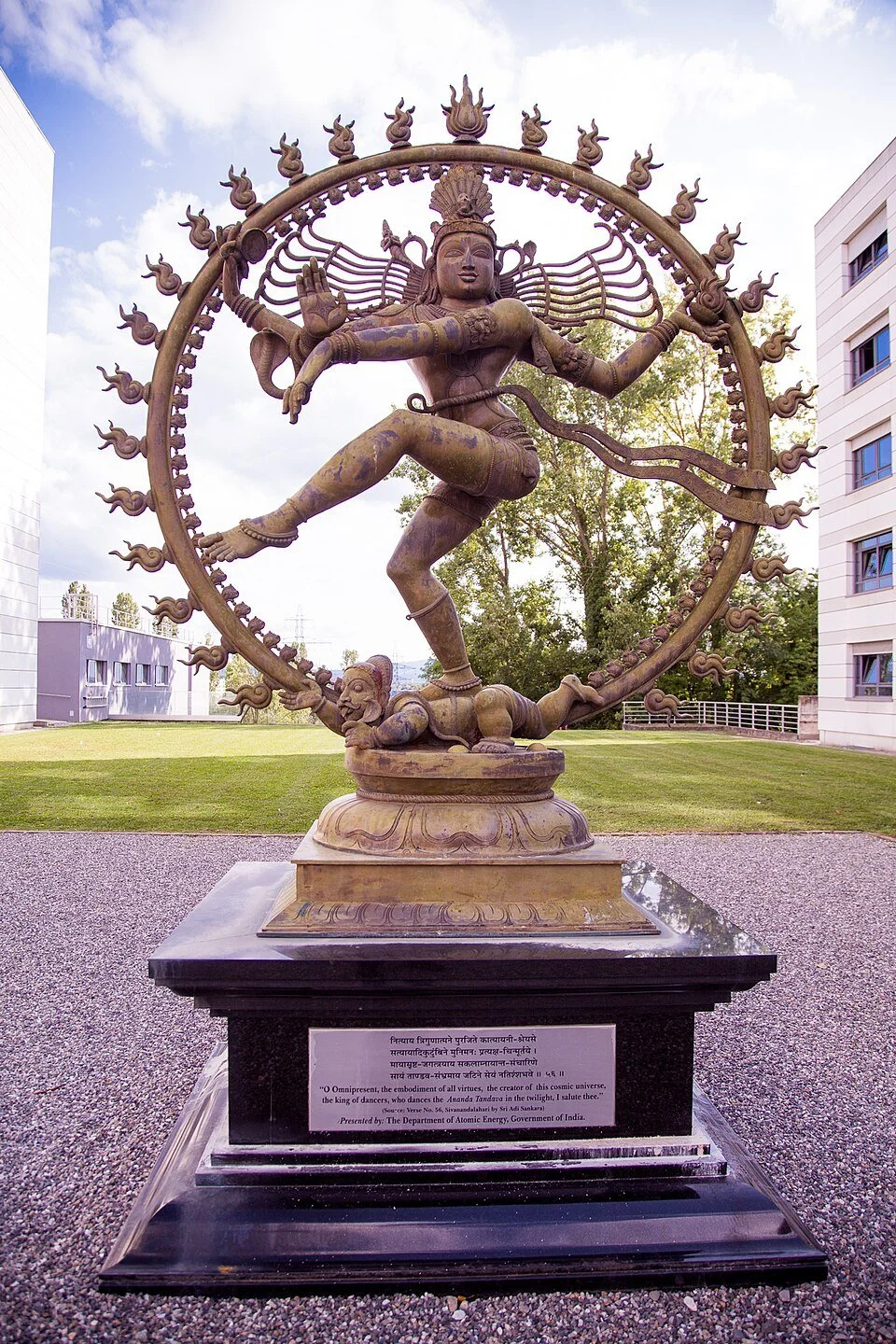
In 2004, a two-metre bronze image of Naṭarāja was installed at CERN, the European Organization for Nuclear Research, in Geneva, presented by the Government of India in recognition of the long presence of Indian scientists at the institution. It stands in a courtyard traversed daily by physicists working at the limits of measurement, where particles arise from vacuum states, annihilate back into them, and where certainty dissolves into probability only to reconstitute itself again. The plaque beneath the image speaks of symbolism, of cultural dialogue between East and West, of art meeting science. The language is careful. It does not misstate, but it withholds.
What stands at CERN is not a symbol, not a tribute, and certainly not an objet d’art. It is a compressed knowledge system, rendered in bronze. And like all such systems, it does not explain itself. It waits for the observer to become capable of reading it.
Begin where few look first: the ears.
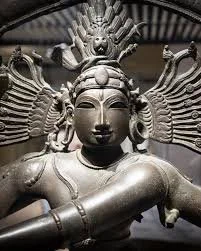
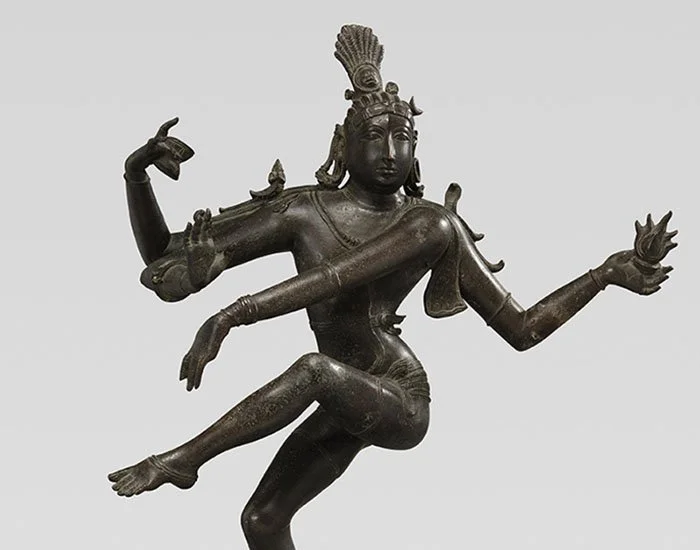
A close examination of Chola Naṭarāja bronzes reveals an asymmetry often overlooked. In the right ear hangs the makara kuṇḍala… elongated, serpentine, solar. In the left, the taṭaṅka or patra kuṇḍala… circular, lunar, feminine (Dehejia; Kaimal). This is not ornamentation. It may be read as ontology. The right side encodes Śiva as witnessing consciousness; the left encodes Śakti as expressive energy. Naṭarāja may thus be read not as Śiva dancing, but as Ardhanārīśvara in motion… an inseparable unity rendered so subtly that recognition demands attentiveness.
Indic knowledge systems rarely reveal directly; they conceal through precision and invite maturity in perception.
Why the Ancients Hid Truth in Plain Sight
This method of concealment appears consistently across Indian intellectual traditions. Vedic metres encode cognition through rhythm. Upaniṣadic paradox fractures linear logic to provoke insight. Tantric sandhyā bhāṣā operates through layered meaning. Śilpaśāstra speaks through proportion and posture rather than prose. The bronze-smiths participated in the same epistemology. An angle of a foot, a bend of the torso, an expression calibrated to neutrality, all function as carriers of meaning.
Naṭarāja is not a text to be read but a form to be encountered. And He reveals Himself, when the seer is ready.
The Axis of Balance
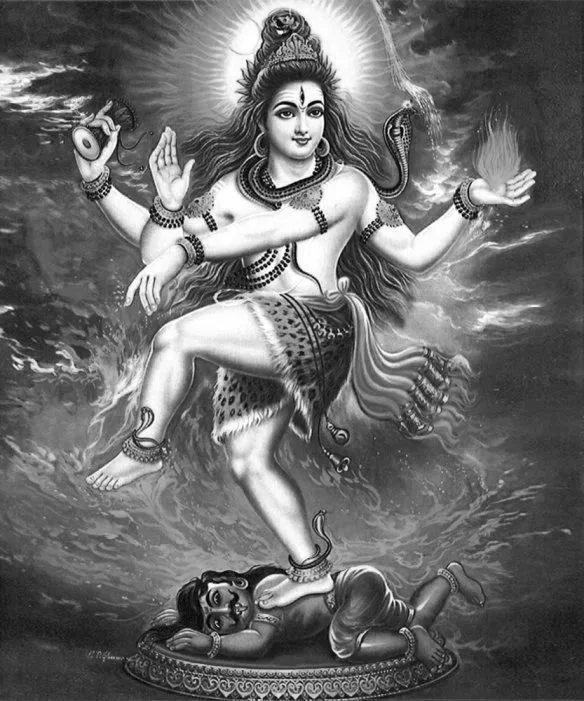
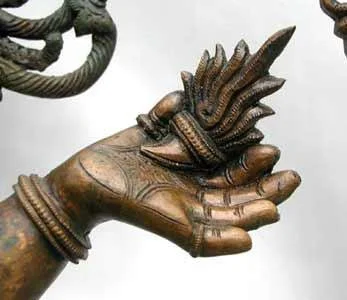
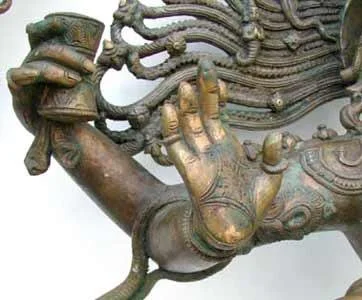
Seen as a whole, the body articulates balance with extraordinary precision. The right side initiates action: the ḍamaru beats rhythm, the abhaya mudrā assures fearlessness. The left side transforms: agni consumes, the gaja-hasta gestures toward release. One foot grounds itself upon Apasmāra; the other lifts, offering passage. Masculine stillness and feminine motion, puruṣa and prakṛti, are not alternated but held simultaneously. This may be read not as symbolism but as ontological instruction: the universe does not resolve opposites by eliminating one; it sustains reality by holding both in dynamic equilibrium.
Nāṭya: The Knowledge Even the Gods Could Not Hold
The Nāṭyaśāstra itself narrates a striking episode. Brahmā synthesised nāṭya as a fifth Veda, integrating recitation (Ṛg), melody (Sāma), action (Yajur), and rasa or affective essence (Atharva). It was conceived as a mode of transmission that must be perceived, not merely heard (Nāṭyaśāstra 1.14-20). When enacted, however, it destabilised its audience. The asuras, confronted with an unflattering mirror, reacted violently.
The narrative may not be read as mythic drama but as philosophical insight: nāṭya reveals reality in it’s entirety, without privileging comfort or moral alignment. Such knowledge cannot be sustained by functional deities (devatā) who govern domains. It requires a principle capable of containing contradiction without fragmentation.
This is why the tradition entrusts nāṭya to Śiva… not as a god among gods, but as the axis in which opposites collapse without erasure. The Śvetāśvatara Upaniṣad speaks of this principle as -
“eko devaḥ sarvabhūteṣu gūḍhaḥ,”
One presence, hidden in all beings. Hidden, not absent. When this presence takes form as Naṭarāja, it may be read as what knowledge looks like when totality seeks expression without reduction.
The Space Where the Dance Happens
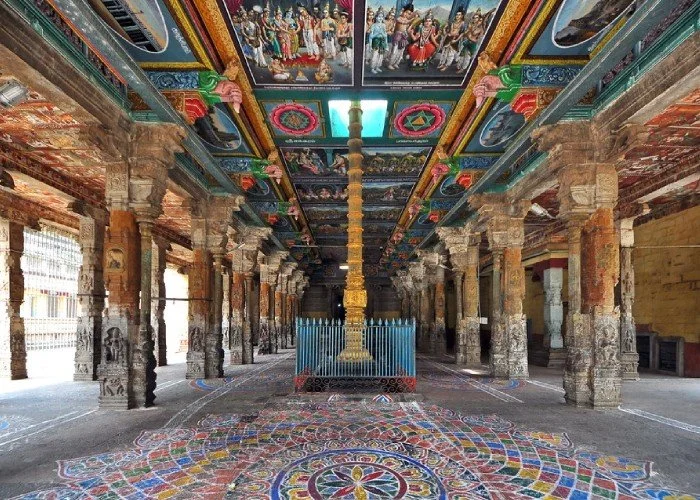
The spatial dimension of this insight becomes explicit at Chidambaram. There, Naṭarāja is not one deity among many; he is the centre.
Chit = consciousness.
Ambaram = space, sky, the infinite.
Chidambaram = the space of consciousness.
In the innermost sanctum, behind the curtain, there is no anthropomorphic idol, only empty space adorned with golden bilva leaves. This Chidambara Rahasyam is not symbolic negation but ontological assertion: space itself is conscious. The dance does not occur within space; the dance may be read as that which renders space perceptible.
Naṭarāja Temple Chidambaram
Modern physics arrives at a strikingly similar insight through entirely different means. Quantum field theory describes the vacuum not as emptiness but as seething potential, a field of constant emergence and annihilation. The “nothing” is active. This convergence does not suggest ancient science anticipating modern equations; it suggests that both are engaging the same underlying reality through different epistemic instruments.
The Chola bronze-smiths encoded it in architecture. And then they waited a thousand years for someone with the right instruments to verify.
Spanda: The Tremor Before Time
Kashmir Śaivism names this underlying activity spanda… a vibration subtler than motion, prior to temporality.
The Spanda Kārikā opens with the assertion that worlds arise and dissolve with the opening and closing of awareness itself.
”Yasyonmeṣanimeṣābhyāṃ jagataḥ pralayodayau"
"By whose opening and closing of eyes, worlds arise and dissolve."
This is not poetry. This is precision. Before there is time, before there is space, before there is anything that could be measured... there is a pulse. Consciousness recognising itself. The first differentiation. The birth of "this" and "that" from undifferentiated "is."
The Śiva Sūtras are more explicit:
”Nartaka ātmā" - "The Self is the dancer."
"Raṅgo'ntarātmā" - "The stage is the inner self."
The dancer does not enter a stage. The dancing generates the stage.
Observer and observed arise together. Neither precedes the other.
Quantum mechanics formalised this insight in the twentieth century;
Śaiva texts articulated it phenomenologically over a millennium earlier.
Naṭarāja encodes the pañcakṛtya, the five cosmic functions, but they are not sequential events.
The ḍamaru beats the first rhythm… Sṛṣṭi: Creation, the primal differentiation, the first "this" emerging from "that."
The agni consumes what has arisen… Saṃhāra: Dissolution, not destruction, but return to source.
The abhaya gesture offers fearlessness… Sthiti: Preservation, the assurance that consciousness sustains.
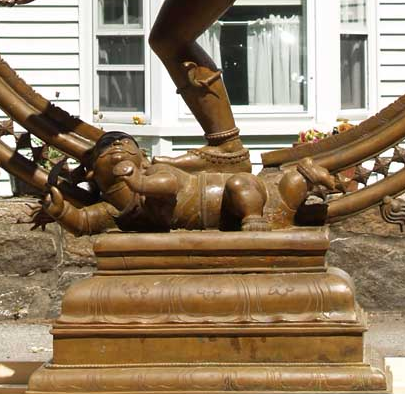
The foot on Apasmāra suppresses the demon… Tirobhāva: Concealment, awareness hidden beneath automation.
The raised foot points to liberation… Anugraha: Grace, the escape offered to those who see.
Creation, preservation, dissolution, concealment, and grace occur simultaneously, in every instant. The universe is not a narrative unfolding in time; it is a gesture held perpetually.
The Demon You Cannot Kill
Apasmāra, the dwarf beneath the foot, is frequently glossed as ignorance. The term, however, denotes loss of remembrance. In Ayurvedic literature, apasmāra is the term for epilepsy, Automation overtaking awareness. Movement without conscious integration.
Naṭarāja does not annihilate Apasmāra. He contains it.
The demon lives beneath the dance, suppressed but present.
Why?
Because automation is necessary. Your heart beats without your attention. Your cells divide without your permission. Planets orbit, electrons spin, galaxies hold shape, all without consciousness micromanaging.
The universe runs on mechanism. It must.
But when mechanism forgets it is being witnessed, when automation believes itself autonomous, when the program mistakes itself for the programmer... That is the fall.
Naṭarāja's foot is the teaching… consciousness must rest upon mechanism without becoming it.
You are not your habits. You are not your conditioning. You are not the patterns you repeat.
You are what watches.
Mechanism is necessary. Automation sustains life. The danger arises only when mechanism forgets it is being witnessed. The icon teaches that consciousness must rest upon mechanism without mistaking itself for it.
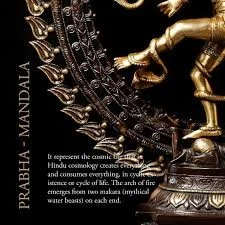
The prabhāmaṇḍala, the ring of fire, surrounding Naṭarāja, is universally described as "the cosmic cycle of creation and destruction."
Look closer.
The flames do not reach the dancer. They define the boundary of manifestation. Everything within this ring is subject to time, change, and transformation. Everything within is permitted to appear, and therefore, must eventually disappear.
The fire is not threat. The fire is permission.
In physics, you cannot define a system without specifying its boundary conditions… the constraints that determine what states are possible. The prabhāmaṇḍala may be read as the boundary condition of existence itself, the rule that impermanence is not failure but structure.
Amidst this complexity, (beating of drum, fire blazing, demon suppressed, liberation offered) the face of Naṭarāja remains perfectly still.
This is sāmya… equalness.
Not neutrality, but total inclusion without preference. The face does not celebrate creation or mourn dissolution. It does not privilege liberation over concealment. It simply holds. This refusal to react is not indifference; it is precision. Reality is not obligated to align with human preference.
In 1972, a physicist sat by the ocean and watched waves. Fritjof Capra had spent years studying particle physics, the dance of subatomic matter appearing and disappearing, energy converting to mass and back, the vacuum seething with potential. Watching the waves, he suddenly saw it… ‘This is the same’.
Creation and destruction. Continuous. Simultaneous. Neither winning.
He thought of Naṭarāja. The image he had seen in books, in museums, in the background of a culture not his own and realized… “They knew”.
He wrote "The Dance of Shiva", an essay that eventually inspired India's government to gift the bronze to CERN. The plaque quotes him:
"Every subatomic particle not only performs an energy dance, but also is an energy dance; a pulsating process of creation and destruction."
Capra did not discover a metaphor. He recognised a transmission that had been waiting.
Why bronze? Because bronze endures without interpretation. Texts require literacy; languages decay. Bronze simply stands. The Chola artisans who cast Naṭarāja were not making art; they were fabricating durable epistemic vessels for knowledge too dangerous to impart openly and too essential to lose. The image does not demand belief or initiation. It waits until perception matures enough to complete the circuit.
The Final Word
CERN is a place where classical categories fail. Matter dissolves into probability. Observation alters outcome. The vacuum refuses emptiness. To enter such a domain unprepared is to impose outdated metaphors and see nothing. Naṭarāja at the gate may thus be read not as ornament but as preparation. Before you seek the fundamental nature of reality, learn to hold creation and destruction in a single gaze. Learn that opposites do not cancel; they complete.
Nothing here is hidden. The asymmetry of the earrings is visible to anyone willing to look closely. The balance of the body is available to anyone willing to feel it. The stillness of the face amid kinetic intensity, the dwarf beneath the foot, the fire that permits rather than annihilates… none of these are concealed. And yet most eyes pass over them. Indic epistemologies have never coerced understanding. They encode. They withhold. They offer without insistence. Seeing, when it occurs, is not granted; it is achieved.
Naṭarāja is not an answer to any question that can be formulated in advance. He may be read as the form knowledge takes when it has exceeded the limits of propositional language. The icon does not explain the unity of Śiva and Śakti; it enacts that unity. It does not represent the simultaneity of the five cosmic functions; it sustains that simultaneity. It does not symbolise balance; it transmits balance as a felt condition.
The image has waited across centuries not because it demands relevance, but because it does not depend upon any single cosmology for its intelligibility. It has endured through empires, languages, metaphysical systems, and scientific revolutions precisely because it was never designed to explain a world, but to train perception itself. It waits still… outside CERN, in temples, in museums, in photographs and reproductions… not as œuvre d'art, seeking interpretation, but as a form awaiting recognition.
This may explain why individuals trained to accept no scripture nevertheless find themselves pausing before this form… silent, recognising something that resists naming. And it may explain why it stands at the threshold of humanity’s most ambitious inquiry into matter itself, not as tribute, but as guardian. Some truths cannot be stated without distortion. They can only be shown. And when the observer is ready, the transmission completes.
The dancer remains still.
The stillness dances.
The fire permits.
The mechanism serves.
The balance holds.
ॐ नमः शिवाय