Hindu / A-Hindu
The Paradox of Exclusion
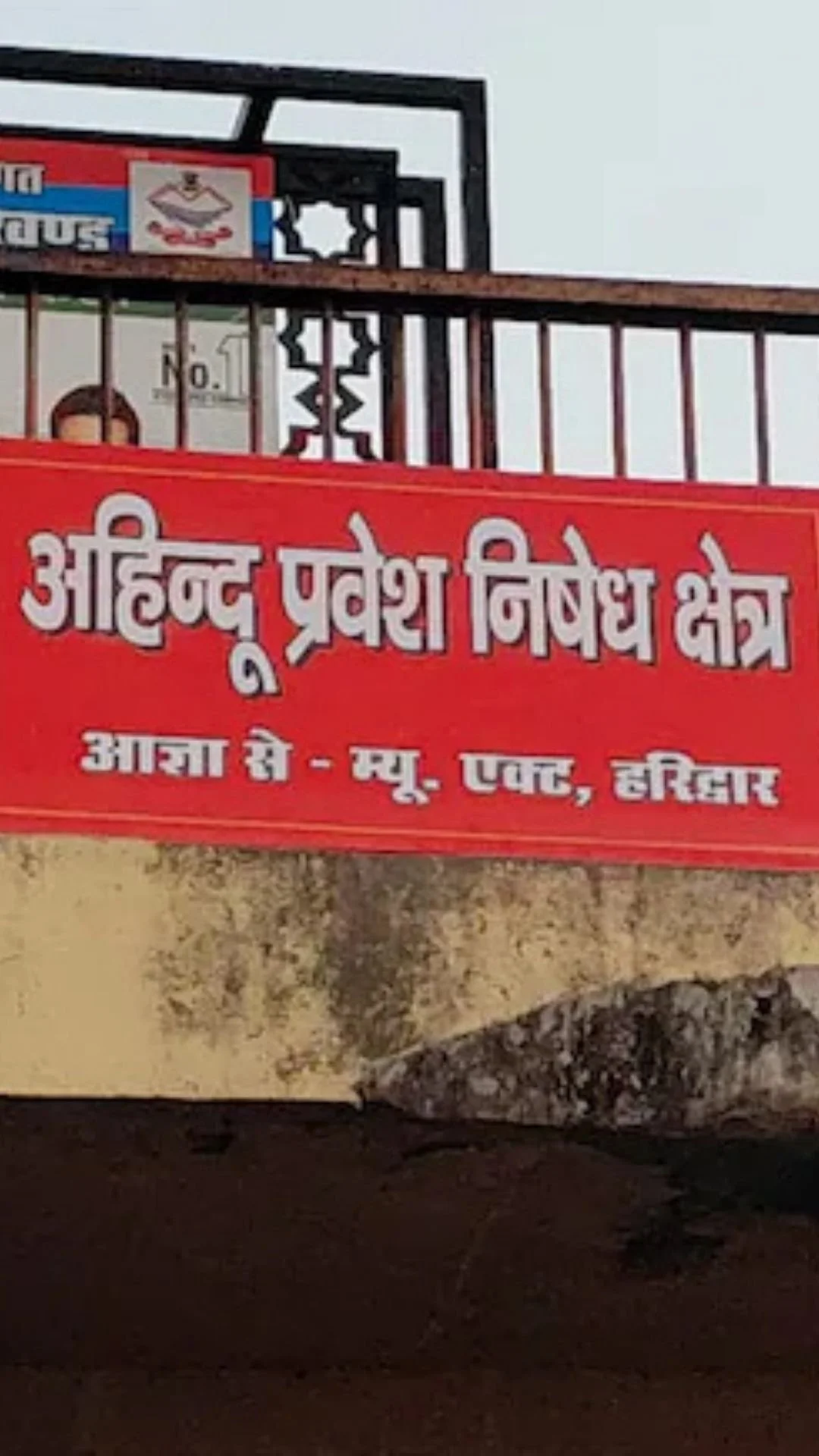
from: The Economic Time
“Ahindu Pravesh Nishedh Kshetra.”
You can read it at multiple places at one of Hindus’ holiest ghats… Har Ki Pauri.
What do you feel?
Pride? Relief? Elation?
A quiet sense that finally… finally… we are taking a stand? That Hindus are asserting themselves at last?
If yes, then what follows is for you.
Not to argue.
Not to shame.
But to ask: what exactly are we standing for… and is it what we think?
When I saw that sign, what stirred in me was not elation, but a quiet, persistent sadness. Not the sadness of weakness, but the sadness of knowing.
Because the longer I sit with Hindu philosophy… genuinely sit with it, not just inherit it… the more clearly I see something that our own tradition has always insisted upon…
Hinduism was never a religion to begin with.
Not in the way the word “religion” is commonly understood… a fixed doctrine, a founding prophet, a single sacred text, a boundary drawn between believer and unbeliever. It has none of those things because it was never built on those things.
It is a dharma… a way of living, inquiring, and being.
A civilizational current that has absorbed, questioned, and refined itself across millennia… without ever demanding that its practitioners think alike, worship alike, or arrive at the same answers.
It doesn’t say: believe this. It says: seek.
What we were handed, in other words, is not a fortress.
It is a river. And rivers, by their very nature, don’t build walls.
They dissolve them.
Who, Exactly, Is a Hindu?
Let’s begin where we should… with the question we’re dodging.
Who decides who is a Hindu, and on what basis?
Is it birth? If so, consider: a person born into a Hindu family, who has never opened the Bhagavad Gita, has no relationship with any of its philosophy, and lives entirely untouched by its wisdom… do we call that person Hindu simply because of biology?
Meanwhile, imagine someone born into a Christian family who has spent thirty years in devoted study and practice of Kashmiri Shaivism. Who chants the Gayatri Mantra with precision and understanding. Who has read the Upanishads not as inheritance but as hard-won discovery. Would we bar that person from Kashi Vishwanath Temple?
That is not just strange — it is philosophically incoherent.
And what of a Sikh? A Jain? A Buddhist? These traditions emerged from the same civilizational soil, the same philosophical aquifer. Where, precisely, does the boundary fall, and who drew it, and when?
Here is the question that should give us pause: find the word “ahindu” in our scriptures. Search the Vedas. Comb the Upanishads. Look through the Gita. You will find sophisticated debates about the nature of consciousness, elaborate maps of the cosmos, breathtaking inquiries into the self… but a category called “non-Hindu, to be excluded”? That’s nowhere. The silence of our sacred texts on this subject is not an oversight. It is a statement. When a word appears only in administration and never in metaphysics, it tells us exactly where it belongs.
On September 11, 1893… a date that would acquire entirely different associations a century later, a young monk from Calcutta stood before the Parliament of the World’s Religions in Chicago and did something remarkable. He didn’t defend Hinduism. He didn’t explain or apologize for it. He declared it, with a confidence that the hall clearly wasn’t expecting.
“I am proud to belong to a religion which has taught the world both tolerance and universal acceptance. We believe not only in universal toleration, but we accept all religions as true.”
The ovation that followed lasted two minutes and began, famously, before Vivekananda had even finished his opening line… “Sisters and Brothers of America,” four words that reduced a formal parliament into something warmer, more human, more real.
He went further:
“I am proud to tell you that we have gathered in our bosom the purest remnant of the Israelites, who came to Southern India and took refuge with us in the very year in which their holy temple was shattered to pieces by Roman tyranny. I am proud to belong to the religion which has sheltered and is still fostering the remnant of the grand Zoroastrian nation.”
When Jewish communities fled Roman persecution, they came to the Malabar Coast. When Zoroastrians fled Islamic conquest, they came to Gujarat. They were not converted. They were not assimilated into erasure. They were received, and they flourished, on their own terms, within a civilization capacious enough to hold them.
That is not tolerance in the weak sense… the grudging, eye-rolling “well, I suppose you can believe what you want.” That is something rarer and harder: the confidence of a tradition so sure of its own depth that it has no need to diminish anyone else’s.
A person secure in their identity does not need to lock the door. Only anxiety locks doors.
The Rig Veda… our oldest surviving text, the document from which this entire civilisational river flows… contains a line that philosophers across traditions have spent centuries trying to fully absorb:
Ekam sat vipra bahudha vadanti. (Rig Veda 1.164.46)
Truth is One. The wise call it by many names.
Not: Truth is ours, and the rest of you are guessing. Not: Truth is one, and we have the monopoly.
The wise, note the qualifier, call it by many names. Indra. Mitra. Varuna. Agni. The verse itself lists them, these different names for the same ultimate reality, as though the Rig Vedic seers wanted to make the point impossible to miss.
This is not relativism. It is not the intellectual laziness of saying “everyone’s equally right about everything.”
It is something more precise: the recognition that the Infinite cannot be fully captured in any single finite formulation. That the map, however detailed, is not the territory. That human language, beautiful and powerful as it is, is always reaching toward something that exceeds its grasp.
The Upanishads press deeper into the same insight.
Tat tvam asi
Thou art That
The Chandogya Upanishad’s great declaration. Not: “Thou art That, conditional on birth certificate.” Not: “Thou art That, pending yagyopavit ceremony.” Just: Thou art That. The consciousness animating you is the same consciousness animating me, animating the cosmos, animating whatever it is we point at when we say “the divine.”
If that is true, and Advaita Vedanta insists it is, then on what philosophical basis do we build a wall?
Adi Shankaracharya, who walked the entire subcontinent in the 8th century debating scholars and establishing the four great mathas, spent his life articulating exactly this non-dual reality. The oneness underlying apparent multiplicity. Atman and Brahman, identical. The individual self and the cosmic self, one. His philosophy wasn’t a cozy metaphor. It was a rigorous intellectual architecture, and it has no room for the idea that the divine is accessible only through particular passports.
The Bhagavad Gita’s reputation precedes it… battlefield setting, existential crisis, divine counsel. But perhaps its most quietly radical moment comes in Chapter 4, verse 11:
Ye yatha mam prapadyante tams tathaiva bhajamy aham.
“In whatever way people approach Me, in that way I receive them. All paths, O Arjuna, lead to Me.”
Vivekananda returned to this verse in Chicago: “Whosoever comes to Me, through whatsoever form, I reach him.”
Read that carefully. This is not Krishna saying: “I prefer the Vedic route, but I’ll make allowances for others.” It is a declaration without qualification. However you come. Through whatever form. By whatever name you call the divine. The theological implications are staggering. Which may be why we sometimes prefer to recite the verse without sitting with what it actually means.
If all paths lead to the same destination, then blocking a path isn’t devotion. It’s obstruction.
In the 19th century, the mystic Ramakrishna Paramahamsa did something no theology textbook could quite contain: he practiced other religions.
Not studied them from a distance. Practiced them… with full sincerity, full immersion. He undertook Islamic practice and, by his own account, experienced Allah. He turned to Christian devotion and experienced Christ. He returned to his beloved Kali and experienced the Divine Mother.
His conclusion, drawn not from scholarship but from direct experience, was unambiguous: all paths lead to the same ocean.
You can, of course, dispute his experiences. But notice what his experiment represents… a Hindu saint who was so confident in the depth of his own tradition that he could enter other traditions fully, without fear of contamination or confusion. He didn’t lose himself. He found the same truth wearing different forms.
That is not pluralism as a philosophical position… it is pluralism as a lived, tested reality. Hindu thought at full height.
So What Are We Actually Protecting?
I want to be honest about something. I understand the anxiety behind the sign at Har Ki Pauri. The history is real… centuries of conquest, conversion, the slow erosion of sacred geography. That pain deserves acknowledgment, not dismissal. The desire to protect what remains is not irrational. It comes from love, and from legitimate pain.
But love and pain are not, by themselves, philosophy. And the question we must ask… carefully, honestly… is: what, exactly, are we protecting?
If we are protecting the philosophy, then the philosophy doesn’t need walls. Truth, as our tradition has always insisted, is not fragile. It doesn’t require armed border control. It requires being lived, articulated, demonstrated… not gate-kept!
If we are protecting our temples… the physical spaces of worship… then we might ask what those spaces are for. They are not museums housing artifacts of a dead culture. They are living sites of encounter with the divine. And the divine, as the Gita makes clear, receives whoever comes.
If we are protecting our identity, then we should ask the harder question: what kind of identity needs exclusion to sustain itself? A civilization secure in its own depth engages the world from confidence, not from fear. It is the traditions that feel threatened that build the tallest walls. We have always been better than that.
Shashi Tharoor, in Why I Am a Hindu, puts his finger on what makes this tradition genuinely distinctive:
“I belong to the only major religion in the world that does not claim to be the only true religion. I find it immensely congenial to be able to face my fellow human beings of other faiths without being burdened by the conviction that I am embarked upon a ‘true path’ that they have missed.”
That absence of burden… that freedom from the need to be exclusively right… is not a weakness. It is the civilizational confidence of a tradition that has been testing itself against reality for thousands of years and hasn’t blinked. To trade that confidence for the anxious business of deciding who is “in” and who is “out” is not a defense of Hinduism. It is a diminishment of it.
Here is what I keep returning to.
The question at the center of Hindu philosophy has never been “Who is a Hindu?”
It has always been:
Ko’ham?
“Who am I?”
This is the Upanishads’ essential inquiry… not a biographical question but a metaphysical one. Not “what is my name, my caste, my family, my credentials?” but “what is the nature of the consciousness that experiences all of this?” What remains when the labels fall away? What is the witness behind the witnessed?
This question… inward, vertiginous, inexhaustible… is the axis on which Hindu thought turns. It dismantles identity rather than constructing it. It dissolves the “I” that wants to know who belongs rather than creating clearer categories of belonging.
We have traded Ko’ham for Kaun hai … “Who are you?” We have replaced the inward inquiry with the suspicious border check. And in doing so, we have reduced one of humanity’s greatest philosophical traditions to something much smaller than it deserves to be.
A Tradition Worth Being Proud Of
Here is what I want to say to every Hindu reading this: we have something extraordinary to offer the world. Not despite the openness of our tradition, but because of it.
We come from a civilization that gave refuge to Jewish communities fleeing persecution… not in exchange for conversion, but simply because that is what civilized people do. We gave the Zoroastrians not just shelter but space to remain Zoroastrian, which is why Parsi culture still flourishes in Mumbai sixteen centuries after it might have been extinguished. We produced philosophies so subtle and so capacious that thinkers from Schopenhauer to Oppenheimer found themselves reaching for Sanskrit to articulate what other languages couldn’t hold.
That is worth being proud of. That is the heritage worth protecting.
What is not worth protecting… what is, in fact, worth resisting… is the reduction of all that depth to a sign on a wall.
Tharoor puts it with characteristic precision: “How dare a bunch of goondas shrink the soaring majesty of the Vedas and the Upanishads to the petty bigotry of their brand of identity politics?”
The question is rhetorical. But it should sting.
Every generation of Hindus has faced its own test.
Ours is this:
Will we be the heirs of Vivekananda’s Chicago declaration… we accept all religions as true… or will we be the people who put up signs saying “Ahindus not allowed”?
Will we live the Rig Veda’s oldest insight… that truth is one but the wise name it differently… or will we insist there is only one permissible name?
Will we practice the Gita’s radical hospitality… however you come, I receive you… or will we stand at the gate with a checklist?
Will we honor Ramakrishna, who dived into other traditions without drowning, or will we be so afraid of depth that we will build a wall around us?
These are not questions about tolerance. They are questions about us… about who we are choosing to become, and whether that person is worthy of the inheritance we claim. There is a teaching that the masters offered when asked about the highest truth. They didn’t reach for complex arguments. After a long pause, they simply said:
Tat tvam asi. Thou art That.
Not: Thou art That, if thou hast the right paperwork.
Not: Thou art That, if thou wert born on the correct side of the sign.
Just: Thou art That.
The consciousness in you, in me, in the sincere seeker standing outside our temples uncertain whether they are welcome… it is the same consciousness. The divine we’re all reaching toward does not, as far as the Gita is concerned, check for membership cards at the door.
If we actually believe what our tradition teaches, then every wall we build is a contradiction.
Every sign that says “not allowed” is a step away from wisdom.
And every act of exclusion is, in the end, a failure to understand what it means to be Hindu.
Because a river that stops flowing no longer remains a river… it stagnates.
Ekam sat vipra bahudha vadanti.
Truth is One. The wise call it by many names.
May we be wise enough to remember it.
May we be confident enough to live it.
And may we pass this tradition on… not as a fortress that keeps the world out, but as a river that has always, always found a way through.