Halahal or Amrit
A Seeker's Reckoning with Samudra Manthan
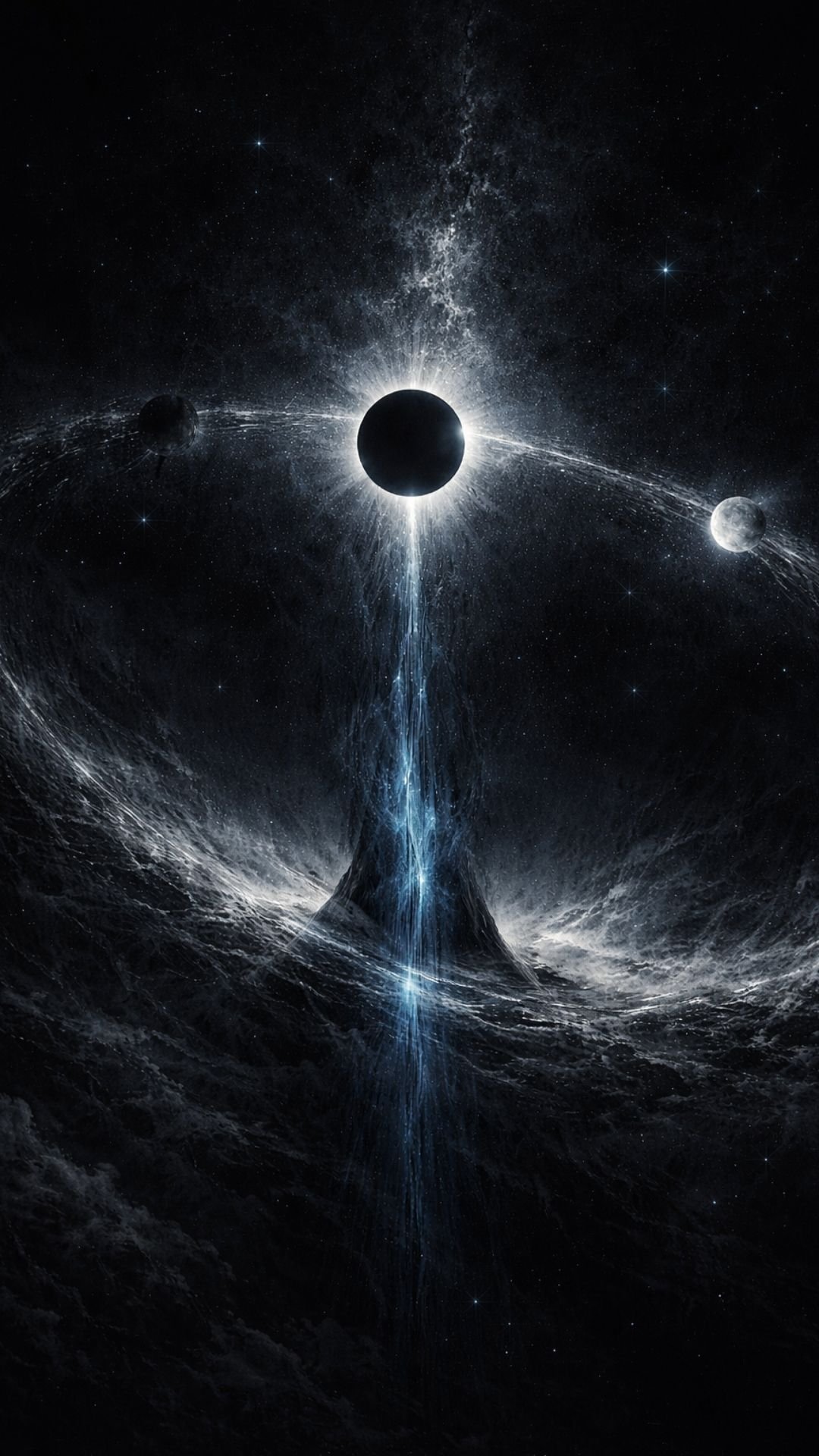
Disclaimer~ What follows is an act of sincere, unabashed imagination... one person pulling at ancient threads, with no arrival point. The references are real. Every interpretation is mine alone, speculative by nature, and offered not as truth but as an invitation to think. Hold it lightly. Read it slowly. Very slowly. Not at one go. At an unhurried pace. And if it makes you want to go looking for yourself... I have achieved my purpose.
It has always fascinated me how the Vedas reveal themselves only partially, as though their true knowledge is deliberately veiled... accessible not through surface reading, but through sustained contemplation. Cosmic events are not described as mere occurrences; they are encoded within mantras, layered in symbolism, rhythm, and sound. When one begins to decode these layers, it feels as though our civilisational memory... our understanding of time, cosmos, and consciousness... can be traced with astonishing precision. The mathematical exactness of certain timings, the astronomical awareness embedded in hymns, and the seamless integration of cosmology with spirituality point toward a civilization far more advanced than we often acknowledge today.
Yet one event continues to perplex me profoundly... Samudra Manthan... the churning of the cosmic ocean.
I repeatedly attempt to situate it within a tangible historical or cosmic framework... some real event that may have unfolded thousands of years ago. But every attempt meets a wall. It clearly cannot be explained as the slow continental drama that separated the Indian subcontinent from the Gondwana landmass and threw up the Himalayas, nor as the catastrophic end of the last Ice Age that swallowed entire coastlines under rising seas, nor as the mysterious drying of the Saraswati, the great Naditama herself, leading to the broader collapse of the Indus-Saraswati civilisation. Each of these events was enormous. Each reshaped the subcontinent. And yet none of them, alone or together, feels sufficient to have produced a myth of this magnitude.
The scale of Samudra Manthan is such that it demands a real referent... something immense enough to give rise to the enduring polarity of Devas and Danavas, an opposition that goes on to shape vast portions of our mythic and philosophical landscape.
What, then, was being remembered?
Was Samudra Manthan a record of a lost astronomical catastrophe, a celestial alignment, a climatic upheaval, or even a profound shift in human consciousness itself? Was it a literal event witnessed by an ancient civilisation, later preserved through symbolic language? Or was it a multi-layered encoding... simultaneously cosmic, psychological, and civilisational... describing the churning of matter, power, and awareness at a pivotal moment in human history?
If the Vedas are custodians of memory rather than mere collection of hymns, then Samudra Manthan must be pointing towards a real disruption... something so transformative that it demanded the full force of sacred imagination to hold it.
What could that event have been?
Let me begin not with what our temple walls and scriptures point toward, but with a problem.
Imagine you survived a catastrophe... something truly, civilisation-endingly catastrophic. There is no paper, no library, no archive fireproofed against the very disaster you just lived through. Your coastlines have changed. Your cities are under water. The people who witnessed what you witnessed are mostly gone. How do you make certain that those who come ten thousand years after you still feel, in their bones, the weight of what happened?
You don't write it down. Writing burns. Papyrus rots. Stone weathers into silence.
You do something more lasting. You make it sacred. You encase the memory inside a mantra, inside a story so densely layered that every generation finds a different reason to preserve it. You surround it with cosmology, with mathematics, with philosophy. And you ensure it will be recited, in homes and temples, in solitude and gatherings, by people who may not fully understand its impact or meaning. Only that it must be recited.
This is the true architecture of Samudra Manthan. A vessel. Built not for the age that preserved it, but for generations far ahead in time... to finally read the cosmic grammar etched into their own DNA.
Now close your eyes for a moment and step away from the page. Walk outside on a clear night, far from city lights, and look up.
There it is... luminous, churning, impossibly vast... a river of light arching from one horizon to the other. Four hundred billion stars compressed by distance into a single luminous path smeared across the darkness. We call it the Milky Way. The ancient Indians named it Akasha Ganga... the Ganges of the sky. And the Puranas named the ocean the gods and demons churned the Kshirasagara... the Ocean of Milk.
Was it coincidence... or was it a coordinate?
When the rishis looked up at that galaxy and chose to call it an ocean of milk, they were not reaching for a poetic allegory. They were being precise. The cosmos they described was not metaphor dressed as myth. It was an observation dressed as story... because the story survives, and a dry astronomical archive does not. The Kshirasagara, I now feel, was possibly always the Milky Way. And the churning that the gods and demons performed upon it may have always been a description of something happening at a scale we are only now, with modern instruments, beginning to measure.
Now look more closely at Mandara. In the myth, it is the great churning rod... a spur of Mount Meru, the world-axis, the cosmic pole around which all of creation revolves. Meru is the celestial axis itself, that still, invisible point in the sky around which every star appears to circle through the night. The Vedic tradition placed it at the centre of existence. Modern astronomy calls it the celestial pole, currently marked by Polaris in the north.
But here is what the rishis may have known that we are only now recovering the language to say… this axis does not stay still.
It wobbles.
Imperceptibly, over a vast cycle of twenty-five thousand, seven hundred and seventy-two years, the Earth's axis traces a slow, silent circle through the sky... shifting which stars sit at the celestial poles, changing which constellations mark the solstices and equinoxes, rewriting the heavens themselves in a script only the most patient civilisations could read. Astronomers call this precession. A civilisation that tracked it across generations would not have experienced it as a measurement. They would have experienced it as a churning.
Mandara, in this reading, is not separate from Meru. It is Meru in motion. The still point, turning. The world-axis beginning to wobble through the ocean of stars. The rishis did not see two separate images, the cosmic mountain and the cosmic sea. They saw one event: the axis moving through the sky it churns.
And that image, once seen, does not release you. The still point, turning through the ocean of stars... and in the turning, calling something else into motion.
And then there is Vasuki.
King of serpents. Cosmic in scale. One of Shiva's most intimate companions. He belongs to neither the Deva camp nor the Asura. He is something older than both... a being from the Naga order, the subterranean realm, answerable to neither gods nor demons. He is not conscripted. He is asked. And he agrees.
The Devas grip his tail. The Asuras, his head. And in their tug-of-war, the serpent writhes, the rod turns, and the ocean begins to move.
Every ancient tradition that looked long enough at the sky knew this... the serpent was not a symbol of time. It was time itself. The force that moves in cycles, swallows its own tail, and has no beginning the eye can locate. Ouroboros in the Greek. Ananta in the Sanskrit. The same recognition, arising independently, across every civilisation that sat long enough in the dark watching what the sky does.
And when the churning is done, Vasuki returns to where he belongs. Coiled at Shiva's throat. Not as ornament. As Kala, the great wheel of cosmic time, resting at the one place in existence where time meets the timeless.
Time coiled at the throat of the one whom time cannot touch.
Now look at the sky. Not at the stars, but at their path. Over the course of a year, the Sun traces a great circle across the heavens... what astronomers call the ecliptic path. The Moon traces its own path, slightly tilted, and these two great arcs cross at exactly two points. A head. A tail. Always opposite each other in the sky. Always moving in tandem.
Do you see Vasuki now?
At those two crossing points, where the lunar orbit intersects the solar path, one where the Moon crosses going north and one where it crosses going south, the sky goes dark. These are the eclipse nodes, two precisely calculable locations always sitting exactly opposite each other in the sky, always moving in tandem, a head and a tail governing the moments when light itself is swallowed.
Ancient Indian astronomers named them Rahu and Ketu.
But the myth does not merely name them. It gives them a story so precise it could only have been written by someone who understood exactly what they were watching.
At the moment the nectar finally surfaced from the churned ocean, a demon named Svarbhanu saw his chance. He slipped silently into the assembly of Devas, disguised as one of them, and drank a drop. He might have succeeded entirely, had the Sun and Moon not recognised the impostor sitting among them and raised the alarm. Vishnu's Sudarshana Chakra came down before Svarbhanu could swallow another breath, severing his head from his body in a single stroke. But it was already too late. He had tasted the nectar of immortality. He could not die. His head lived on as Rahu, his tail as Ketu, immortal and separated forever at the neck, carrying an undying grievance against the two luminaries who had exposed him.
And so Rahu and Ketu take their revenge at those precise nodal points where the Moon's orbit crosses the path of the Sun. Rahu swallows the Sun, Ketu swallows the Moon, holding them inside the severed neck until the light tears free... the same throat that could not hold what it drank at the moment of the churning.
This is not mythology reaching for analogy. This is a civilisation encoding its most precise astronomical knowledge inside a story dramatic enough to survive ten thousand years of telling.
Aryabhata, the fifth-century mathematician who calculated the length of the sidereal year to within three minutes and twenty seconds of the modern value, did not invoke Rahu and Ketu as articles of faith. He used them as mathematical variables, as coordinates in an eclipse equation of extraordinary accuracy. When a French astronomer arrived in eighteenth-century India and set his own charts beside predictions produced by these ancient methods, he found the Indian calculations more accurate than his own.
Samudra Manthan carries the marks of catastrophe... savage, indelible, written in a hand that was shaking. And catastrophes leave traces not only in myth, but in the ice, the soil, the deep ocean floor, the genetic memory of every species that somehow came through.
Scientists, in their cool and careful way, call it the Younger Dryas, named for a small arctic wildflower that bloomed across Europe as the world turned suddenly, inexplicably cold. But a wildflower's name does no justice to what this was. Somewhere between 12,900 and 11,700 years ago, something faltered in the very rhythm of the planet's climate. Ice cores pulled from the depths of Greenland, each one a frozen record of an ancient atmosphere, show that temperatures across the Northern Hemisphere fell by as much as ten degrees Celsius. Not across centuries. Not even across decades. Some climate scientists now believe the transition may have completed itself within a single human lifetime. Perhaps faster. The world one generation was born into was not the world their children inherited.
What gave way was the great oceanic circulation that had, for millennia, breathed warmth across the planet... a vast, slow pulse of temperature and salt moving through the Atlantic like blood through a body, carrying tropical heat northward, returning cold and dense water south, and in doing so, holding the entire climate of the inhabited world in a kind of steady, ancient embrace. Every monsoon that ever watered the subcontinent. Every river that ever fed a city. Every coastline that ever cradled a people. All of it resting, without knowing it, on this one slow pulse continuing.
And then the pulse broke.
Torrents of glacial meltwater poured into the North Atlantic, diluting the salinity on which that entire circulatory system depended, breaking the very tension that had kept the pulse alive, and what followed was not a gradual weakening but something closer to a planetary seizure... the circulation faltering, stalling, and in places reversing, the warmth that had sustained entire continents withdrawing without warning, as though the earth itself had forgotten how to breathe. The consequences arrived swiftly and without mercy. The monsoons of South Asia collapsed. Rivers that had run full and steady for ten thousand years swelled without warning, then shrank to nothing. Coastlines lurched as seas rose and shifted, swallowing whatever had been built at the water's edge. And entire cultures, peoples who had made their lives on the continental shelves now lying under the Arabian Sea and the Bay of Bengal, slipped beneath the water without leaving a single word behind.
Without trace. Without a record. As though they had never existed.
Then, approximately 11,700 years ago, as suddenly as the disturbance had arrived, it passed. The circulation steadied. The warmth returned. The Holocene began. And with it came the possibility of everything we recognise as home. The Saraswati flowed full from the mountains to the sea. The Indus found its course. The great river cultures took root in a landscape that had, at enormous cost, been made stable enough to sustain them. None of what we call Indian civilization could have existed before this moment. The Holocene was not merely a climate period. It was the precondition. Whatever cataclysm had preceded it was not incidental to the story of this land. It was the story.
And perhaps the rishis knew that too. Perhaps Samudra Manthan was never only cosmology or philosophy. Perhaps it was the deepest kind of memory there is... not the kind that lives in texts or monuments, but in the marrow of a people who had watched the world end and somehow, inexplicably, remained. A memory still warm with the lived terror of a civilisation that had passed through precisely this... the poison first, the long terrible churning, and then, against all expectation, the emergence of everything worth having.
Because the first thing the churning yielded was not Amrita. Before the goddess Lakshmi, before the physician-god Dhanvantari bearing his golden pot of Amrit, before any jewel or gift that might justify the ordeal... the ocean surrendered its darkest secret first.
Halahal.
Poison. World-ending, total, absolute poison.
A toxin so lethal it threatened to destroy all three worlds before anyone could drink a single drop of what they were seeking. The gods and demons, who had been pulling at either end of Vasuki with every ounce of their combined cosmic strength, recoiled in terror. Even Brahma, the creator, was at a loss. The very act of seeking the nectar had, first, produced the one thing capable of ending everything.
There are those who have spent years at the difficult and contested intersection of mythology, climate science, and archaeoastronomy, and what they have found buried in the geological record of the Younger Dryas onset is not comfortable reading. The evidence points, haltingly but persistently, toward the sky. Fragments of a large comet, or perhaps several, may have impacted or exploded across multiple continents simultaneously, and what that would have meant on the ground is almost beyond imagining... firestorms rolling across entire landmasses, the atmosphere filling with toxins, the sky darkening for years at a stretch as ash and debris blocked the sun that every living thing had organised its existence around. Platinum-group metal anomalies and nano-diamonds consistent with cosmic impact have been found at site after site across Europe, North America, and the Middle East, all locked inside the same geological layer, all pointing to the same moment. The evidence is fiercely debated. But it does not go away.
Fire falling from the sky. The atmosphere turned to poison. The sun, extinguished.
Halahal.
And then Shiva stepped forward.
In the myth, it is Shiva, and only Shiva, who could deal with the Halahal. He did not destroy it. He did not dissolve it. He took it into his own throat and held it there, the poison turning his neck the blue-black colour that gave him the name Neelakantha, the blue-throated one. His consort Parvati, alarmed, pressed her hand around his throat to prevent the poison from descending further into his body. The Halahal sat suspended, neither swallowed nor released, in the one place where sound is formed and language lives.
Consider what that meant. Shiva did not remove the catastrophe from the world. He contained it. He absorbed the unsurvivable and remained standing, marked permanently by what he had held, but not destroyed. And the place where he held it was the throat: the seat of expression, the organ of speech, the location in the body where thought becomes word and word becomes the world.
This is where the myth stops being cosmology and becomes something else entirely... something I can only speak of as a seeker. One who has sat long enough in sadhana and swadhyaya to know that what follows is not commentary. It is recognition.
With the Halahal contained, the ocean began to yield.
Not randomly. Not as reward. As memory... a civilisation's precise record of what it needed to recover first, and what could only come after.
Kamadhenu surfaced first... and she was a cow. But to say only that is to miss everything. The tradition holds that within her body resided the entire cosmos... the four Vedas in her four legs, the four purusharthas in her udders, the Trimurti in her horns, the sun and moon in her eyes. She was the inexhaustible source of the milk and ghee without which no yagna could be performed... and the yagna, that ancient fire ritual of reciprocity between human consciousness and the cosmos, was not merely a religious practice. It was the spine of Vedic civilisation itself. To lose Kamadhenu was to lose the ability to speak to the cosmos. She was one of the four pillars of Sanatan Dharma... not a symbol of plenty, but the condition under which the sacred could continue to function at all.
The Rigveda offers a precision here that the popular tradition tends to overlook. The Sanskrit word go means both cow and the rays of the sun... not as poetic coincidence but as a deliberate equation, used repeatedly and knowingly by the rishis who composed the oldest hymns. The sun's radiance was described as a herd of luminous cows released each morning from the cave of night, and Kamadhenu carried both meanings simultaneously... the nourishing source and the illumining one, the udder and the ray, inseparable. A catastrophe that had darkened the sky and poisoned the atmosphere would have extinguished both at once. What emerged first after Halahal from the churned ocean was not a reward for the churning. It was the precondition for everything that followed. Without the return of continuous, unbroken, self-replenishing light... nothing else the ocean was about to yield would have found a living world to enter.
Ucchaihshravas came next, bursting from the depths with all seven heads blazing... a horse, white and luminous as the moon itself, and Indra reached for him before the spray had settled. The light had returned with Kamadhenu. Now it was about to be made complete.
Seven heads. In Vedic cosmology the Sun's chariot was pulled by seven horses, and their names were not chosen arbitrarily... they were the seven sacred meters of the Rigveda itself: Gayatri, Brihati, Ushnik, Jagati, Trishtubh, Anushtubh, Pankti. The seven rays of the Sun and the seven meters of sacred sound were understood as a single illumining principle, moving outward in the same direction, at the same velocity, through different media. The horse in the Vedas was never merely speed. It was the solar mind... the capacity of illumined consciousness to traverse vast distances instantaneously, to perceive what the body has not yet reached. In the Bhagavad Gita, Krishna named Ucchaihshravas among his own divine expressions... born of Amrita, born of the immortal. He was not something the churning created. He was something the churning revealed... always present in the depths of that cosmic ocean, waiting for the moment the world was ready to receive him. If Kamadhenu was the light returning to a darkened world, Ucchaihshravas blazing with seven heads may mark something still more total... not the light restored but the light complete, all seven rays simultaneously present, the sky no longer merely lit but fully, irreversibly clarified. Indra, the lord of thunder and the bringer of rain, claimed the full solar principle before anything else was distributed. He knew what everything else depended on.
The Kaustubha gem emerged next... a ruby of extraordinary radiance... and Vishnu claimed it without hesitation, placing it upon his own chest where it has remained in every depiction of him since. The tradition describes Kaustubha as the pure, undivided awareness at the heart of all existence. That a gem of supreme, self-luminous radiance surfaced from the same ocean that had produced the Halahal, and came to rest on the chest of the preserver, feels like the myth encoding something precise: that at the centre of the preserved cosmos there is a brilliance not borrowed from any star and not dependent on any fuel. It was not created by the churning. It was released by it. Already there, in the deepest dark... waiting.
Thereafter, Kalpavriksha rose from the waters, unhurried, eternal, the wish-fulfilling tree whose blossoms never faded and whose fragrance reached across all three worlds. In Vedic cosmology, trees were understood as living connections between the subterranean waters and the sky, their roots drinking from the depths and their branches reaching into the heavens, mediating between worlds. Kalpavriksha may encode the restoration of the biosphere itself... the return of vegetation to a world the Halahal had stripped bare, the greening of the earth after catastrophe. Roots drinking again from the deep. Branches reaching again toward a sky that was finally clear enough to nurture them.
Airavata rose from the churned waters... an elephant, immense and white, and Indra claimed him as well. The light had been restored. Now the world needed water.
His epithets were precise: Abhra-matanga... elephant of the clouds. Arkasodara... brother of the Sun. These were not decorative titles. The tradition held that Airavata plunged his great trunk into the subterranean waters of the earth, drew them up through his body, and exhaled them as rain into the waiting clouds above. He was a living conduit... the mechanism by which the earth's hidden depths communicated with the sky, by which underground water became monsoon. He stood as guardian of the eastern quarter, the direction from which both the sun and the rain arrive on the subcontinent each year. Light without water would have meant barren land. Airavata in Indra's keeping meant neither would arrive alone. A catastrophe that had broken the ocean circulation and silenced the monsoons for a human generation would have made Airavata's emergence feel like exactly what it was: the rains returning. The clouds massing again over a land that had watched its rivers fill, falter, and disappear...
The Apsaras glided in next... and they were far more than the celestial dancers the popular tradition has given us. Their very name came from apas... water... and sara... to flow. In the earliest Vedic texts they were spirits of the clouds and celestial waters, born from the primordial ocean itself, moving between the worlds as water moved. The Atharvaveda placed them in direct connection with the nakshatras... the twenty-seven lunar mansions through which the Vedic sky was mapped and all astronomical calculation organised. Their emergence from the churned ocean may have meant something precise: the return of the visible night sky, the nakshatras legible again after years of atmospheric darkness and disruption, the celestial map restored, time finally recoverable to a civilisation that had always measured it through the stars.
Varuni arrived next, carrying her fragrant cup, like a question no one had thought to ask. Of all the ratnas, this was the one I find most philosophically charged. Her name derived from Varuna... guardian of Rta, the cosmic order underlying all existence. She was not simply intoxication. She was the dual nature of liquidity itself... water that purifies and water that dissolves, the Soma that elevated consciousness toward the divine and the Madira that pulled it toward oblivion. Soma, the sacred ritual drink prepared under specific nakshatra conditions and offered into the yagna fire, was understood as the liquid bridge between the human and the divine. Varuni may have been the restoration of this chemistry... the liquid medium through which consciousness could once again reach toward transcendence. The Devas accepted her and were called Suras. The Asuras rejected her, and the rejection itself named them. She may have been the question the churning was always building toward: would a civilisation that had survived catastrophe use its restored gifts to reach upward... or simply to consume?
And then Lakshmi. Who did not rise so much as arrive.
She had been consistently underread. The texts described her as Sridevi and Bhudevi simultaneously... the goddess of celestial radiance and the goddess of the earth's own abundance, sky and ground united in a single sovereign presence. She rose from the same ocean that had produced the Halahal, and she rose from it untouched, carrying a lotus rooted in the very depths that had produced the poison and blossoming above them in complete purity. This is the precise instruction the lotus has always carried in this tradition: not that one escapes the depths, but that one rises from them without being defined by them. Lakshmi chose Vishnu of her own sovereign will... not claimed, not distributed, not awarded. She looked at all that the churning had produced and aligned herself with the one principle that preserves across time. Where she settled, the conditions for genuine civilisational flourishing came into being... not wealth as accumulation, but abundance as the condition under which a people could finally flourish.
Then Chandra lifted free of the waters... luminous, full... and Shiva placed the crescent upon his own matted hair where it has remained in every depiction of Shiva since. Of all the ratnas, Chandra was the most directly, unambiguously astronomical, and his position in the sequence is worth sitting with. The Moon was not merely a light in the sky. In Vedic understanding, Chandra was the lord of the nakshatras... the twenty-seven lunar mansions that formed the primary framework of Vedic astronomical calculation. He was the keeper of Soma, the sacred ritual drink contained in his own body, diminished nightly as the gods drank from him and replenished again at every new moon. He governed the tides, the moisture in plants, the rhythms of biological life across the subcontinent. That Shiva now held the purifying waters of the earth, the Soma of the sky, and the Halahal in his throat made him something specific: the one whose body was itself a complete cosmology. Every component of existence contained... and none of it destroying what held it.
Panchajanya came up spinning on the current, and Vishnu claimed it without hesitation. The conch in the Vedic world was never merely an instrument. Its sound, produced by breath forced through a spiral form, was understood as a replication of the primordial sound of creation itself, the AUM that the tradition held had preceded all material manifestation. In the Bhagavad Gita it is the first sound of the great war, Vishnu-Krishna blowing Panchajanya to signal that what is about to unfold is not merely a battle but a cosmic recalibration. Panchajanya emerging from the churned ocean may encode the restoration of sacred sound, the vibrational order of the cosmos made audible again after the silence and destruction of catastrophe.
And then, finally, Dhanvantari.
He walked out of the churned waters carrying a golden pot, and everything went still. The physician-god. The one who knew what survival actually costs. Medicine emerging from the same ocean that had produced the poison. The catastrophe and the cure, children of the same churning.
This was the instruction encoded in the sequence all along. The Halahal came first. And only after the sky had been restored, the rains returned, the stars appeared, the earth breathed, the sacred sound recovered... only then came the knowledge of how to heal what the ordeal had broken. You cannot offer medicine to a world that has no light, no water, no food, no sky to navigate by. Healing was not what they reached for first. It was what they reached for when enough else had been restored to make healing matter. When the world was finally whole enough to be healed.
Dhanvantari opened his pot.
And mortality, finally, got its answer.
Now picture what was happening at the bottom of the ocean while the churning was at its most violent.
Mandara was spinning. Vasuki was being twisted. The Milky Way was turning around its own axis. The Devas and Asuras were pulling with all their might, every fibre of cosmic will stretched past its limit. All the three worlds were in agony. And beneath all of it, in the absolute silence of the deepest dark, where no light reached and no name was spoken, was a turtle. Kurma. Not a spectator. Not a narrator. But a bearer. Holding the weight of the cosmic mountain on his back. The axis of creation held steady from underneath while the most violent event in the history of existence raged directly above him.
That turtle, the Kurma was Vishnu.
And this is where the myth reveals something that deserves full attention. Because Vishnu was not a silent presence in Samudra Manthan. He was its most continuously visible force. Before the churning began, it Him alone who saw what neither Devas nor Asuras could... that Amrita could never be seized by one side defeating the other. The moment either side won, the churning would stop and with that the entire process of evolution would come to stand still. The nectar could only emerge from a tension held perfectly, equally, unresolved. Opposition itself, sustained until the ocean yielded what it was holding.
It was Vishnu's intelligence that foresaw everything, before the rope was picked up.
His Sudarshana Chakra moved at the moment of greatest danger, severing Svarbhanu's head with a precision that transformed a crisis into cosmic architecture. Those two severed points became Rahu and Ketu, the lunar nodes, giving Indian astronomy not a myth but a permanent mathematical framework for calculating eclipses with an accuracy that European astronomers, arriving centuries later with their own instruments, found they could not improve upon.
And as Mohini, he appeared at the precise instant the nectar was about to pass permanently into dissolution, and redirected it with a clarity no force of arms could have achieved.
Beginning. Crisis. Resolution. Vishnu at every threshold.
And yet. In the single moment that made all other moments possible, he went to the bottom. Became a turtle. Became the thing nobody could see, name or acknowledge. The Taittiriya Aranyaka records that when Prajapati himself encountered Kurma in the primordial waters, Kurma told him quietly that he had existed long before Prajapati did. Before the creator. Before creation. The foundation was already there, in the dark, carrying what would be placed upon it before anyone knew what that weight would be.
What the ancient mind encoded here, and what modern science has only recently found precise language for, is this: the force that holds planets in orbit, that keeps moons circling, that prevents every spinning system in the universe from flying apart, makes no sound. It announces nothing. It asks for nothing. It simply holds. Without it no mountain stays in place, no axis keeps its alignment, no churning produces anything but chaos.
We call it gravity.
Kurma, at the bottom of the churned ocean, holding Mandara steady on his back while the cosmos spun itself toward nectar or annihilation above him, may be the oldest encoded description of this force that any civilisation has left us. Not gravity as a measurement. Gravity as a presence. Gravity as the silent, invisible, absolute foundation without which no event, however dramatic, however divinely engineered, could have held together long enough to produce anything at all.
A civilisation that encoded the lunar nodes as a severed demon's head, that embedded precessional mathematics inside a myth of cosmic churning, that described gravitational force through the image of a turtle bearing a mountain in the dark of a primordial ocean... was not reaching for metaphor. It was doing what we would now call science... encoded in the only medium it trusted to outlast every catastrophe that was coming.
Viś... a Sanskrit root meaning to pervade. To pass through every boundary until there is no longer any distinction between the one who sustains and the thing sustained. Vishnu is not a god who inhabits the cosmos the way a king inhabits a palace. He is the condition under which the cosmos holds its shape at all. Present at every turning point. And most essentially, most quietly... the ground itself.
Not holding on. Simply holding. As it always has. As the myth promises, it always will.
The Sustainer of it all.
And now the question that has been sitting at the back of this entire piece, waiting.
Who were the Devas and the Asuras?
Begin with the words themselves, because the words know more than the stories built around them.
Deva comes from the Sanskrit root div: to shine. The shining ones. Light that radiates outward, the luminous, the celestial, the visible. Asura comes from asu: breath, vital force, the animating power that moves within matter. The Brahmanas record that Prajapati created the Asuras from his own breath, specifically from the lower breath, the breath that descends into the body and keeps it alive from within.
Light that shines outward. Breath that animates inward.
Two modes of the same primordial energy, one that illuminates and one that enlivens, each meaningless without the other. A cosmos flooded with light but without the animating breath within matter would be a dead cosmos. A cosmos pulsing with inner vital force but without the light of consciousness to illuminate it would be a blind one.
The rishis knew this. Coomaraswamy, studying the oldest layers of the Rigveda, found something that should have rewritten everything written since: the same cosmic force can be called both Deva and Asura depending on its mode of operation at that moment. The Sun rising, radiating light freely outward, is Deva. The same Sun setting, withdrawing, turning its energy inward, becomes Asura. Not two beings. One being, two orientations. The polarity was never between two separate categories of existence. It was between two directions of the same power.
And then the Puranas give us the genealogy that makes this precise.
Both Devas and Asuras had the same father. Kashyapa Rishi, one of the seven Saptarishis of the Rigveda. Their mothers were sisters, both daughters of Daksha Prajapati. Aditi, whose name means the boundless, the infinite, the one without limit, was the mother of the Adityas, the Devas. Diti, whose name means the bounded, the contracted, the defined, was the mother of the Daityas, the Asuras. Same father. Two sisters. The outward-shining and the inward-breathing, born of the infinite and the finite, of expansion and contraction, the two forces without whose simultaneous operation nothing in existence could hold its form.
They were not enemies by nature. They were complements by origin.
And then there is the name of their father, which stopped me completely when I finally noticed it. Kashyapa means turtle in Sanskrit. In several Puranic texts, Kashyapa is directly identified with the Kurma avatar of Vishnu. The cosmic turtle who bore the weight of Mandara on his back. The silent, all-pervading foundation. The father of both the Devas and the Asuras is, in the tradition's own language, the same principle as the ground beneath the churned ocean itself.
The rishis were being precise.
Now look at what happened when this unity fractured.
In the Zoroastrian tradition of ancient Iran, the very same two categories exist but with the polarity completely inverted. Ahura Mazda, the supreme good being, takes his name from Ahura, the same word as Asura. The evil beings are called Daevas, the same root as Deva. What the Rigveda calls the luminous shining ones, the Avesta calls demons. What the Rigveda names the vital animating force, the Avesta elevates to the supreme divine principle.
When did complementarity turn into confrontation?
I have no certain answer. But I keep circling back to the Sun.
Deva: the Sun rising, radiating outward. Asura: the same Sun setting, withdrawing inward.
Two orientations of the same power. Not two suns. Never two suns.
Could it be that when two branches of the same civilisation separated and carried this understanding into different geographies, each held onto one half and slowly forgot the other existed? One people made the outward-radiating principle their supreme good and named the inward-animating force their enemy. The other reversed the hierarchy entirely. And in both cases, what had once been a living unity, two faces of the same coin, hardened into a theology of opposition.
The emerging archaeology, the astronomical dating of researchers like Nilesh Oak and Rupa Bhaty, and the genetic evidence for deep civilisational continuity on this subcontinent all resist the Aryan invasion framework, the assumption that the civilisational impulse arrived here from elsewhere. The Rigveda itself may carry the memory of the parting. The Battle of the Ten Kings, in the seventh Mandala, records a conflict between the Puru-Bharatas and the Anus along the Ravi in Punjab, in which the Anus were pushed westward. The Anus, some scholars argue, were the ancestors of the Iranians. If this reading holds, the inversion is not a puzzle about migration. It is the memory of a departure, after which each half of a living unity hardened into a side.
And a side needs an enemy.
Which is precisely what Samudra Manthan refuses to give us. This was never a story about gods defeating demons. It was the memory of a real astronomical event whose consequences played out across the Earth, encoded by people who understood that the two forces pulling at either end of Vasuki were not opponents but polarities, the outward-shining and the inward-breathing, the finite and the infinite, each made necessary by the other, each incapable of producing the nectar without the tension the other provided.
The Bhagavad Gita names this with characteristic directness. In the sixteenth chapter, Krishna speaks of daivi sampad and asuri sampad, the divine endowment and the vital endowment, and says both are present in every human being. Not as a curse and a blessing distributed unequally. As the two necessary orientations of a complete existence. The question has never been which force you carry. It has always been which direction you point it: toward the whole, or toward the self alone.
That is the only choice Samudra Manthan was ever asking you to make.
For a moment imagine the ocean... still... before the manthan. Like the night sky before the events unfolded. Because stillness is not absence. It is the ground on which everything moves.
Every etymology decoded in this manthan has been pointing toward something. Kshirasagara: the Milky Way. Mandara: the precessional axis. Vasuki: time itself, the ecliptic serpent. Deva: light radiating outward. Asura: breath animating inward. Vishnu: the pervading intelligence that holds all three worlds in form.
But how do you explain the one who was not present at the site... yet without whose intervention the whole play would have fallen apart?
He did not churn. He was not on either side of Vasuki. He was elsewhere... in cold stillness... on a summit no one could touch. And when the churning produced something beyond the capacity of devas and asuras, combined, to hold, they turned in the same direction for the first time, together.
They turned to Shiva.
They call him Bholenath. The simple one. The innocent one. And I have never understood that name, because nothing about him is simple. It took Parvati three thousand years of tapasya before he even looked at her. Where does that leave us, mere mortals? He is Mahadev. He is Adiyogi. He is the most enigmatic force in the entire mythology, and they named him Bholenath. Perhaps that is the first koan he offers.
In the Rigveda, shiva was not yet a proper name. It was an adjective, applied to multiple deities, meaning simply: the auspicious one, the benign, the one in whom there is no harm. And Rudra, the fierce storm god who would eventually become Shiva, had two natures, as the Rigveda itself says: one wild and howling, one kind and tranquil. The terrifying and the auspicious held within the same being... not in conflict, in completion.
The folk etymology breaks the name into two roots: śī, meaning "in whom all things lie," and va, meaning "embodiment of grace." That which contains everything. That which harms nothing it contains.
And somewhere in the ruins of Mohenjo-daro, sealed in the earth for five thousand years, on a small steatite seal, is a carved figure... seated in stillness, knees out, spine erect, surrounded by animals. Scholars have called it the Pashupati seal, the Lord of Beings. Whether it depicts Shiva or not remains debated. What is not debated is this: the posture is unmistakable. Long before the Tantraloka mapped the architecture of his consciousness, someone in a lost city on the banks of the Saraswati was already recognising something in that stillness, worth carving into stone.
That something held power, even then. Even without the name.
Why him? Why, of all the forces assembled at that ocean, was there only one who could hold what would have destroyed everything else?
Because Shiva literally means "that which is not." Not as philosophy reaching for the ineffable. As a precise description. The void. The nothingness that is not empty but is the only container large enough to hold everything. Something can never contain everything. Only nothingness can. Every source of light, every star, every sun, every flame will exhaust itself. Darkness asks nothing of anyone. It simply is, everywhere, always, the ground in which light briefly, beautifully appears and disappears.
This is why the Halahal could not destroy him.
But the tradition says something still more precise. Vishuddhi literally means filter. Not absorber. Filter. Shiva did not swallow the poison. He did not release it. He held it at the one point in existence where what enters as one thing can emerge as another. Where the unsurvivable, contained long enough in the right stillness, becomes something else entirely.
He held it in his throat... at the Vishuddhi centre.
The yogic tradition holds that Vishuddhi, when fully awakened, radiates blue. The same blue that marks Neelakantha's throat. It may be worth sitting with the possibility that the colour was never simply the consequence of the poison. It may have been the signature of what was already there... the mark of a throat so completely activated that it could receive the unsurvivable and hold it without breaking. And if that reading carries even a grain of truth, then something else follows quietly from it. It is from this same throat, tested at the most extreme scale existence could produce, that everything the world would later receive as sacred knowledge... mantra, yoga, the complete transmission of Adiyogi to the Saptarishis... arose. The poison and the elixir. Both held in the same blue throat.
That point where sound is also born.
Consider what has just been said. The same throat that held the unsurvivable poison is the point where sound is born. Where the Halahal was contained... the Om arose. The primordial sound. Not despite the holding. Because of it. The filter did not just preserve the world. It gave the technique to return to its origin.
Shiva is Adiyogi. The first yogi. Not a man who sat in a particular posture in a particular century, but the one who perceived, from within the stillness of "that which is not," the complete mechanics of existence. He did not reason his way to this knowledge. He did not compose it. He sat in that vast nothingness that is his nature until the knowledge arose from within it the way the ratnas arose from the churned ocean. Already there. Waiting to be surfaced.
And then he transmitted it. Not as doctrine. Not as belief. As direct technique, carried by the Saptarishis into every direction of the world. The same seven sages whose names the Vedic astronomers mapped onto the seven stars of the Saptrishi Mandal (Great Bear) turning around the celestial pole.
What came through them was not knowledge that could be written down. It could only be heard.
The mantras were not composed. They were revealed. A rishi in deep meditation did not author a mantra... he encountered it arising from a depth the tradition refused to allow him to call personal. Mantra-drashta... seer of mantra, not its maker. Om Namah Shivaya in the Taittiriya Samhita of the Yajurveda. The Mahamrityunjaya in the Rigveda itself. These mantras are older than memory itself. They were already present before the rishis arrived, already vibrating in the space of existence, waiting only for a consciousness polished transparent enough to receive them.
There is a point in recitation where it stops feeling like something being done and becomes something being received. Where the sound moves through rather than from. Every sadhak who has sat long enough in that stillness knows exactly what this means and cannot explain it to anyone who has not. That precise and unmistakable dropping below the personal into something that does not feel individual... that is what the tradition calls Shiva. Not a metaphor for it. Not a symbol pointing toward it. The thing itself.
Om Namah Shivaya is not a prayer addressed upward. It is a return. Five syllables, one for each element... na for earth, ma for water, shi for fire, va for air, ya for space... the entire cosmos contracted into a sound and offered back to the silence that preceded it. Not asking for anything. Pointing back toward the ground from which everything arose. The means by which an ordinary human being, in an ordinary lifetime, can lean toward the same containing stillness that Shiva held at cosmic scale.
What the rishis delivered to the world was not carved in stone or saved in an archive. It was breathed. Passed from word of mouth across ten thousand years, surviving every catastrophe that took everything else, because it lived inside the one vessel no flood could swallow and no fire could reach... the living human voice, still reciting, in the predawn dark, the name of the one who alone could hold what no one else could.
Our ancestors were not primitive people who looked at the sky and told stories. They were cartographers of consciousness who encoded their most precise findings in the only medium they trusted to survive: sound, repetition, the living human memory. What we are beginning to unearth, through archaeology, through astronomy, through the slow recovery of Sanskrit, is not new knowledge. It is the tip of what they knew and hid in plain sight, in the mantras we still chant without fully understanding, in the geometry of temples we walk through without reading, in the myths we have been reciting for ten thousand years without asking what they were actually telling us.
The ancient seers could not have spoken of what they survived in ordinary language. Ordinary language would have flattened it, turned the unsurvivable into anecdote. And so they gave it a home inside sound. Inside mantra. Inside the myth itself. And trusted, with a patience that defeats imagination, that the mark of Neelakantha would outlast every library, every stone, every empire that rose and fell on the banks of these rivers.
The Saraswati dried. The cities of the Sindhu went under sand. The knowledge scattered, carried in fragments by those who remembered, reconstituted across centuries by those who refused to let it dissolve. And yet here we are. Still breathing Om Namah Shivaya into the predawn dark. Still asking what the rishis encoded and why they trusted us with it.
That continuity is the nectar. It was always the nectar.
No astronomical correspondence, however precise, no geological parallel, however eerily accurate, touches what happens in that predawn stillness. The speculation illuminates the myth. It was never meant to replace the deity who stands at its centre.
Neelakantha. The scar worn openly. The mark of what was held, survived, and never pretended away. The blue throat was the civilisation's scar. A scar, unlike a wound, makes no demand. It simply remains. Evidence that something came. That it was held. And that the holding did not break what held it.
This too is a manthan. The one we are being asked to perform right now. Not to follow what was left for us. To churn it. To ask what it means. To hold the poison of not-knowing long enough for the nectar to surface.
Samudra Manthan does not end with the nectar. It ends with a choice.
Amrita and Halahal both rose from the same ocean. Both claimed by the same churning. The myth does not say one side deserved what it received and the other did not. It leaves that question open... deliberately, provokingly open. Perhaps because that openness is itself the teaching. What a civilisation receives from its churning may depend less on its virtue than on what it is willing to hold.
The myth promises only the process.
The churning. The poison first. The cooperation of forces that cannot produce anything alone. The silent ground bearing the weight from underneath. And if the Halahal is held rather than released or swallowed... the possibility of something that does not die.
The possibility. Not the guarantee.
The question this myth has been asking across every yuga it has survived is not about what happened ten thousand years ago. It is about right now. Whether you are willing to churn. Whether you are willing to hold both ends of the rope when the force on the other side is the very thing you have spent a lifetime opposing. Whether you are willing to keep pulling after the poison rises... on faith alone, without proof, that what comes next is worth what it cost.
Whether you are willing to be Neelakantha for whatever age you have been born into.
The myth does not end in a temple. It ends in a question addressed to whoever is still reading.
Halahal or Amrit?
The ocean does not wait for your answer.
It is already churning.
The references below are real. Every source cited exists. Every interpretation drawn from them, every connection made between ancient myth and modern science, between Sanskrit cosmology and geological catastrophe, between the blue throat of Shiva and the survival of a civilisation, is my speculation alone.
I cite what is real. I flag what is conjecture. The rest I leave to your own churning.
This was always, only, a seeker threading the nail.
A Note on Sources
Rigveda (c. 1500 BCE or considerably earlier, depending on which dating methodology one accepts). The oldest surviving layer of the Vedic corpus. The Mahamrityunjaya mantra appears here. So do the earliest usages of Asura as an honorific rather than a pejorative. The astronomical references that scholars like Bal Gangadhar Tilak and Nilesh Oak have used to argue for much older dating are embedded in its hymns.
Taittiriya Samhita of the Yajurveda. Contains Om Namah Shivaya in its oldest textual form. One of the most important surviving layers of Vedic ritual literature.
Taittiriya Aranyaka. Contains the reference to Kurma declaring his existence prior to Prajapati himself. The foundation preceded the creator. Read it slowly.
Vishnu Purana, Bhagavata Purana, Mahabharata. Primary sources for the genealogy of Kashyapa Rishi, Aditi, Diti, and the birth of both Devas and Asuras from the same father. Also primary sources for the full account of Samudra Manthan and the sequence of the fourteen ratnas.
Bhagavad Gita, Chapter 16. Krishna's direct articulation of daivi sampad and asuri sampad... the divine endowment and the vital endowment... present in every human being not as curse and blessing distributed unequally, but as the two necessary orientations of a complete existence. The question was never which force you carry. Only which direction you point it.
Bal Gangadhar Tilak, Orion, or Researches into the Antiquity of the Vedas (1893). Tilak's astronomical dating of Vedic nakshatra references using precessional analysis. Contested within mainstream Indology. Methodologically significant and worth reading with an open mind.
Subhash Kak, The Astronomical Code of the Rigveda (Aditya Prakashan, 1994; revised 2000). Argues for embedded mathematical and astronomical structures in the Rigveda. Peer-reviewed, debated, and deserving of more serious engagement than it typically receives.
Nilesh Oak and Rupa Bhaty, work on astronomical dating of Vedic and Puranic events. Oak's When Did the Mahabharata War Happen? and related research uses planetary astronomy, hydrology, geology, and genetics to argue for a civilisational timeline extending back 24,000 years or more. Outside mainstream consensus. Internally rigorous. Read it and decide for yourself.
Aryabhatiya by Aryabhata (499 CE). Composed in Kusumapura, modern Patna. Aryabhata's sidereal year carries an error of only three minutes and twenty seconds against the modern value. His eclipse calculations using Rahu and Ketu as the lunar nodes remained in active use for over a millennium and were found, by visiting European astronomers in the eighteenth century, to be more accurate than contemporary Western methods.
Ananda K. Coomaraswamy, Selected Papers, Volume 1: Traditional Art and Symbolism (Princeton University Press, 1977), and related essays. Coomaraswamy's finding that the same cosmic force in the Rigveda can be designated either Deva or Asura depending on its mode of operation at that moment... the Sun rising as Deva, the same Sun setting as Asura... is not a popular reading. It should be. It dissolves a misreading that has persisted for centuries.
Abhinavagupta, Tantraloka (c. 1000 CE). The most comprehensive philosophical and practical text of Kashmir Shaivism. Abhinavagupta's articulation of Paramashiva as pure, undivided, self-luminous consciousness, the sole reality in which the entire cosmos arises and dissolves, is the intellectual foundation of the reading of Shiva offered in this piece.
Michel Danino, The Lost River: On The Trails Of Saraswati (Penguin Books India, 2010). A detailed, carefully researched examination of literary, archaeological, geological, and satellite evidence for the Saraswati river and its identification with the Ghaggar-Hakra palaeochannel. One of the most accessible and honest books on this subject.
A.V. Sankaran, 'Saraswati: The Ancient River Lost in the Desert,' Current Science, Vol. 77, No. 8, 1999. Peer-reviewed geological survey of evidence for the Saraswati palaeochannel and the timeline of its disappearance, approximately 5000 to 3000 BCE.
R.B. Firestone et al., 'Evidence for an extraterrestrial impact 12,900 years ago that contributed to the megafaunal extinctions and the Younger Dryas cooling,' Proceedings of the National Academy of Sciences, Vol. 104, No. 41, 2007. The primary paper proposing the Younger Dryas Impact Hypothesis. The platinum-group metal anomalies and nano-diamonds found across multiple continents in the same geological layer are documented here. Fiercely contested. The evidence does not go away.
Steffensen et al., 'High-Resolution Greenland Ice Core Data Show Abrupt Climate Change Happens in Few Years,' Science, Vol. 321, 2008. The foundational ice core evidence for the speed of the Younger Dryas temperature transitions. Not mythology. Not speculation. Measured, frozen, ancient atmosphere pulled from the ice.
F.B.J. Kuiper and Wendy Doniger, comparative Indo-Iranian scholarship on the etymology and evolution of Asura and Deva across the Rigveda, Avesta, and later Puranic literature. The polarity inversion between the Vedic and Zoroastrian traditions, Ahura as good in Iran, Daeva as evil, is documented and not seriously contested. What it means is another question entirely.