When Milk Became Consciousness
The Doer's Dissolution
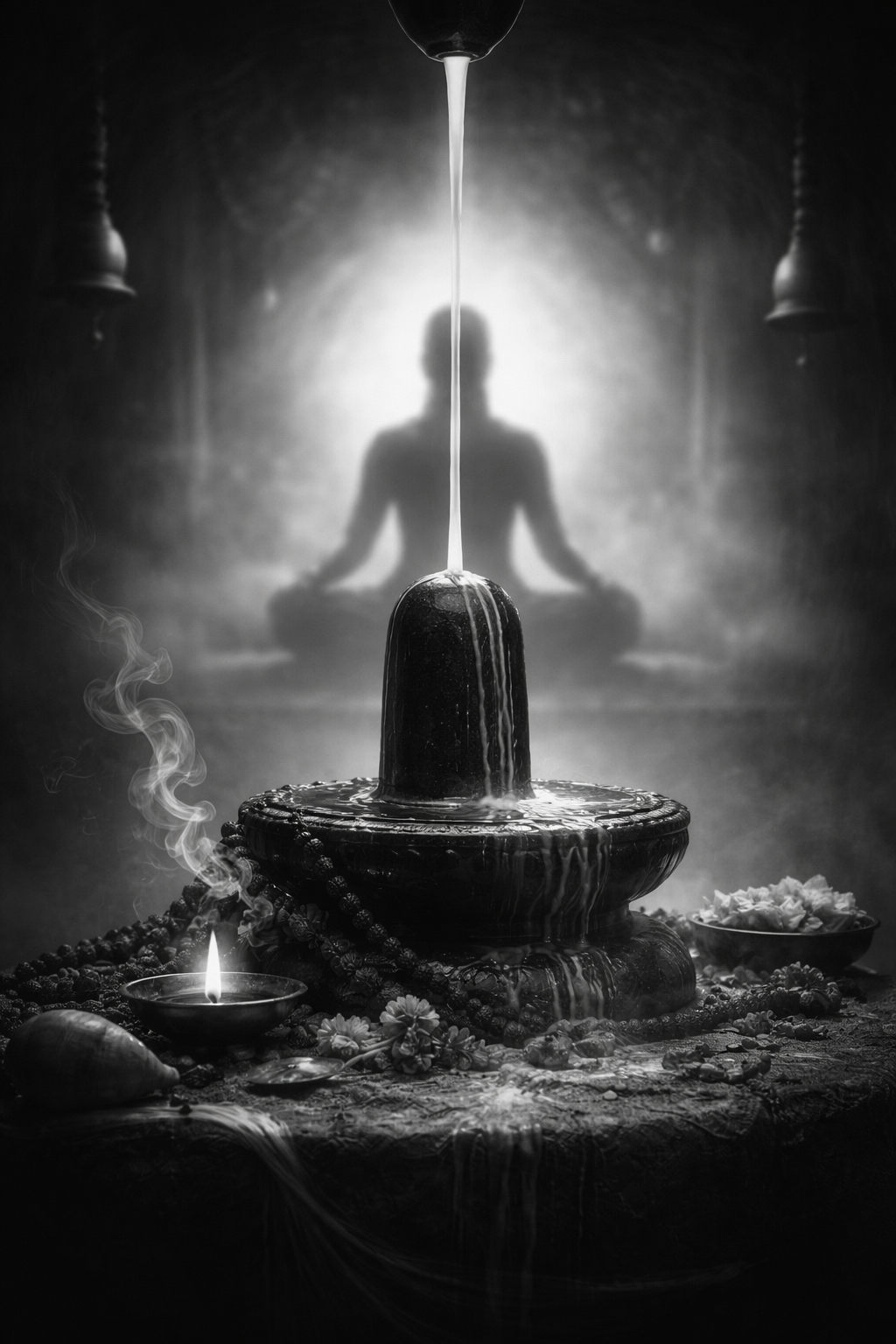
I have been walking the path of adhyātma for over a quarter century now, carrying its imprint since childhood, as though drawn from memories that stretch across lifetimes. Spirituality... or more precisely, adhyātma... when broken gently, reveals its true intent: apnā adhyayan... the study of the Self, one’s own inward inquiry.
What follows here is exactly that… my confusions, my questions, my interpretations, unfolding as I learn to read rituals not as performance, but as revelation. These are not universal truths I claim to teach; they are intimations... what is descending into awareness... layer by layer, as each veil lifts and draws me inward into a world where ancient wisdom does not reside in texts alone, but breathes... alive, intimate, and present.
Two years ago, I began teaching Rudrābhiṣekam.
Not because I got married into a family where it was performed every Mahāśivarātri. Not because I inherited family mantras or pūjā vessels sanctified across generations. I come from no Brahmin lineage, no childhood steeped in early-morning dhoopam, deepam smoke, or the resonance of ghaṇṭā-nāda.
It was during my Devī Sādhana... entirely by Her anugraha... that this knowledge descended. The sequence came alive, embedded in memory that transcend births, as if I had been performing it across lifetimes. I knew which sacred offerings were needed, where each mantra arose, which mudrās sealed the movement, and the precise rhythm of every prahar. Nothing was assembled. Nothing was memorized. The sequence emerged whole. The rhythm found me.
I knew how to pour milk, curd, honey, ghee, and sugar over the Śivaliṅga, guided by precise order and sacred mantras. At the time, I honoured tradition with utmost devotion. I taught with conviction. I believed in every act of abhiṣeka I performed.
And yet, I was also watching... watching the very same sequence from outside myself.
Something within me was always tugging at the heart of it all.
The Question That Wouldn't Dissolve
A question began to insist itself, quietly at first, then relentlessly:
If Advaita declares ahaṁ brahmāsmi... I am Brahman... or śivoham... I am Shiva... then how can Shiva be external to us? Why pray to Him only at Pradoṣa-kāla? Why remain awake through all four prahars of Mahāśivarātri? Why recite mantras with such precision, pour offerings in exact sequence over a liṅga?
Was I performing a ceremony... or training myself to see something I could not yet perceive?
This question settled at the very core of my practice. How could a civilization capable of articulating non-duality with such metaphysical audacity simultaneously insist on elaborate karmakāṇḍa? If the Truth is already what we are, why this relentless emphasis on doing? Why such structure? Why the insistence on the gross... milk, curd, ghee, honey... when the subtlest realization was clearly the destination?
Was this divine communion... or had philosophy been reduced to ceremonial performance?
I would wake at 3 a.m. for sādhana and feel the absurdity wash over me: here I was, pouring milk over a black, egg-shaped stone in the dark, while the Upaniṣads thundered tat tvam asi... you are already That.
Had I mistaken the pointing finger for the moon? Was I playing priest to a stone while truth waited, unrecognized, within my own heart?
When the Veil Began to Lift
I did not know where to look for answers, so I began reading... voraciously, indiscriminately. Osho, Paramahansa Yogananda, Ramana Maharshi, Nisargadatta. In the course of this deep quest, I learned about Abhinavagupta... the 10th-century Kashmiri polymath who synthesized Tantra, aesthetics, and non-dual Śaivism into a complete metaphysical system. But all his manuscripts were in Sanskrit. For the first time, I regretted not pursuing the language more deeply. Then I found Swami Lakṣmaṇjoo's luminous books and commentaries on Abhinavagupta's work. Tantrāloka... dense, coded, and strangely alive. Osho’s discourses on the Aṣṭāvakra Gītā, which doesn’t instruct so much as fracture something essential or perhaps break precisely what needs to be broken.
And slowly, like dawn arriving not all at once but in gradations of gray becoming gold, the veil began to lift.
What I once understood as ritual, I began to see as a map of inner alignment. Not a metaphor. Not poetry. Not symbolism in the modern, decorative sense. But operational technology... designed with surgical precision to educate the human system: body, breath, attention, cognition... until it becomes capable of recognizing the non-dual reality Advaita points toward.
The confusion, I realized, had never been in the system. It was in my reading of it. I had been encountering a language without its grammar... seeing letters but missing syntax, performing gestures without inhabiting the consciousness from which they were conceived.
Rudrābhiṣekam and Pañcāmṛta Snāna were never acts of appeasement toward an external deity. They are technologies of inner alignment, conditioning the perceiver so that body, breath, attention, and cognition can recognize what has always been present, yet obscured by the very momentum of seeking.
These rituals do not describe Truth. They dissolve the perceiver’s resistance to it.
They do not tell you what Śivā is... they remove what you are not, until what remains has no choice but to recognize itself.
The Śivaliṅga: Axis of the Unmanifest
I had to understand the Śivaliṅga correctly... or risk misunderstanding the entire ritual framework, and with it, the possibility of transformation itself.
The liṅga is not Śivā. It is not an idol to be worshipped, nor a representational form seeking appeasement or devotion. It is a concentrated axis of consciousness... a stabilizing reference for awareness itself. It signifies the unmanifest from which all form arises and into which all form dissolves.
Its deliberate aniconic nature prevents projection. The mind finds nothing to grasp... no face to anthropomorphize, no narrative to domesticate divinity, no image to soften the encounter. Deprived of foothold, the mind is compelled to turn inward, forced to witness its own restless searching.
In this sense, the liṅga does not point to Shiva as “other”... somewhere outside, measuring devotion or counting offerings. It points to that which precedes all forms, including the most persistent and stubborn form of all: “I.”
Shiva, understood as consciousness itself, requires nothing. Consciousness does not hunger. It does not thirst. It does not wait for milk and honey to feel complete. The offerings made during abhiṣeka are not for Him. They are maps of inner transformation placed upon this axis of the unmanifest awareness.
Each offering is not for Shiva… it is for me. To place my own layers of attachment, conditioning, identification consciously upon the axis... to see them clearly for what they are... and then release them.
The liṅga holds nothing. Absorbs nothing. It simply witnesses... unchanging... as everything is offered and everything flows away.
Like consciousness itself.
Pañcāmṛta Snāna: The Inner Alchemy
Pañcāmṛta… milk, curd, ghee, honey, sugar… is not a list of substances assembled for ritual propriety. Nor is it an offering meant to please a deity. It is a precise inner grammar, encoded into action so that transformation is entered, not merely contemplated. What remains elusive to abstract thought is allowed to settle into the body through sequence, rhythm, repetition.
When I hold that vessel now, I no longer see ingredients. I see movements of consciousness made visible. The inner landscape, ordinarily too intimate to be perceived, is externalized... so it may finally be seen.
Milk (Kṣīra)
Primordial. Unformed potential. Unconditioned.
Milk is awareness before it curdles into preference, judgment, identity. Consciousness before it learns to call itself someone. It carries the memory of first nourishment, the earliest intimacy with existence... the unquestioned assumption of being sustained. Before you knew hunger as a concept, you knew it as the ache answered by milk.
To offer milk is to loosen that most fundamental insistence: I must be held, I must be fed, I must continue. Reliance itself is placed into the formless.
When I pour it now, cognition softens. Awareness returns to its liquid state, prior to thickening into story, struggle, self-definition. The mind does not resolve anything... it simply rests.
Curd (Dadhi)
Milk altered by bacteria, time, process. Cultured. Thickened.
This is saṁskāra… experience sedimented into pattern, memory coagulated into identity. What was once fluid awareness now appears as personality, history, tendency. The milk of pure awareness has curdled into wound, pride, shame, preference.
Offering curd is not denial of lived experience. It is acknowledging the accumulated patterns... real in function, influential in movement... without mistaking them for essence. Identity is seen as awareness shaped, not awareness lost.
When I offer curd now, I'm not rejecting my story. I'm recognizing: this too is not ultimately what I am. Present, yes. Substantive, yes. But provisional. Not final. Not eternal. Not me.
Ghee (Ghṛta)
Purification through churning and fire. Butter clarified, heated until moisture disappears, residue separates, and only luminous essence remains.
This is tejas... discriminative fire. Viveka... the discerning ability to distinguish real from unreal, eternal from temporary, self from non-self. What survives the fire was never produced by it... it was simply revealed.
When I offer ghee, I surrender even understanding itself. Familiar frameworks, cherished insights, the very edifice of "knowing" I've constructed... all become combustible. Because true clarity doesn't come from accumulation... it comes from elimination. From letting the fire of inquiry consume what felt certain... until only what was always there remains.
Honey (Madhu)
Essence drawn from a thousand flowers, concentrated into singular sweetness. Countless blooms relinquish their separateness so that one sweetness may remain.
Bees do not create honey... they extract, condense, refine. They dissolve distinction until only essential nectar remains. This is what sādhana performs upon fragmented life. All those moments... the argument that still stings, the sunset that stole your breath, the dream you can't shake, the fear that visits at 3:00 am... honey is their distillation. Not the experiences themselves, but what remains when everything inessential burns away.
When I pour honey now, I feel attention gathering, condensing, becoming singular. And I recognize something subtle: sweetness is still a state. Bliss still arises. And what arises must also be offered. Even pleasure, even concentrated awareness... must be released. Must be recognized as arising within consciousness, not as consciousness itself.
Sugar (Śarkarā)
Desire crystallized. Pleasure made graspable. Attachment transformed.
The Tantrics understood what puritans never could: you don't kill desire. You don't transcend pleasure by rejecting it, by turning away in disgust or fear. You crystallize it. You refine kāma (craving) into prema (devotional absorption). Same energy, different octave. Same force, different expression.
Sugar dissolving in the abhiṣeka is tṛṣṇā (thirst) dissolving into ānanda (bliss)… not by negation, not by violence against the self, but by recognition. By seeing clearly what desire is, what it seeks, what it can never finally grasp... and offering even that seeking back to awareness.
This is the final subtle attachment, offered back to what was never attached to anything.
Beyond Pañcāmṛta: Deeper Dissolution
Rudrābhiṣekam does not end with Pañcāmṛta Snāna.
The sequence continues... moves deeper, becomes more precise. Turmeric (haldi), sandalwood (chandana), sulfur (gandhaka), sugarcane juice, bhāṅg, wild fruits and flowers, bilva leaves, bhasma - the sacred ash, and other offerings, not necessarily in fixed order, but within a deliberate inner progression. Each belongs to a specific energetic and psychological register. Nothing here is random. Nothing is ornamental. Nothing is the accidental residue of tradition repeated without understanding. Each substance marks a distinct engagement with consciousness, a carefully chosen step in the inner laboratory of transformation.
And between each offering... śuddha jala. Pure water, often sanctified with Gaṅgā-jala, washes everything away and returns the liṅga to its original state. This repeated washing is not redundancy... it is reset. A return to neutrality before the next layer is engaged. Consciousness brought back to zero, again and again, before it meets something subtler.
Bhāṅg disrupts linear cognition, softening the tyranny of sequential thought and creating a gap where something beyond mental chatter can surface. Bilva leaves... always offered in threes... return the three guṇas to their source, collapsing rajas, tamas, and sattva back into the unmanifest ground from which they arise.
Bhasma... ash... reduces form to essence. What was solid becomes powder. What appeared permanent reveals its impermanence. Bhasma delivers an uncompromising instruction: everything that arises must dissolve. Form returns to formlessness. Manifestation withdraws into the unmanifest.
What remains? Only awareness itself... the unchanging witness that watched the arising, watched the dissolving, and was touched by neither.
This is not symbolic poetry meant to inspire pleasant feelings. This is operational. The sequence moves deliberately, inexorably, from the gross to the subtle, from conditioning to dissolution, from identification to recognition... from doing to being to the recognition that even being is just another movement within That which precedes all categories.
The Prahars: Mapping Consciousness Through Night
I used to set alarms for each prahar... first, second, third, fourth. Military precision in service of the sacred, as though divinity operated on schedule.
Then understanding shifted. The four prahars are not clock-time. They are four states of consciousness… jāgrat, svapna, suṣupti, and that which witnesses them all, turīya… mapped onto the architecture of night so they can be traversed, experienced, recognized through the body rather than merely named by the mind.
Mahāśivarātri is chosen precisely because night is a sūkṣma container for consciousness. It lacks the solidity of the day. Sensory dominance naturally recedes. The world loosens its grip. Circadian rhythms are disrupted, and the ordinary markers through which identity stabilizes… activity, engagement, being seen, being affirmed… begin to dissolve.
The mind loses its anchors. And in that loss, something else is given space to emerge.
Remaining awake through all four prahars is not austerity for merit... it is training in non-interruption. A discipline of continuity, learning to remain as awareness while states arise and pass. Sleep is identification: the complete collapse into unconsciousness, the disappearance of the witness. Wakefulness through the night becomes an experiment in witnessing... staying present as fatigue, dullness, agitation, and clarity move through the field.
Fatigue arrives first. Then heaviness. Then restlessness, as the body resists this unnatural vigil. And then... if attention is not abandoned... a different clarity appears. Not the sharpness of a rested mind, but a quieter lucidity that arises when the mind exhausts its strategies and something deeper is allowed to surface.
These states unfold predictably so the practitioner can observe the mind in motion, not only in meditative stillness. You watch thoughts slow and thicken. You watch identification loosen. You watch agitation arise and pass. You watch clarity emerge from exhaustion.
And through it all, if attention holds, a recognition dawns: something is watching. Something remains untouched—unchanged by fatigue or brightness, restlessness or calm.
By the fourth prahar, if one has remained awake not merely physically but consciously, awareness begins to rest as itself… no longer confused with the states moving through it.
That awareness is Śiva. And it was never separate from you.
And this is precisely why Śiva is worshipped at Pradoṣa-kāla… the twilight junction. Not as symbolism, but as exact correspondence. Pradoṣa is neither day nor night, neither waking nor sleeping, neither light nor darkness. It is not a transition between states but a suspension of them. Duality has not yet asserted itself; non-duality has not been named. Distinctions loosen their grip. The mind loses its certainty about where one thing ends and another begins.
This is the Advaitic threshold… not an idea to be understood, but a condition to be entered. A narrow aperture in time where identity softens, categories dissolve, and awareness briefly stands unclaimed. A crack in the architecture of perception... where truth does not announce itself, but quietly slips through.
The Scaffold and the Recognition
Sitting with the Tantrāloka, alongside Lakṣmaṇjoo’s commentary, one understanding of Abhinavagupta returns again and again, refusing to let me rest:
External ritual (bāhya pūjā) is a scaffold for internal realization (āntara pūjā).
Not a substitute.
Not a concession to the “less evolved.”
Not a symbolic distraction from philosophy.
A scaffold... temporary, necessary, dismantled only once the structure can stand on its own.
Ritual is not the destination. It is the means by which what is otherwise inaccessible becomes perceptible. The substances are not endpoints; they are mnemonic triggers... sensory anchors that train attention to notice movements of consciousness too subtle, too intimate to be seen directly.
The ritual functions as a mirror. You externalize your own consciousness... onto the liṅga, onto the offerings, onto sequence and timing... so that you can finally perceive what has always been too close to objectify.
When milk is poured, it is not meant to represent dissolution. You are meant to feel thought soften, loosen, return toward formlessness. When honey is offered, you are meant to notice attention gathering... how scattered awareness naturally concentrates when conditions align. When you anoint with ghee, you are meant to witness false identity burn away... not as metaphor, but as lived experience: the discomfort of unraveling, the stark clarity that emerges as certainty dissolves.
This is not a metaphor.
This is embodied epistemology.
The ritual teaches through the body what the mind can only circle conceptually. You are not thinking about the teaching. You are becoming it.
The Advaitic Resolution
What destabilized me completely… and then, slowly, liberated me… was this:
Advaita is not opposed to action.
It is opposed to the ignorance of doership.
As long as the sense “I am the doer” persists… as long as there is identification with the one who acts, chooses, succeeds or fails, advances or regresses on a spiritual path… action remains necessary.
Not to reach Brahman (you cannot reach what you already are), but to exhaust the illusion of separation. Action becomes the very means through which the fiction of a separate self is worn down, using the same activities that seem to reinforce it.
Karma, in this context, is not a path running parallel to jñāna. It is a preparatory language… a necessary fiction that dissolves once understanding stabilizes. You cannot skip it. You cannot outthink it. The ego that wants to transcend ritual through intellectual clarity is precisely the ego that must be dismantled through ritual.
This is why the tradition remains deeply karma-pradhāna while articulating the most uncompromising non-dualism. Humans do not transform through concepts alone. The nervous system must be reorganized. The senses retrained. Time itself experienced differently. The relationship to body, breath, and attention must shift… not theoretically, but somatically, rhythmically, lived.
You cannot think your way into non-dual awareness. You have to live your way there… ritual by ritual, offering by offering, prahar by prahar… until the one who believed it was “doing” the living recognizes that it was always only Life itself, appearing briefly in this particular form.
Fasting withdraws habitual sensory authority… the constant reinforcement of “I am this body that needs, that hungers.” Mantra stabilizes attention, giving the restless mind something to hold until it discovers it no longer needs to hold at all. Mudrās redirect prāṇa, sealing dispersion, creating the internal conditions where recognition can occur.
Every element of the ritual converges toward a single purpose: to return the mind to itself… until it becomes unmistakably clear, not philosophically but experientially, that the liṅga and the offerings, the mantras and sequences, the night and the vigil, are not objects out there, but mirrors of what is always, already here.
Action continues until identification thins.
The ritual is repeated until it exhausts itself into awareness.
Until doing dissolves into being...
and being reveals itself as That which has always been witnessing both.
Becoming Shiva
On Mahāśivarātri, when the night is fully embraced, the question is not what you do, but what you allow to happen. When you do not resist fatigue, do not cling to clarity, do not judge dullness or congratulate yourself on focus... but simply remain, watching... something profound occurs.
The practitioner is not worshipping Shiva externally. How could you worship what you are? Shiva is consciousness itself... not a being, not a deity with moods or preferences, but the very awareness reading these words, the awareness aware of reading, the awareness aware of being aware. Shiva needs nothing. Requires nothing. Lacks nothing. Is complete, always, utterly.
The night, the sequences, the offerings, the mantras... they are scaffolding, scaffolding for the dissolution of the doer. Through attentive ritual, as presence is maintained through fatigue and clarity alike, mind, body, and breath align. The fragmentation that defines ordinary consciousness... I am thinking this, I am feeling that, I am doing this... begins to dissolve. Identification falls away layer by layer. The stories you tell about who you are, why you are here, what you seek, become transparent, obviously constructed, no longer solid. Awareness rests as the unchanging witness... not achieving, not becoming, simply recognizing what it has always been.
The external acts become internalized. The liṅga is recognized as your own consciousness, the offerings as attachments, made visible to be released. Mantras are recognized as the vibration of awareness itself, temporarily taking form as sound. Slowly... and this is grace, not accomplishment... the ritual stops being something you do to Shiva. It becomes something Shiva does through you. The distinction collapses. The separation was always apparent.
The sādhaka begins to abide as Shiva... not by acquiring divinity (what could be added to what is already infinite?), but by ceasing to be fragmented, by being wholly present as that which observes the rising and dissolving of all phenomena without being touched by any of it.
I am beginning to perceive... and this perception is still unfolding, still deepening, still revealing layers I did not know existed... that Mahāśivarātri is not about pleasing Shiva. It is not about earning grace or accumulating merit or securing blessings for the coming year. Fatigue, dullness, restlessness, clarity... these are not obstacles; they are instruments. Each sensation, each state, each substance offered is a variable in the laboratory of consciousness. The Pañcāmṛta, the prahars, the liṅga, the sequences, the night.. everything is a mirror, reflecting what was always too close to see.
And then, if attention holds, something shifts. Action thins. Doing dissolves into being. Being dissolves into That which witnesses both. There is no acquisition, no achievement, no perfect performance… only alignment: body, breath, attention, thought... so complete that the sense of being separate dissolves like mist in the morning sun.
Ritual becomes a lived experiment. Awareness becomes the laboratory. The substances, the sequences, the wakefulness... they are triggers, pointers, scaffolding. They do not produce consciousness... they reveal it. Transformation is interior, embodied, somatic, undeniable. This is how our ancestors encoded enlightenment into action: how they gave the formless form, so that one could finally recognize: form is emptiness, emptiness is form, and you have always been both... the wave and the ocean, the offering and the witness, Shiva and the one who recognizes Shiva.
Mahāśivarātri is the most powerful night precisely because it provides optimal conditions to transcend ritual itself. The darkness, the timing, the sequences, the wakefulness... all of it conspires to remove everything that is not consciousness.
The night does not give you Shiva. The night removes what you are not.
And in that absence... that blessed, terrifying absence of all the stories and identities and protections and achievements you thought defined you... Shiva is revealed as what has always been, what could never not be, what you are when you stop trying to be anything at all.
What Flows Now: From Ritual to Recognition
I do not know why this knowledge is arriving now, at this particular moment in my life, in these particular words. I do not know why it did not come before, two years ago, when I taught Rudrābhiṣekam with conviction, despite no traditional training, no lineage authority, no cultural right to this knowledge. I only know it is flowing… from above, from within… the distinction blurs and finally dissolves into meaninglessness.
Where does rain come from? The sky? The ocean? The earth that receives it? The cycle has no beginning.
I share this with you not as proof. Not as doctrine. Not as certainty that demands your agreement or belief. This is my lived experience, my adhyātma… my own study, my own inquiry, my own stumbling journey from ritual to recognition. I do not claim authority. I claim sincerity. I claim what is arising, what is being revealed, what is dissolving in the very act of seeing it.
This is not academic study. This is not formal learning, though I have read deeply and gratefully from those who came before. This is adhyātma... apnā adhyayan: my own inner inquiry, my awareness turning back upon itself, tracing its own movements, and discovering meaning in every gesture, every pattern, every symbol. Finding that nothing is random. Nothing is merely cultural. Nothing is just decoration or superstition or the confused remnants of a bygone age.
Everything our Rishis gave us is a coded transmission… not to obscure truth from the unworthy, but because truth cannot be spoken directly. Language points. Philosophy describes. But transformation? Transformation must be enacted. Embodied. Lived into recognition.
The Pañcāmṛta are not five substances. They are five movements of consciousness, made visible so they can be recognized and released. The prahars are not clock-time. They are states of awareness, mapped onto the night so they become traversable, knowable, integrated. The Liṅga is not a deity’s representation somewhere “out there.” It is your own consciousness, concentrated and externalized, made perceivable so you can finally see what has always been too close to see.
Everything... everything... is a mirror.
Embodied Awakening
If these words have stirred something... even a question, a pause, a soft “wait, what if?”... then I have shared exactly what I came to share.
Next time you perform abhiṣeka, or any ritual, or even if ritual is entirely new to you, pause. Before pouring, before speaking, before moving through the familiar sequence... pause. Hold the offering, whatever it is. Feel its weight. Its temperature. Its texture. Let it be real, immediate, physical. Then ask, gently, without expecting an answer:
"What pattern in my consciousness does this embody?"
Pour slowly. Watch not just the external act... the milk flowing over stone, the honey pooling and running, the ghee dissolving... but feel the internal movements they awaken. Notice what softens when milk touches the liṅga. Notice what gathers as honey flows. Notice what burns and releases as ghee is offered. The ritual is a trigger; the transformation is always inward.
This is how our ancestors encoded enlightenment into action. How they made the pathless path walkable for those of us who need steps, who need structure, who cannot simply hear "you are That" and be done with all seeking. How they gave the formless form, so we could eventually recognize: form is emptiness, emptiness is form, and we have always been Both... the wave and the ocean, the offering and the witness, Shiva and the one who recognizes Shiva.
I am still walking this path. Still questioning. Still watching what was once solid become transparent, and what was transparent become luminous, and what was luminous dissolve into something that has no name because it precedes all naming.
This is not the end of the ritual for me. It is the beginning of ritual understanding. Ritual performed with eyes open. Ritual that knows itself as play, as scaffolding, as temporary form pointing always toward the formless.
May this Mahāśivarātri be not a night of rituals alone, but a night of turning deeply, fearlessly inward: to see the witness that observes waking and sleeping, to see the unchanging presence that persists through fatigue and clarity. And perhaps... if grace allows, if the conditions align, if the accumulated ripeness of lifetimes of seeking reaches its flowering... you may see yourself as Shiva.
Not Shiva the deity. Not Shiva the myth. But Shiva as you have always been: pure consciousness, aware and free, untouched by anything that arises within it, the eternal witness of all that comes and goes.
These are reflections from my own inner journey...questions I am living with, recognitions arising in the space between ritual and realization. I share them not as answers, but as companionship for anyone walking this same beautiful, bewildering path. This is how these rituals are coming alive for me now... as vehicles for inner transformation, not external observance. If they resonate, they are yours. If they do not, release them like offerings into water, and trust what flows to you from your own depths.