The Kailashā Conspiracy
How Shiva's abode ended up in Chinese hands
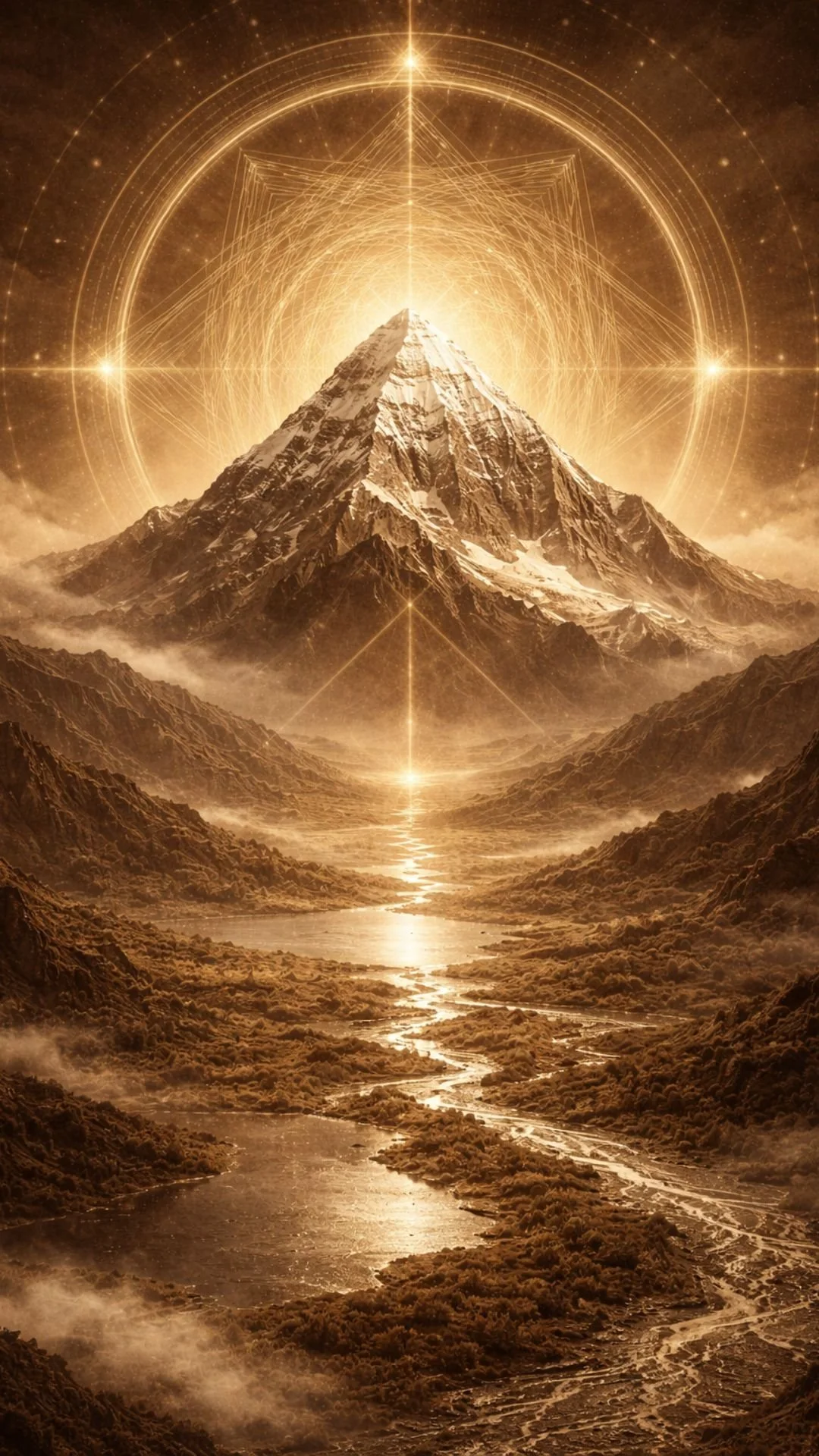
Shiva's throne sits on Chinese soil. From its base flow four rivers, feeding half of Asia. Its name survives in a tribe thousands of miles away, who have forgotten everything except their devotional practices. Russian scientists have called it a pyramid. Others have wondered if it was something far more complex, even a nuclear reactor.
And in 1954, without a single shot fired, it slipped out of India's hands.
Not by conquest. Not by accident. But by a decision few remember, and fewer still dare to question.
Ask any Indian child where Lord Shiva lives, and they will answer without hesitation… Kailash Parvat. It is the first geography lesson woven into their bedtime story. The cosmic mountain. Shiva's eternal seat. The axis around which the universe turns. And yet, open any map, and there it is, sitting inside the Tibet Autonomous Region, fenced off by Chinese bureaucracy, accessible only by Beijing's permit, and for the past several years, effectively sealed shut to Indian pilgrims entirely.
The god of India's oldest faith lives in a foreign country. And almost nobody asks how that happened.
This is that story.
Where a Mountain Stops Being Just a Mountain
Before we get to politics and betrayal, let us first stand before the mountain itself… because Kailashāis not merely sacred. It is, by any geological and mathematical measure, deeply… unsettling.
Rising 6,638 metres from the western Tibetan plateau in the Gangdisê Range, Mount Kailashā is nowhere near the tallest peak in the region. Everest dwarfs it… dozens of other peaks do too. And yet, not one of those taller, more dramatic peaks has stirred the human soul across four religions, thousands of years, and a hundred generations the way Kailashā has.
Why? Because nature, for all its majesty, rarely produces anything this deliberate.
Its four faces align almost perfectly with the cardinal directions… north, south, east, west… as if placed by a hand that understood what a compass was, long before compasses existed.
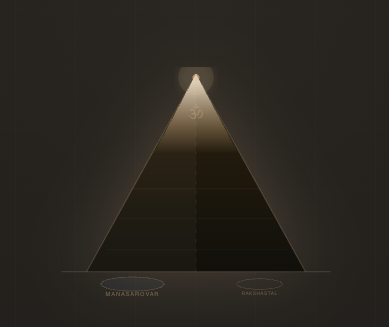
Its silhouette rises like a near-perfect pyramid… not jagged, not chaotic, but deliberate.
The north face appears as dark, almost jet-black stone.
The south face remains draped in snow, as though untouched.
The east face catches the first light and gleams like crystal.
The west face glows with a reddish hue at dusk… a tone ancient texts compared to ruby.
These are not poetic exaggerations… they are observations.
The Shiva Purana, composed long before the language of modern geology, describes Kailashā as having four distinct faces… gold in the north, lapis lazuli in the south, crystal in the east, and ruby in the west.
When 19th-century British explorer G.C. Rawling encountered the mountain, he struggled to put what he saw into words, noting with visible unease that it appeared as though it had been constructed by “giant hands… of immense blocks of reddish stone.”
A Geometry That Defies Explanation
6,666 km… the approximate distance from Kailashā to both the North Pole and Stonehenge… measured independently.
13,332 km…the distance to the South Pole… almost exactly double.
Four rivers emerge within a radius of roughly 60 kilometres… flowing outward in the four cardinal directions… sustaining the Indian subcontinent and lands far beyond.
Geological paradox: The north face... which receives less direct sunlight... carries less snow than the south face. This is the exact opposite of what physics predicts for a northern-hemisphere mountain.
No physical ascent has ever been confirmed in recorded human history. No mountaineer has planted a flag on its summit. The only ascent the mountain seems to have permitted was Milarepa's... a Tibetan Buddhist saint who, by legend, rode a sunbeam to the top.
Make of that whatever you wish to.
China officially prohibits any attempts at ascension. But long before any official prohibition, something about Kailashā seems to have turned climbers back by choice, or by circumstance.
The Five Rivers: A Mountain That Feeds the World
The ancient scriptures were unequivocal: all rivers flow from Kailashā. For centuries, the claim was filed away as mythology, a poet's flourish, the faithful's exaggeration. Then geographers arrived with their instruments. And found, to their considerable discomfort, that the Puranas had not been entirely wrong.
Within roughly sixty kilometres of Kailashā, four great rivers rise from the earth, each departing in a different cardinal direction, each going on to sustain an entire civilisation. Their Tibetan names are not incidental. Each river carries the name of an animal. Each animal corresponds to a face of the mountain. Together, they form what Tibetan Buddhists have long called the Chhu Lung Zhi, the Four Great Fountains, a cosmological map disguised as hydrology.
The Four Sacred Rivers of Kailashā
From the northern face descends the Singgye Khabub, the Lion River, known in China as the Shiquanhe and to the world as the Indus. Travelling northwest through Kashmir and Pakistan before emptying into the Arabian Sea, it covers more than 3,000 kilometres, tracing the very corridor along which the Indus Valley Civilisation once flourished.
From the west, near the shores of Rakshastal, flows the Langchen Khabub, the Elephant River, the Sutlej. It passes through Himachal Pradesh and Punjab, crosses into Pakistan, and meets the Arabian Sea, sustaining the agricultural plains through which it moves with quiet persistence.
From the eastern face emerges the Tachok Khabub, the Horse River. In Tibet it is known as the Yarlung Tsangpo. Crossing into India through Arunachal Pradesh, it becomes the Brahmaputra, carving a formidable path through Assam before joining the Ganga in Bangladesh. It is among the most powerful river systems on the continent.
From the south flows the Macha Khabub, the Peacock River, the Karnali. Nepal's longest river, it merges eventually into the Ghaghara and then the Ganga, sustaining, without announcement, an entire nation.
Four rivers. Four cardinal directions. Four civilisations drinking, unknowingly, from the same source.
What the ancient seers intuited in the language of symbol and scripture, the geographer confirmed in the language of coordinates and watershed maps. The correspondence is not approximate. It is exact.
There is, however, a fifth story. One that is considerably less spoken of.
The Yangtze Question
Here is the geopolitical bombshell hiding in plain sight… the Yangtze River… the cradle of Chinese civilisation, the longest river in Asia, the third longest in the world at 6,300 km… does not directly originate from Mount Kailash itself. Its formal source is the Tanggula Mountains in the eastern Tibetan Plateau. But that distinction is almost beside the point. The Tibetan Plateau as a whole, of which Kailashā is both the spiritual and geographical anchor, feeds the Yangtze's entire glacial system. Over 400 million Chinese people depend on its water. Add the Indus, the Brahmaputra, the Sutlej, the Karnali, the Mekong, the Yellow River, and the Salween, all rising from the same plateau, and the numbers become difficult to absorb. Nearly two billion people across ten Asian nations drink, farm, and survive on water that begins its journey here.
This is why China wanted Tibet. This is why China keeps Tibet. Not for Buddhism. Not for history. Not for territory in any conventional sense. For water. The Tibetan Plateau holds the largest freshwater reserve on Earth outside the polar ice caps. Whoever commands the plateau commands the watershed of an entire continent. And Shiva's mountain sits at the spiritual, and very nearly the hydrological, heart of all of it.
Kailashā is not merely Shiva's home. It is Asia's water tower.
And China has locked the gate.
The Two Sacred Lakes: Where Stillness and Shadow Coexist
At the foot of Kailashā lie two lakes that, despite their proximity, could scarcely differ more in character, chemistry, or the accumulated weight of meaning that centuries have pressed upon them.
Manasarovar… The name arrives already laden. In Sanskrit, manas is mind, sarovar is lake: the Lake Born of the Mind. Hindu tradition holds that this lake was first conceived within the imagination of Brahma, the Creator, before it assumed physical form upon the Earth, and that its waters therefore carry the original imprint of creation itself. This is not merely poetic assertion. There is a quality to the lake that resists geographical description entirely.
It spans 320 square kilometres at an altitude of 4,600 metres, ranking among the highest freshwater lakes in the world. Its form is nearly circular. Its waters move between blue and deep emerald, clear to considerable depth, and held in a stillness that those who reach its edge describe not in terms of what they see but of what they feel: an emotion that arrives unannounced and does not wholly depart. In Sanskrit literature, the lake is associated with the hans, the swan, that enduring symbol of discernment, of a consciousness sufficiently refined to separate the eternal from the transient.
Three kilometres to its west stands another presence entirely.
Rakshastal… also known as Langtso… the “Demon’s Lake.”
Where Manasarovar is circular, Rakshastal is crescent-shaped, a moon caught in its darkest quarter. Where one sustains life, drawing fish beneath its surface and migratory birds to its shores, the other is saline and largely barren, its banks of pale cobble and rust-red hill lending the surrounding landscape an austerity that feels less geological than deliberate. Pilgrims on the Kailash circuit are traditionally counselled to observe it from a distance, not out of fear alone, but out of deference to what it represents in the religious imagination.
It is here, according to the Ramayana, that Ravana, demon king of Lanka, performed his most ferocious tapasya, offering his own heads in successive sacrifice to Shiva, each regrowing so that the devotion could be extended and intensified. The boon was granted. The power Ravana received became the governing fact of his existence and, in time, the precise instrument of his ruin.
What geology cannot satisfactorily account for is why two bodies of water separated by three kilometres should exhibit such radically divergent chemistry. Rakshastal occupies a tectonic depression; its salinity is the accumulated consequence of millennia of evaporation and mineral concentration. This much science offers. What it does not offer is any persuasive explanation for why the contrast between these two lakes is so total, so visually and chemically absolute, as to appear considered rather than accidental. The Tibetan explanation requires no such qualification: one lake was made by a god, the other by his adversary.
Between them runs the Ganga-Chhu, a slender natural channel through which Manasarovar overflows westward into Rakshastal. It does not always flow. When it does, Tibetan monks regard it as a portent of consequential events to come. The channel flowed in 2019, for the first time in several decades. That same year, tensions along the India-China border sharpened with unusual intensity.
Whether one receives that as coincidence, as pattern, or as something that resists both categories, Kailashā offers no clarification.
Is Kailashā a Pyramid?A Nuclear Reactor? An Alien Antenna?
These are not questions to be waved away. They deserve a direct examination, followed by an equally direct verdict.
In 1999, Ernst Muldashev, a Russian ophthalmologist based in Ufa, led an expedition to Kailashā comprising specialists in geology, physics, and history. After months at the foot of the mountain, his team arrived at a conclusion that reverberated through fringe scientific circles: Kailashā is not a natural mountain. It is a colossal man-made pyramid, the centrepiece of a complex of more than a hundred smaller pyramidal structures.
His case rested on several observations. The mountain's geometric symmetry is striking, its four faces sharply defined and aligned with near-perfect precision to the cardinal directions. On more than one occasion, Muldashev and his colleagues reported hearing, in the silence of the night, sounds of falling stone that appeared to originate from within the mountain itself, which he interpreted as evidence of hollow interior chambers. He further proposed that the surrounding formations, when mapped as a system, bore an unexpected resemblance to the spatial structure of DNA molecules. He called this arrangement the City of the Gods, and argued that it had been constructed by an ancient civilisation possessed of knowledge of subtle energy that modern science has yet to fully account for. Mohan Bhatt, a Sanskrit scholar based in Mumbai, independently pointed to references in the Ramayana that describe Kailashā as a cosmic axis, while Vedic texts speak of Meru, the archetypal mountain, in terms that are almost geometric in their precision.
Whether these ancient descriptions are symbolic, metaphysical, or literal remains, as it has always been, a matter of interpretation.
The Chinese authorities formally banned climbing attempts on Kailashā in 2001, following international protests from religious communities when a Spanish expedition received conditional permission. They had earlier dismissed Muldashev's pyramid hypothesis, though no detailed geological data accompanied that dismissal. Geological analyses indicate the mountain's formation is natural, shaped by tectonic processes over millions of years, and Muldashev's broader claims have not been independently validated. What has not been provided, from any quarter, is the permission to conduct a thorough physical examination of the mountain. The summit remains unclimbed. The interior remains untested. The rejection, in other words, arrived without the evidence that would make it conclusive.
A separate and more speculative line of inquiry places Kailashā within the framework of ancient astronaut theory, connecting it to vitrified ruins and anomalous archaeological patterns at Mohenjo-daro, and to passages in the Mahabharata describing the brahmastra in language some interpret as resembling high-energy weapons. These interpretations remain well outside mainstream archaeological and scientific consensus and are noted here for completeness rather than credibility.
More scientifically grounded is the observation that granite and quartz, which form the composition of mountains across the Himalayan range, possess well-documented piezoelectric properties: under tectonic pressure, such materials generate electromagnetic energy. Whether Kailashā functions as a natural piezoelectric system at any meaningful scale has not been demonstrated. But the principle is not scientifically absurd. It is, in fact, established physics.
What mainstream science has not yet resolved is this: why Kailashā is shaped the way it is, why the north face carries less snow than physics predicts, why four major rivers emerge from within sixty kilometres of its summit, and why a peak of 6,638 metres, well within the range of accomplished mountaineers, remains unclimbed in all of recorded human history. The mountain poses questions that neither faith nor geology has yet fully answered. That, perhaps, is the most unsettling thing about it.
So where does that leave us?
The geometric precision of Kailashā is real and measurable. The cardinal alignment is documented. The hollow-mountain sounds remain unexplained. The Chinese denial arrived without supporting data, and no physical excavation has ever been permitted. The pyramid theory cannot be proven. But it cannot be cleanly dismissed either. Intriguing. Unresolved.
The nuclear reactor and alien technology theories rest on archaeological interpretations that mainstream science does not support. Colourful. But thin on evidence.
The Axis Mundi and energy vortex idea stands on firmer ground than most would expect. Four civilisational rivers from one location is verified geography. Compass failures near the mountain have been reported by multiple independent trekkers. Piezoelectric properties of granite are established physics. Partially supported by science. Worth watching.
The accelerated ageing accounts, hair and nails growing at double speed, climbers dying within a year of approaching the summit, remain anecdotal. No peer-reviewed documentation exists. Unverified. But curiously persistent.
The Kalash Tribe: Are They Shiva's Forgotten Children?
In three remote gorges of the Hindu Kush in northern Pakistan, valleys called Bumburet, Rumbur, and Birir, lives one of the most extraordinary communities on Earth. Fewer than 4,000 in number, they are polytheists encircled by Muslims. Their women do not observe purdah. They press wine from their own vineyards, dance at festivals that predate every neighbouring civilisation, and worship a deity they call Mahandeo. Which is to say, Mahadeva. Which is to say, Shiva.
These are the Kalash.
The etymological thread runs deeper than it first appears. Kalasha in Sanskrit denotes the sacred vessel, the pot that holds divine water, the same vessel that appears in every Hindu ritual from birth to death, the same vessel that crowns the iconography of Kailash itself. Phonetically, Kailash and Kalash share the same root. There are scholars who maintain this is not coincidence.
What scholarship has established about the Kalash is remarkable enough without embellishment. Their faith is classified academically as a form of ancient, pre-Vedic Hinduism fused with animism, rooted, in the words of Harvard Sanskrit scholar Michael Witzel, in "Indo-Iranian, pre-Zoroastrian Vedic traditions." Their supreme creator deity, Dezau, derives from the same Indo-European root, dheigh, meaning to form or create, that underlies the pre-Vedic conception of Brahman. Their sky deity is Indr, unmistakably Indra. Their universal sovereign is Imr'o, which maps directly onto Yama Raja. These are not approximations or convenient parallels. They are the same names, carried intact across millennia, in a valley a thousand miles from the Vedic heartland.
Their genetics confound science no less than their theology. A landmark 2015 study published in the American Journal of Human Genetics found that when human populations worldwide are sorted into six genetic clusters, the sixth cluster consists of one population and one alone: the Kalash. They stand apart from Europeans, East Asians, Africans, Oceanians, Native Americans, and the broader South Asian grouping alike. Researchers concluded they were among the earliest populations to diverge from the ancestral stock of the Indian subcontinent, the divergence estimated at approximately 11,800 years ago. The romantically persistent legend of Alexandrian descent has been formally and conclusively dismissed; no genetic evidence supports it.
Their oral tradition preserves the memory of a homeland they call Tsiyam, a name that recurs in every folk song, every epic, every ceremonial chant. Some historians have proposed this as a memory of ancient Syria or Mesopotamia. Others argue it is a corruption of Shyama, the Sanskrit word for the dark and sacred land, and point eastward toward Tibet, toward the black-faced mountain that the Hindus have always called their holiest.
The Kailash connection, when assembled, is this: the Kalash pray to Shiva under His oldest name. They live in the shadow of the Hindu Kush, those mountains named for the passes where Hindu pilgrims perished attempting the journey toward Kailash and Central Asia. Their sacred oral tradition places their origin to the east and south of where they now stand. And certain anthropologists have traced their ancient migration path directly through the Kailash-Manasarovar region.
Is the name Kalash derived from Kailashā? No definitive linguistic proof exists. But this much can be said with confidence: the Kalash are the last surviving community in the entire region who still practise a religion that is, in its essential structure, the very faith that made Kailash sacred in the first place. They carry the memory of that mountain in their worship, whether or not they know they do.
And yet, for all that the mountain holds in memory and mythology, the story of how it left Indian hands is neither ancient nor mysterious. It is recent, documented, and entirely human.
How Kailashā Moved Without Moving
Kailashā was never conquered in battle. It was relinquished, quietly and without condition, through a compound of idealism, diplomatic naïvety, and a singular failure to grasp that certain geographies are not merely political. They are theological.
Tibet was not historically a province of China. For the greater part of recorded history it was a sovereign civilisation, possessed of its own language, government, military tradition, and spiritual lineage. The Tibetan name for their land, Bod, derives from the Sanskrit Bhautta. Buddhism reached Tibet from India in the fifth century. For over a thousand years, Indian pilgrims walked freely to Kailashā, requiring no visa, no permit, no foreign authority's dispensation to approach the seat of their own god.
In October 1950, the People's Liberation Army marched into Tibet. The world took note. India took note. And India proceeded to do something that history has not yet ceased to find remarkable: it quietly signed away its right to object.
The Signature That Surrendered a Sacred World
On 29 April 1954, Prime Minister Jawaharlal Nehru concluded the Panchsheel Agreement with China in Beijing. Its formal designation: Agreement on Trade and Intercourse between the Tibet Region of China and India. Those words warrant careful attention. "Tibet Region of China." It was the first occasion on which any sovereign nation had formally recognised, through an international instrument, China's authority over Tibet. With a single act of statecraft, Kailashā, Manasarovar, and the entirety of the Tibetan plateau acquired, in the language of international law, a Chinese address.
The concession did not end there. In 1953, Nehru had separately and unilaterally relinquished India's centuries-old administrative claim over Menser, a cluster of villages situated at the very foot of Kailashā, on the banks of Manasarovar.
The history of Menser reaches back to 1684 and the Treaty of Tingmosgang, concluded at the close of the Ladakh-Tibet war. Under its terms, the rulers of Ladakh were granted jurisdiction over these villages for two explicit purposes: to maintain a transit post for pilgrims bound for Kailashā, and to defray the costs of religious offerings at the mountain. From 1846 onwards, the Maharajas of Jammu and Kashmir inherited and honoured those same obligations, collecting taxes from Menser accordingly.
For nearly three centuries, Menser had served as India's foothold at the gates of Shiva's home.
Nehru surrendered it before China had even raised the matter, framing the concession as a gesture of goodwill. His own instructions to India's negotiators were unambiguous: "It is clear that we shall have to give it up, if this question is raised. We need not raise it." Nothing was received in return.
Eight years later, in 1962, China invaded India. Hindi-Chini bhai-bhai concluded in Indian blood on Himalayan ice.
Sardar Vallabhbhai Patel had issued an explicit warning. In a letter of November 1950, the Deputy Prime Minister set out, with characteristic precision, why a militarised China in possession of Tibet constituted an existential threat to India's northern frontier. The counsel went insufficiently heeded. Historians including Claude Arpi, and former Intelligence Bureau chief R.N. Ravi, have since documented the strategic consequences of that failure at considerable length.
After 1954, the yatra to Kailashā ceased to be a right and became a privilege, dispensed at Beijing's discretion. It was suspended following the Tibetan uprising of 1959, sealed entirely between 1962 and 1981, and thereafter permitted only as a regulated trickle, a few hundred Indian pilgrims per year, chosen by lottery. In 2020, it was closed once more under the provisions of COVID-19 restrictions, and it has not been fully restored since.
Citizens of the civilisation whose oldest scriptures placed Kailashā at the axis of the universe must now seek a foreign government's sanction to stand at the base of Shiva's abode. That government, it bears noting, demolished monasteries in the Kailashā region during the Cultural Revolution between 1966 and 1976, imprisoned monks, consigned sacred texts to fire, and drove out the communities of nuns who had tended the mountain for generations. It is this same authority that today holds the keys to the holiest address in the Hindu cosmos.