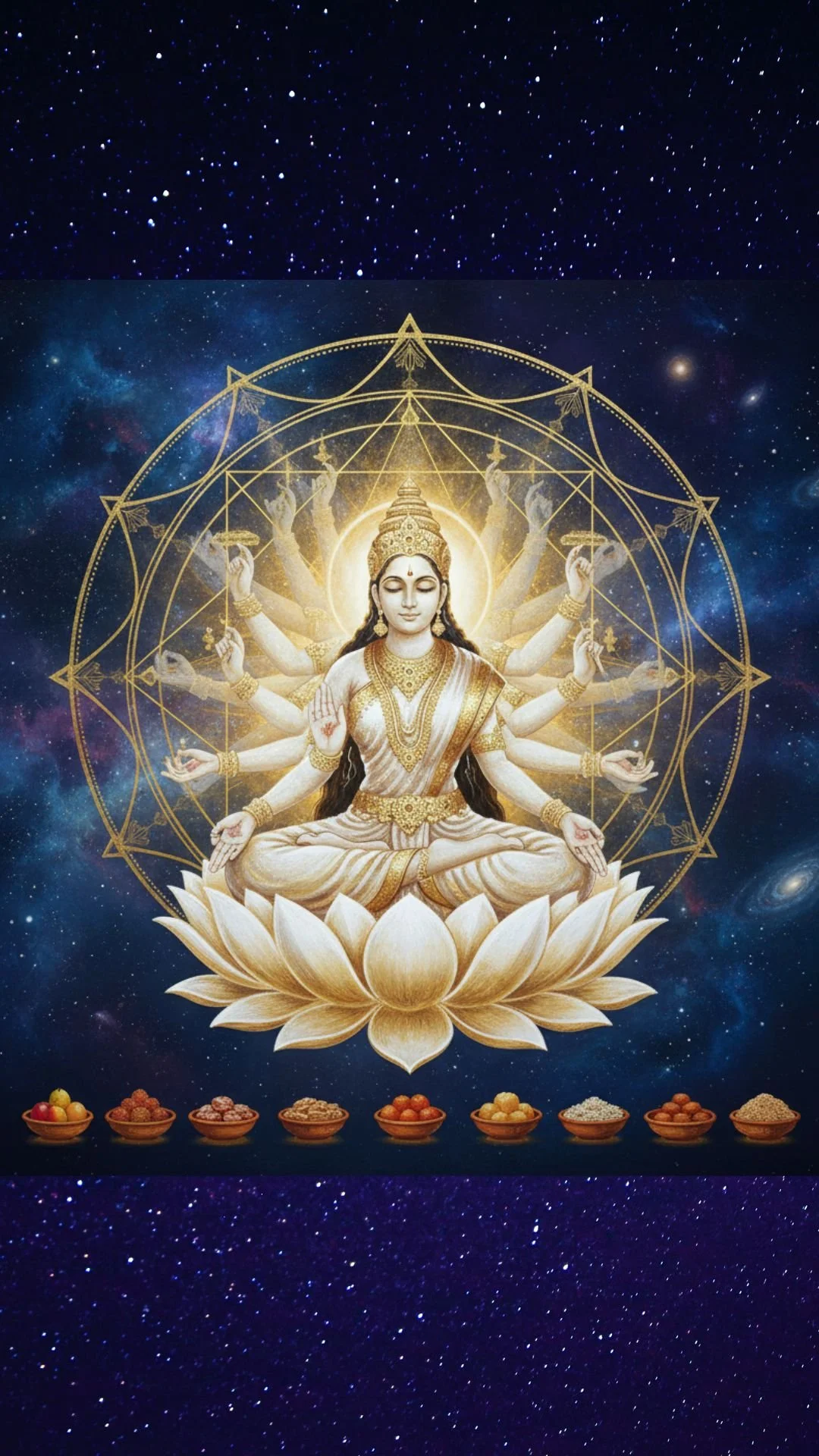
The Inner Architecture of Consciousness
Nine Forms of the Feminine. One Complete Science of Being.
There is a civilisation that, thousands of years before the word "neuroscience" existed, understood the architecture of human consciousness with a precision that modern science is only beginning to approach. That, thousands of years before quantum physics proposed that matter and energy are not separate, built an entire cosmology on the principle that consciousness and the material world arise from a single source. That, at a time when most of the ancient world treated women as property, not only worshipped the feminine as the supreme force in the universe but encoded that worship into every layer of daily life, seasonal festival, and inner practice.
That civilisation is ours. Sanatan Dharma. And if you have grown up celebrating Navratri without knowing what you were actually celebrating, what follows will change the way you see everything.
The Essence
Navratri is not a festival of nine nights. It is a map. Every element of it, from the colour worn on a particular day to the specific food placed in a small clay bowl before the Goddess, carries an encoded meaning. The ancient seers who designed this sequence were not building a religion in the way we use that word today. They were building a curriculum, a complete science of inner transformation. They wrapped it in beauty, colour, song, and celebration so that it would survive across millennia, living in the body and the kitchen and the hands of ordinary people, not entombed in philosophical texts accessible only to scholars.
It survived. And it is time to read it properly.
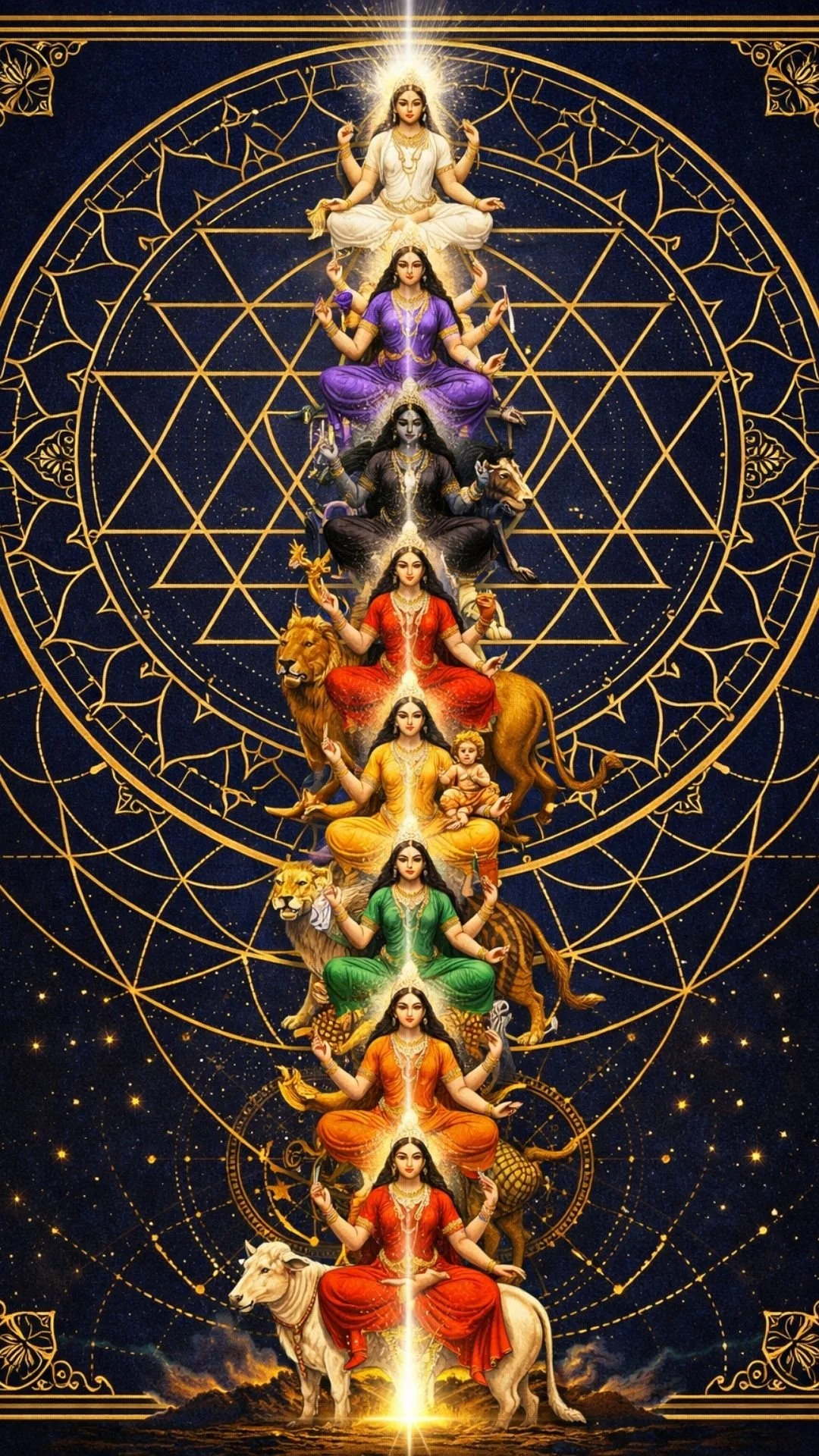
The nine forms of the Devi, collectively known as the Navdurga, are not nine separate goddesses. They are nine states of being, nine qualities of consciousness, nine phases of an inner journey that begins at the root of what we are and opens at the threshold of the infinite. The sequence is deliberate. The bhog, the specific food offered to each form, is deliberate. Every layer of this tradition is a question the seers left for us, trusting that one day we would be ready to ask it.
Day One… Shailputri: The Foundation
Bhog: Pure Ghee
Shakti cannot be extinguished. She returned as Shailputri, the daughter of Himalaya, and the mountain she was born of is not incidental to her teaching. It is her teaching. A mountain does not succumb to pressure. It does not negotiate with the storm or flinch at the cold. It simply stands, ancient and unhurried, having been formed by forces that would have destroyed anything less committed to its own nature.
Geological science tells us that mountains are born of tectonic collision, two massive forces pressing against each other for millions of years until the earth has no choice but to rise. Shailputri is that principle alive in a human being: something that has been through every kind of pressure and has not fragmented, has not fled, has only become more itself.
She carries the trishul, which cuts through what the Puranas identify as the three fundamental sources of all human suffering: adhidaivik pain, from forces beyond our control, adhibhautik pain, from the world around us, and adhyatmik pain, from within ourselves. Suffering, the ancient seers observed, always arrives from one of these three directions. Understand its source and we are already closer to freedom from it.
The bhog offered to Shailputri is pure ghee, clarified butter, and what ghee actually is deserves to be understood. Butter heated until every impurity rises and is removed, leaving behind only the essential, luminous fat. Ayurveda holds it as the supreme vehicle for ojas, the body's deepest vitality, precisely because it does something no other heavy, nourishing food can: it kindles agni, the inner fire, rather than suppressing it. Groundedness that carries fire within it. Stability that does not become stagnation. To offer ghee to Shailputri is to make a statement of intent: we aspire to this, to carry only what is essential, to be the kind of ground from which something can actually rise.
Day Two… Brahmacharini: The Virgin Force
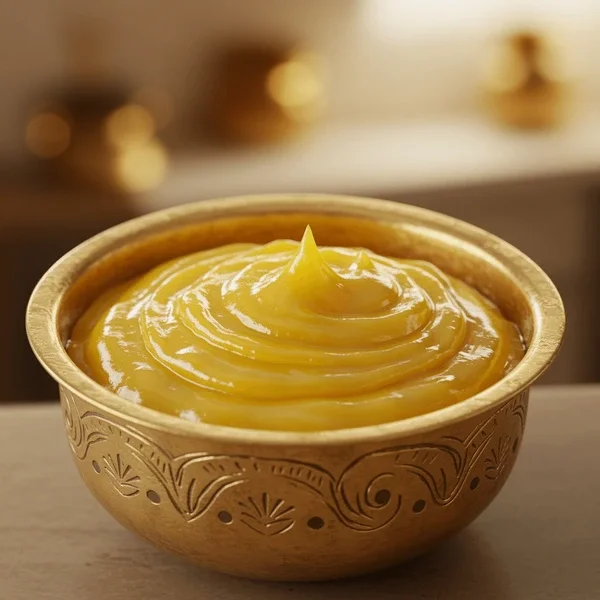
Bhog: Shakkar
She is the second form, and she walks into the forest alone. Brahmacharini, from Brahma, the supreme consciousness, and charini, the one who moves toward it, undertook a tapasya of such severity that it moved even the great ascetic, Shiva himself, from stillness into recognition. She gave up food, then shelter, then comfort, until she was living on light and will alone.
But before we arrive at her tapas, there is something more fundamental to understand about who she is, because the tradition is precise about this. Brahmacharini is the unmarried form of the Goddess. She is the maiden, Parvati before union, energy that has not yet been given outward, Shakti turned entirely inward and upward. The deeper meaning of brahmacharya is not simply celibacy, as the word is commonly reduced to. It is the state of energy that remains whole within itself, undispersed, undiminished, like a river that has not yet reached the sea and therefore holds within it the full force of everything it will become. This is the virgin aspect of energy, not a moral category but a description of concentrated potential. Brahmacharini moves through infinity without losing herself in it. She is the moon's light, ancient beyond reckoning, and yet arriving each night absolutely herself.
What the seers understood about this state, modern neuroscience is only beginning to map. Deliberate restriction, of food, of stimulation, of comfort, activates the prefrontal cortex, the seat of willpower and long-range planning. The ancient tapas and the modern practice of disciplined fasting operate on the same neural circuitry, which means the seers understood, without brain imaging, that the mind sharpens precisely when the body is not being indulged. Brahmacharini walks barefoot, her hands holding only a kamandalu and prayer beads. This is the principle she maps: before anything of genuine worth can be offered outward, energy must first be gathered completely inward, held without dispersal, sharpened to a single point. In a world of relentless outpouring, that capacity is not a retreat. It is the most radical and most demanding form of preparation there is. She asks for the one thing a distracted age has almost forgotten how to give: the complete gathering of oneself, inward, still, undivided.... and the discovery of what blazes in that silence.
The bhog offered to her is shakkar, raw cane sugar in its most natural and unprocessed form, carrying within it the trace minerals and compounds of the earth it came from, untouched and whole. Shakkar has never been bleached into brilliance, never stripped of its origin in the name of refinement. It arrives before the Goddess exactly as it is. This is the correspondence the seers encoded with extraordinary precision: Brahmacharini is Shakti that has never been given away, energy that has never been diluted by dispersal, sweetness that needs no processing to justify its existence. The tapas does not manufacture something new. It burns away everything that was obscuring what was always already there. What remains is not a reward. It is a revelation.

Day Three… Chandraghanta: The Radiance
Bhog: Kheer
Chandraghanta stands at the threshold where tapas meets the world. She adorns herself with one of Shiva's ornaments, and the tradition is precise about what she chooses. A crescent moon, curved into the shape of a bell, rests on her forehead. Chandra meets ghanta, the moon meets the bell, in a single image that is simultaneously an aesthetic statement and a philosophical one.
Chandraghanta is the married form of Parvati, and this matters to the sequence. Brahmacharini was the maiden, energy wholly concentrated within itself. Chandraghanta is what that energy points toward after union: the inner work no longer held quietly inside but turned outward to meet the world.
She governs the Manipura chakra, the solar plexus, which the ancient texts called the city of jewels, Manipura translating directly from mani, lustrous gem, and pura, city. This is the seat of personal power, the fire centre of the body, where raw intention is converted into decisive action. Physiologically, it governs the digestive system, the body's literal furnace of transformation, converting what enters into energy that sustains life. The correspondence the seers drew between Chandraghanta and Manipura is exact: she is the form that has internalised the moon's luminosity and now radiates it outward as heat, as confidence, as directed force. Her planetary deity is Shukra, Venus, governing love, beauty, and creative power, which tells us something important: the fire of Manipura at its most refined is not aggressive. It is creative. It is radiant. It is the force that makes things beautiful and alive.
The bell on her forehead carries its own teaching. A bell, when struck, does not negotiate with the air around it. Sound moves outward in expanding rings, reaching what it reaches without effort or apology. This is the quality Chandraghanta embodies and what this form of the map asks of us: that the clarity cultivated through the silence of tapas must eventually ring, must become audible, must take up the space it has earned.
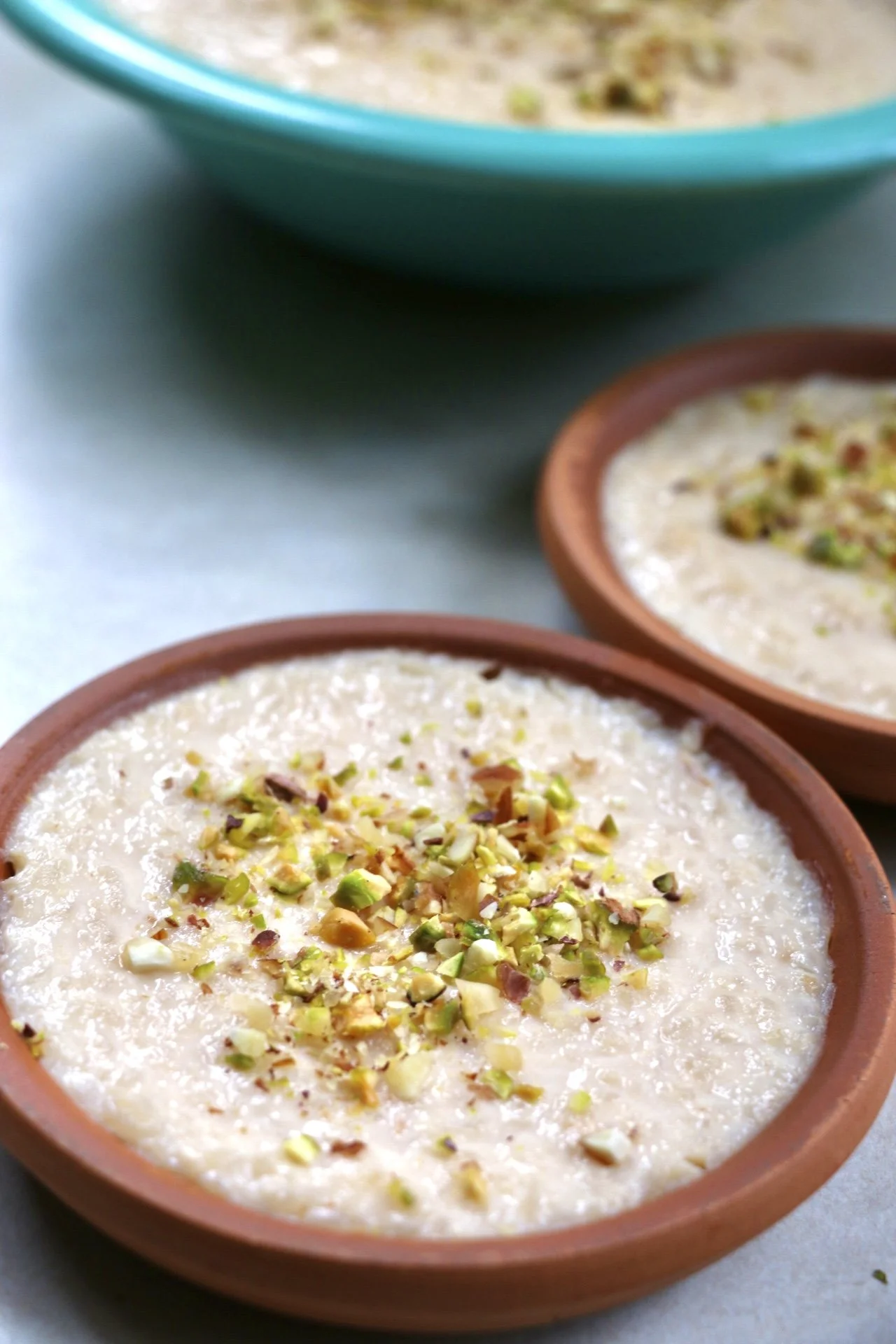
The bhog is kheer, rice cooked slowly in milk until the two substances become inseparable. In Ayurveda, milk carries Soma, the cooling, nourishing essence that sustains the body's fire without letting it burn out of control. Kheer is not made quickly. It demands steady, patient, continuous attention over low heat until what were two distinct things become one. This is not incidental. Chandraghanta is herself the union of two qualities that have no business existing together and yet, in her, become inseparable: the moon's cool luminosity and the bell's outward-ringing fire. The bhog offered to her is not merely the food of sustenance. It is her own nature, made edible. The teaching it carries at this precise point in the map is exact: the fire of Manipura, of personal power and directed will, must be sustained, not burned through in a single blaze. Chandraghanta marks the point in the map where inner luminosity becomes outer radiance, and what keeps that radiance steady, what prevents it from becoming aggression or from dimming into exhaustion, is exactly this: nourishment that is patient, cool, and sustaining.
Day Four… Kushmanda: The Bliss
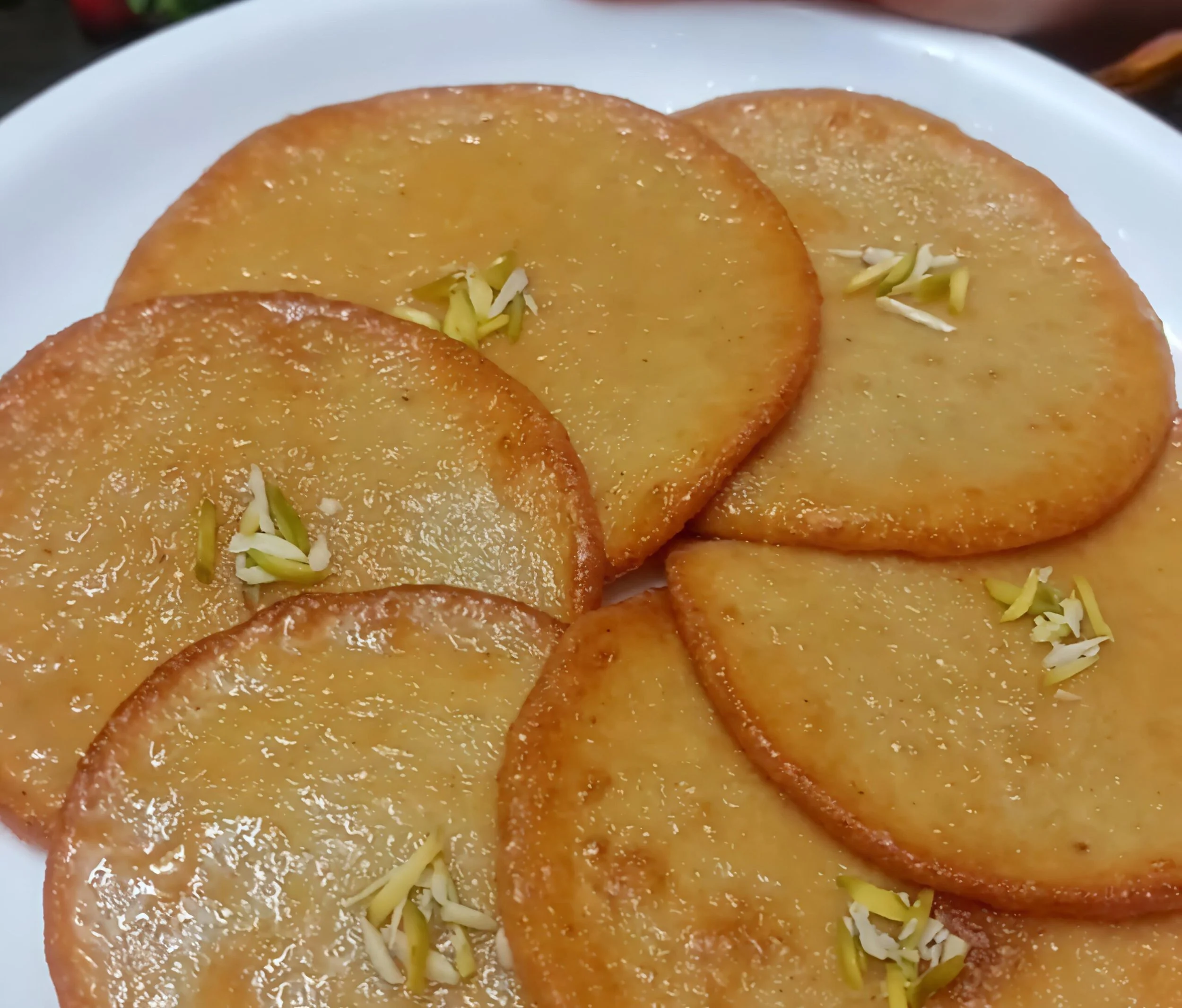
Bhog: Malpua
The first three forms of this map point, in the most precise sense, toward preparation. Shailputri offers us our ground. Brahmacharini offers us the fire of absolute commitment. Chandraghanta offers us the courage to step outward, luminous and ready, carrying our inner work visibly in the world.
And then the fourth form arrives, and the entire frame shifts.
Kushmanda does not ask us to be more prepared, more disciplined, or more courageous. She asks us to turn and face something that the first three forms could only point toward: the question of what we actually are, and what the universe actually is, and whether those are, at the deepest level, the same question.
Before space. Before time. Before even darkness, because darkness requires somewhere to exist in. There was the Mother. And she smiled.
That smile, according to the Devi Bhagavata Purana, was the first event in existence. The first warmth, the first light, the beginning of everything. Kushmanda holds the universe within her name itself: ku meaning small, ushma meaning warmth, anda meaning the cosmic egg. She is Adishakti, the primordial source, and she is Adiswarupini, the original form from which all forms arise. She does not reside near the sun as a celestial being might. She resides at its very core, as its animating intelligence, controlling Surya Loka itself. Her planetary deity is Surya, and every chain of energy that makes life possible on this planet traces back to solar light, which traces back, in the Puranic understanding, to her.
Modern cosmology describes the originary event of the universe as an unimaginable concentration of energy expanding into space and time. The Puranas described the same moment and located its cause not in a mechanical event but in the joy of consciousness. The ancient seers did not separate the question of cosmic origin from the question of awareness. They insisted that at the foundation of everything is not a cold, indifferent force but something that can only be described as ananda, bliss. This is not a minor philosophical position. It is a radical one, and it remains unrefuted.
This is the Pratyabhijna move at the heart of Kashmir Shaivism, the sudden recognition that the self is not a participant moving through the universe but the ground from which the universe arises. Chandraghanta says: I am ready to meet the world with full presence. Kushmanda says: I am what the world arose from. The distance between those two statements is the distance between a seeker who is still preparing and one who has glimpsed, even for a fleeting moment, that there was never any boundary between themselves and the source.
Kushmanda governs the Anahata chakra, the heart centre. Anahata in Sanskrit means the unstruck sound, the vibration that arises without two things colliding, self-arising and pure. The Anahata is the precise midpoint of the seven chakras, the bridge between the lower three, which govern survival, desire, and personal will, and the upper three, which govern expression, perception, and transcendence. It is the centre from which creation in its truest sense flows: not the creation of objects or structures, but the creation of meaning, of compassion, of beauty, of anything that requires a human being to remain genuinely open to something beyond their own protection and comfort. To create, in the deepest sense, is to risk the heart. Kushmanda, who smiled the universe into being from the darkness, is the Goddess of that precise risk.
The bhog offered to her is malpua, sweet pancakes, round and golden, fried in warmth, each one carrying the colour and the radiance of the sun itself. The tradition is encoding something that goes beyond sweetness as reward. The Anahata chakra, when open, generates a quality of expansive, self-arising joy that the seers understood as the true engine of everything worthwhile that a human being creates or offers to the world. A mind contracted by fear cannot create. A heart sealed by grief cannot give generously. Malpua is warm, immediate, and generous in its pleasure, offered to the Goddess who did not labour the universe into being but smiled it into existence. The seers who designed this offering were encoding a teaching that most spiritual traditions miss entirely: ananda is not the destination. It is the fuel. A seeker who has lost access to joy does not indicate seriousness about walking their path. To be devoid of the very quality that Kushmanda embodies and that the fourth form of this map asks us to locate within ourselves, not as an emotion that comes and goes, but as the unchanging ground beneath every emotion that does, is to return to the most safe place on this earth.... the mother's womb.... to eternal bliss.
Day Five… Skandamata: The Transmutation
Bhog: Kela (Banana)
Day Four opened a door. Standing at the threshold of Kushmanda, we encounter, perhaps for the first time, the recognition that consciousness is not a passenger in the universe but its very source, that the smile which began everything is not a distant cosmic event but the nature of awareness itself. It is an enormous recognition to sit with. And the tradition, with characteristic precision, does not let us rest at the threshold.
Because a realisation encountered only as idea is not yet complete. Ananda glimpsed at the threshold of the heart has not yet become what it is capable of becoming. Day Five asks: now that we have glimpsed the source, what are we to do with what it generates?
A consuming darkness was spreading through all three worlds. Tarakasura had obtained his boon with careful calculation.... knowing that Lord Shiva, the supreme ascetic, would never marry, he asked Lord Brahma to grant him death only at the hands of Shiva's son. It was, he believed, a condition that could never be met. What he had not accounted for was the force of Shakti, which recognises no permanent impossibility. The gods implored Shiva to marry. He agreed. Their son, Skanda Kumara, dismantled Tarakasura completely.
Skandamata is the fifth form of the Goddess: four-armed, three-eyed, of radiant complexion, seated upon a lotus, which earns her the name Padmasani. She holds her infant son Skanda in one arm and a lotus in another, while her left hand is raised in Varada Mudra, the gesture of infinite bestowal. She is also worshipped as Parvati, Maheshwari, and Mata Gauri. To worship Skandamata is simultaneously to worship Skanda himself in his infant form, for mother and son are, in this swarupa, inseparable.
She governs the Vishuddha chakra, the throat centre, and the esoteric significance of this correspondence is one the tradition has encoded with extraordinary precision. Vishuddha translates as supremely pure, and the ancient texts identify it as the great purification centre of the subtle body. From above, the divine nectar amrita descends and arrives at Vishuddha, where it meets its decisive moment: if the chakra is open and balanced, the nectar is preserved and becomes the source of longevity, creative power, and luminous expression; if it is blocked, the nectar falls into the fire below and is consumed and lost. Lord Shiva himself is the supreme embodiment of this chakra, for it was here that he held the halahala poison drawn from the churning of the cosmic ocean, neither swallowing it nor releasing it, but transmuting it entirely, so that the world could be saved. That is the essential quality of Vishuddha: the capacity to receive what is destructive and convert it, through purification, into what sustains life.
Skandamata embodies this transmutation in its most intimate and powerful form. The threat that was Tarakasura was not simply destroyed from the outside. Through the love of the Mother and the force that love generated, darkness was drawn into the cosmic order and converted into its own undoing. This is the inner architecture the fifth form maps: we arrive at Vishuddha carrying everything encoded in the four forms below, the groundedness of Muladhara, the creative force of Svadhisthana, the fire of Manipura, the open heart of Anahata, and at this centre, when we are ready, that entire accumulation is purified and rises as wisdom, as clear expression, as power that serves something larger than the self. Her planetary deity is Buddh, Mercury, governing intellect, communication, and the refinement of lived experience into articulate truth.
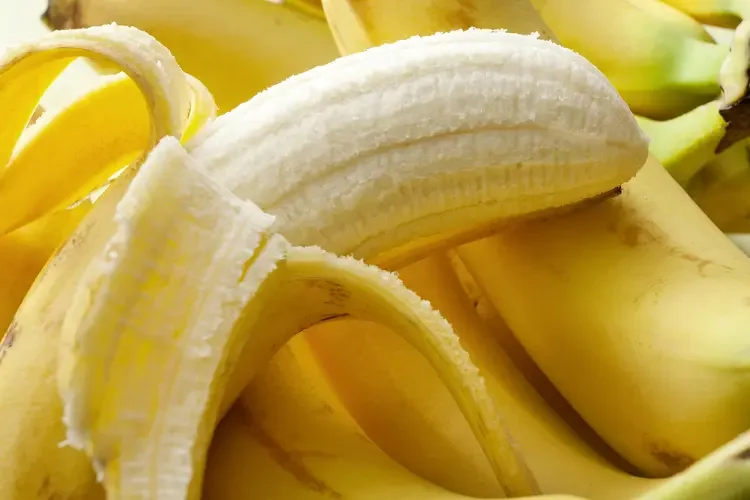
The bhog offered to Skandamata is kela, the banana, and its most extraordinary quality is one that most of us have never paused to notice. The banana grows against gravity. Every other fruit surrenders to its own weight and hangs downward. The banana, carrying its full cluster, defies that pull and grows upward, always toward light. This is not incidental. It is the most precise correspondence in the entire sequence of nine offerings. Vishuddha, the chakra Skandamata governs, is the centre where everything accumulated in the four forms below, the groundedness, the discipline, the fire, the love, stops moving outward and begins to rise. Where what was heavy becomes luminous. Where the weight of all that has been lived is not discarded but transmuted, lifted upward as wisdom, as clear expression, as truth that serves something larger than the self. The banana does not shed its weight to rise. It rises because of what it carries. And that, precisely, is Skandamata.
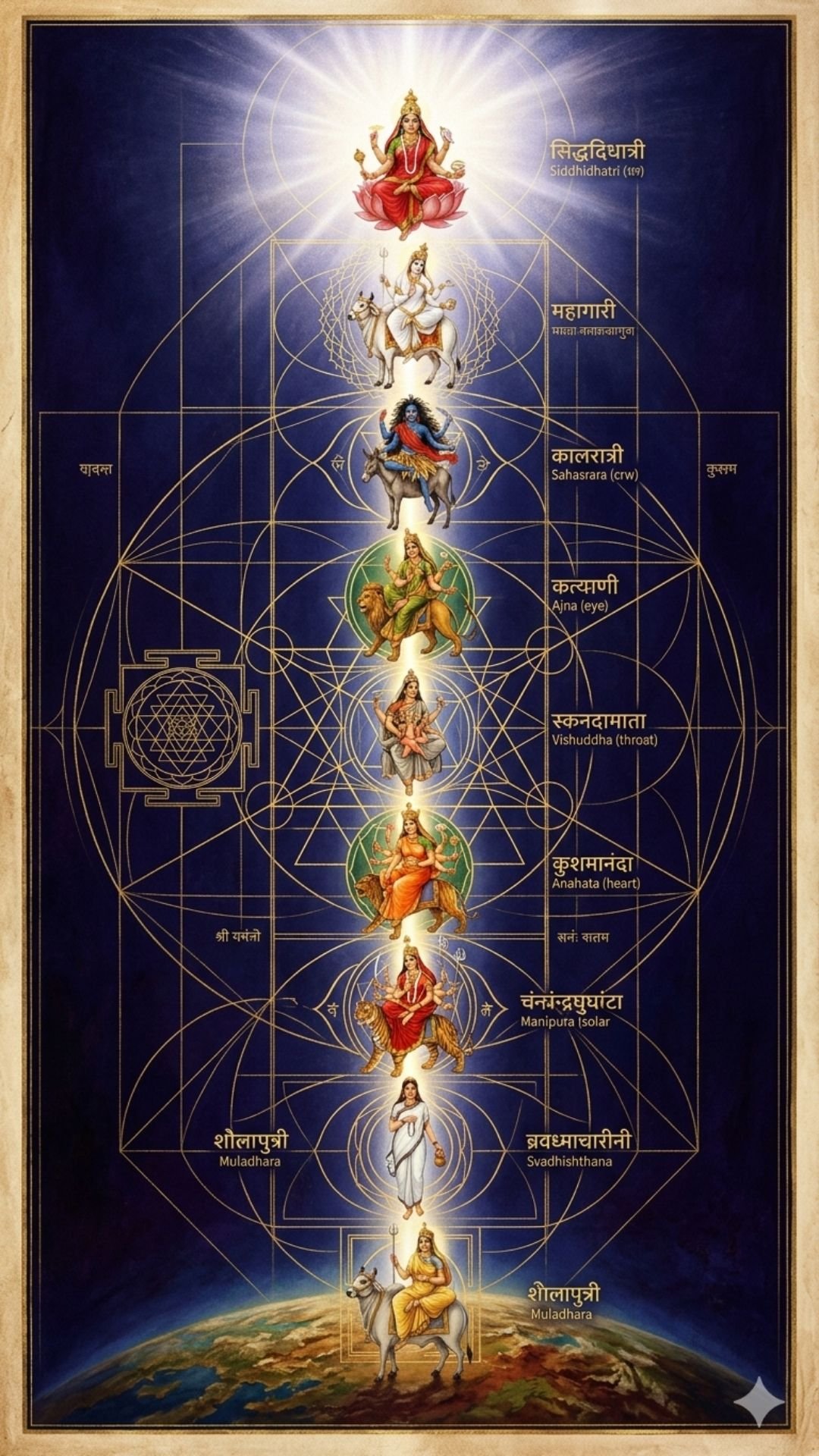
Day Six… Katyayani: The Discernment
Bhog: Shahad
There comes a point on any genuine inner journey when understanding alone is no longer sufficient, when what has gathered quietly as knowledge must become something sharper, something that can cut through the last remaining illusion. Katyayani is that edge.
Mahishasura had been spreading his darkness through all three worlds behind the shield of a boon: no man and no god could destroy him. He had made a precise and fatal error. Shakti is not a god. She is what gods are made of.
From the combined energy of every deva, Brahma, Vishnu, Shiva and the full assembly of divine force, each one pouring his concentrated power outward without reservation, a light emerged, blinding and absolute, and from it stepped Katyayani: born in the ashram of the sage Katyayana, gold-bright, lion-mounted, a weapon in every hand, her expression carrying a stillness more precise and more final than rage.
She governs the Ajna chakra, the sixth energy centre, the seat the tradition calls the third eye, located between the eyebrows. This is not the chakra of physical force. It is the chakra of prajna, of penetrating wisdom, of the capacity to see through illusion directly to what is real. Its planetary deity is Brihaspati, Jupiter, the great teacher of the gods, the force associated with knowledge, expanded consciousness, and the wisdom that accumulates through lifetimes. The seers are telling us something specific here: the force that ultimately destroys darkness is not brute strength. It is clarity. It is the wisdom that has sharpened itself through every previous stage of the journey until it can see, without flinching, exactly what needs to be cut and exactly where.
Shahad, honey, carries in Vedic literature a name that philosophy itself borrowed: madhu. The Madhu Vidya of the Brihadaranyaka Upanishad is among the oldest and most luminous teachings in the entire Vedic corpus, the doctrine that at the heart of every element of existence, earth, water, fire, sun, and the self itself, there is a sweetness, a fundamental bliss that is the nature of Brahman. The seers called this sweetness madhu, and they called it honey because honey is what bees produce through thousands of purposeful flights, through extraordinary collective discipline, each creature executing its precise function, over weeks and months, to yield a substance of concentrated nourishing power. Wisdom is made exactly like this: thousands of encounters with experience, each one processed, each one carried back, until something crystallises that is both medicinal and sweet.
The tradition says her worship destroys the accumulated weight of many lifetimes and bestows the strength to face disease, sorrow, and fear without flinching. This is not a promise of escape from difficulty. It is a precise description of what prajna, wisdom that has sharpened itself into clarity, actually makes possible in a human life. Katyayani receives madhu because she is the form in whom the sweetness of Brahman, the ananda at the heart of all existence that Kushmanda first revealed, has become not just a recognition but a force. The map has arrived at its sixth station, and what it is pointing to now is this: the deepest knowledge does not remain interior. It becomes the most precise instrument available to us.

Day Seven… Kalaratri: The Crown
Bhog: Gur
Katyayani showed us the warrior's clarity: the capacity to see what must be faced and to face it without hesitation. One might assume that after such a reckoning, the map would ease. It does not. It goes deeper. Because there is a form of darkness that no sword reaches, a darkness that lives not in the world outside but in the innermost architecture of the self. For this, the Mother takes her most ferocious form, and she takes it willingly.
Kalaratri is not a form the Goddess is forced into. She is the form the Goddess chooses. To destroy the demons Shumbha and Nishumbha, who had embedded themselves inside darkness itself and could not be reached by light, Parvati removed her own golden skin. What remained was absolute: dark as the space between galaxies, hair unbound and wild, three eyes blazing with lightning, flames rising from her nostrils with every breath. In her left hands she carries a cleaver and a torch. Her right hands hold Abhaya mudra and Varada mudra, the gestures of protection and of giving. This is the detail the tradition insists upon: even in her most terrifying form, she is simultaneously protecting and bestowing. The ferocity and the grace are not in opposition. They are the same gesture, offered from the same hands.
She rides a donkey, the most humble of animals, the one that carries the heaviest loads without recognition. The seers made nothing of this by accident. The one who governs the highest threshold of consciousness arrives not on a lion or a tiger but on the animal of patient, unacknowledged endurance. Genuine spiritual power does not announce itself.
She is associated with the Sahasrara, the thousand-petalled lotus at the crown of the skull, the point at which individual consciousness either meets its boundary or dissolves into the infinite. The Sahasrara has no element because it is beyond the elements. Every chakra below it has its domain, earth, water, fire, air, ether, light. Here, at the crown, there is only the choice: hold on to the last thread of personal identity, or release it entirely. Kalaratri governs that threshold. Kala means both time and death. Ratri means night. She is the night that even time and death must ultimately enter, and if even time itself is consumed by her, then the only thing that is real is what is happening now.
Her planetary correspondence is Shani, Saturn, the dandakarak, the dispenser of karma. Saturn does not punish. He settles accounts with absolute accuracy. The tradition says that worshipping Kalaratri dissolves the accumulated weight of what has been wrongly done, not by bypassing the arithmetic of karma but by facing it directly, under her blazing eyes.
She is also known as Shubhankari, the auspicious one, and this is the name that stops the uninitiated mid-breath. Auspiciousness, in its deepest meaning, is not comfort. It is alignment with truth. What Kalaratri destroys is avidya, the fundamental not-knowing, the illusions and false identities that accumulate across a lifetime and eventually obscure the self from itself. Certain forest ecosystems cannot renew themselves without periodic fire. Specific seeds carry shells so dense that only the concentrated heat of a burn can crack them open. The landscape that appears as devastation is the same landscape that returns within a season, more diverse and more alive than before. Kalaratri is that fire. What is left after she passes through is not ruin. It is the ground prepared for what comes next.
Her bhog is gur, raw jaggery, and the correspondence is exact. Made by boiling sugarcane juice over sustained fire until it thickens and sets into a dense dark mass, nothing in gur is extracted or refined away. Every mineral the cane drew from the earth remains: iron, calcium, potassium, magnesium, phosphorus, in a form the body absorbs directly, properties that white sugar destroys entirely in its pursuit of brightness. Gur is dark, complex, and incomparably richer than anything that has been processed into surface refinement. What has been through fire and survived it, retaining everything it was, becomes the fitting offering to the Goddess who governs the fire of time itself. Kalaratri does not want what is polished and comfortable. She receives what is real.
One who walks faithfully through six forms of the Mother arrives not at a victory but at a threshold. The crown of the skull. The point where the individual either holds on or opens. Kalaratri stands at that threshold with a cleaver in one hand and a torch in the other, and she makes the choice unmistakably clear.
She does not ask if you are ready. She arrives when it is time.

Day Eight… Mahagauri: The Luminescence
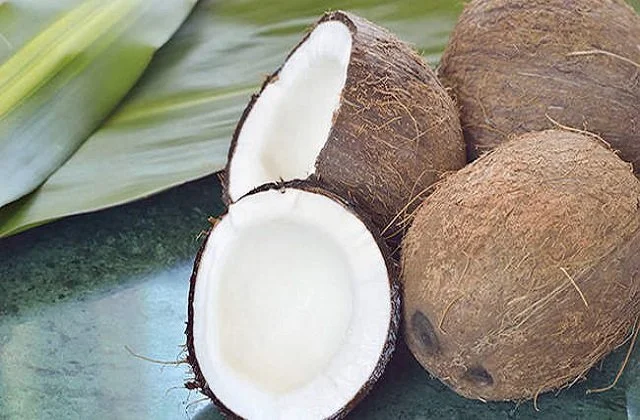
Bhog: Nariyal
The seventh form asks something almost impossible of us: to stop protecting what was never truly ours to keep, to stand still while Kalaratri burns through the accumulated weight of everything we have mistaken for ourselves. If we are willing to meet that fire without flinching, the eighth form brings us to a discovery that no amount of seeking could have delivered without it. Underneath everything that was stripped away, we were already this. Already whole. Already luminous. Mahagauri is not the reward that follows suffering. She is what suffering, endured with full awareness, finally uncovers.
The Puranas hold this teaching in a form worth understanding. After the fierce battles fought through her many forms, the darkness that Kalaratri had embodied did not simply vanish. When Shakti immersed herself in sacred waters, that darkness separated from her entirely and manifested as Kaushiki, a force in her own right, capable of her own work in the world. What this encodes is precise: the darkness we move through in genuine inner work does not need to be destroyed or denied. Transformed, it becomes its own kind of power. What remains after that transformation, washed and revealed, is Mahagauri, radiant as the moon, as the conch, as the kunda flower, fair not because she avoided darkness but because she went all the way through it and came out as herself. Kalaratri cracked the Sahasrara open. Mahagauri is the light that floods in. They are not opposites. They are the two faces of the same threshold.
She is called Shwetambardhara, the one who wears white. Her form carries four arms: the abhaya mudra that dissolves fear, the vara mudra that grants every boon, the trishul that cuts through the three sources of suffering, and the damaru whose two-sided rhythm is the oldest symbol in Shaiva cosmology for the pulse within which creation and dissolution are held as one. She sits on an eight-petalled lotus, each petal opening in one of the eight directions of consciousness, a map of awareness that has released its contractions and expanded fully into the present. Her connection to the moon is not incidental. The moon governs the mind in Vedic understanding, its tides of thought and emotion, its capacity for both restlessness and stillness. Mahagauri's lunar radiance is understood to calm what the fire of the previous days has stirred, restoring the clarity that only becomes available after everything false has been burned away. Her mount is the white bull, and the seers placed this detail with great precision: the journey began on day one with Shailputri also riding the bull. The same symbol returns on the eighth form, but everything it carries has been transformed. This is not repetition. It is the spiral nature of genuine inner work made visible. We return to what we began with, but from a height that makes even the familiar unrecognisable.
The colour of her day is pink, and this too is deliberate. Not the red of Katyayani's battlefield, not the cold abstraction of pure white, but the precise point where fire meets tenderness, where strength blooms into compassion. Pink is not a soft colour in this context. It is what happens when the heat of the entire journey begins to flower.
Among the living traditions woven into her worship is Kanya Pujan, in which prepubescent girls are invited into the home and honoured as living embodiments of the Goddess herself. The theological precision of this practice is worth sitting with carefully. The prepubescent girl embodies Mahagauri's particular quality of energy: complete within itself, whole before the world has asked it to be otherwise. To serve her, to bow before her, to feed her before feeding ourselves, is to recognise the divine not in the distant or the abstract but in the living, present, entirely undefended form before us. It is also, quietly, one of the most radical statements any civilisation has ever made about the inherent sanctity of the feminine at every stage of her life.
The bhog offered to Mahagauri is nariyal, the coconut, among the most symbolically complete objects in the entire ritual language of Sanatan Dharma. Its outer shell is hard, fibrous, sealed entirely, revealing nothing of what it holds within. Inside that armoured exterior are two gifts: the jal, water that is transparent, sweet, and pure, and the white flesh, dense and nourishing, entirely protected by what surrounds it. To break a coconut before the Goddess is a precise ritual act: break the outer, the defended, the armoured, so that what is pure and clear inside can finally be offered. Mahagauri receives the coconut because she is this teaching made visible. After everything the journey has held, she stands luminous from within, undefended, transparent, whole. Nothing hidden. Nothing armoured. The tradition says this offering dissolves accumulated sin and draws to the devotee both worldly grace and spiritual liberation simultaneously, because Mahagauri's deepest teaching is that these two were never in opposition. When the shell is broken completely, when what is inside is genuinely clear, the world and the divine are revealed as the same light seen from different distances.
Day Nine… Siddhidatri: The Culmination
Bhog: Til
We began this journey at the root. At the Muladhara, the base of the spine, the seat of the earth element, the place where Kundalini Shakti lies coiled and dormant in most human beings like a sleeping serpent, carrying within her the compressed potential of everything we could ever become. Shailputri held a half-bloomed lotus in her hand. It was just beginning. The whole journey of the Navdurga is the map of that lotus, moving upward through every centre of consciousness, through every quality the Mother has shown us, until it arrives here, at the ninth form, at Siddhidatri, who does not govern a single chakra because she represents the integration of all of them, the complete circuit from Muladhara to Sahasrara closing into wholeness. She is not the destination of one energy centre. She is what becomes possible when every centre has been awakened, purified, and offered back to the source.
That fully opened lotus is what Siddhidatri sits upon.
Her name carries its meaning precisely: siddhi is the complete flowering of human potential, every capacity latent within consciousness brought to its fullest expression, and datri is the one who bestows it. She holds four objects, the gada, the chakra, the shankha, and the lotus, and she rides a lion, but her posture is not that of a warrior or an ascetic or a mother or a burning dark goddess. She simply sits. In absolute stillness. In the completion that has no anxiety in it, no reaching, no becoming. Only being.
The tradition records that even Shiva, the supreme consciousness, the destroyer of worlds and the greatest of all yogis, worshipped Siddhidatri. Through her grace, he became Ardhanarishvara, the form that is simultaneously half-Shiva and half-Shakti, the right side masculine and the left side feminine, not divided but unified in a single body. This is the final and perhaps the most radical philosophical statement of the entire Sanatan worldview: the universe is not made of opposites at war. Purusha and Prakriti, consciousness and energy, stillness and movement, masculine and feminine are not enemies and not merely complements. They are two aspects of a single reality that was never actually divided. Ardhanarishvara is not a metaphor. It is a precise map of what becomes visible when the circuit completes: the apparent duality of existence resolves, not into the victory of one side over the other, but into the recognition that the division was always only apparent. And it is the feminine, Siddhidatri, who bestows this recognition even upon the greatest of the gods.
Siddhidatri is said to possess and bestow 26 distinct siddhis, among them the eight named in the Deva Bhagavata Purana: Anima, the capacity to become infinitely small; Mahima, the capacity to expand without limit; Garima, the capacity to become infinitely heavy; Laghima, the capacity to become weightless; Prapti, the capacity to reach anything; Prakamya, the fulfilment of every intention; Ishitva, absolute mastery; and Vashitva, the capacity to bring all things into harmony. A physicist might recognise in this list something that sounds like a description of mastery over the fundamental forces of nature. Whether these siddhis are literal capacities or precise descriptions of states of consciousness that simply have no other language available to them, the tradition is insisting on something that most modern frameworks are only beginning to approach: human consciousness, at its most expanded, operates by different laws than human consciousness in its contracted everyday state. The Navdurga is the map of how to move from one to the other.
Her planetary correspondence is Ketu, the most esoteric of the nine grahas, the planet that governs dissolution of ego, severance from material attachment, and the final turning of awareness toward liberation. Ketu cuts what no longer belongs to us. In the Jyotish tradition, a strong Ketu in a chart is not comfortable, but it is the signature of a soul moving toward something the material world cannot contain. Siddhidatri, governed by this most inward-pointing of planets, sits at the end of the nine-form sequence and asks only this: are we ready to stop being only what the world has told us we are?
Her 64 divine attendants, the Chausath Yoginis, surround her, and the number is not incidental. In the cosmology of Tantra, 64 is the square of 8, and 8 is the number that appears at every foundational layer of Sanatan understanding: the eight directions of space, the eight siddhis, the eight Ashta Matrikas, the eight limbs of yoga, the 64 arts of the Chausath Kalas. The Chausath Yoginis arise from the eight great Matrikas, each manifesting into eight further Shaktis, producing a complete matrix of 64 distinct frequencies of feminine cosmic energy, covering every expression of Shakti from the most gentle and nourishing to the most fierce and transformative. Together they map the entire universe of feminine power, nothing excluded, nothing ranked above another. The temples built for them across ancient India were circular and open to the sky, the 64 Yoginis arranged around the circumference, all facing inward toward a central Shiva.
The feminine does not stand at the periphery of the sacred. She surrounds it, holds it, and makes it possible.
The colour of her day is sky blue, the colour of the infinite, of space without boundary, of consciousness that has released every contraction and expanded into what it always was beneath the weight of its own accumulations.
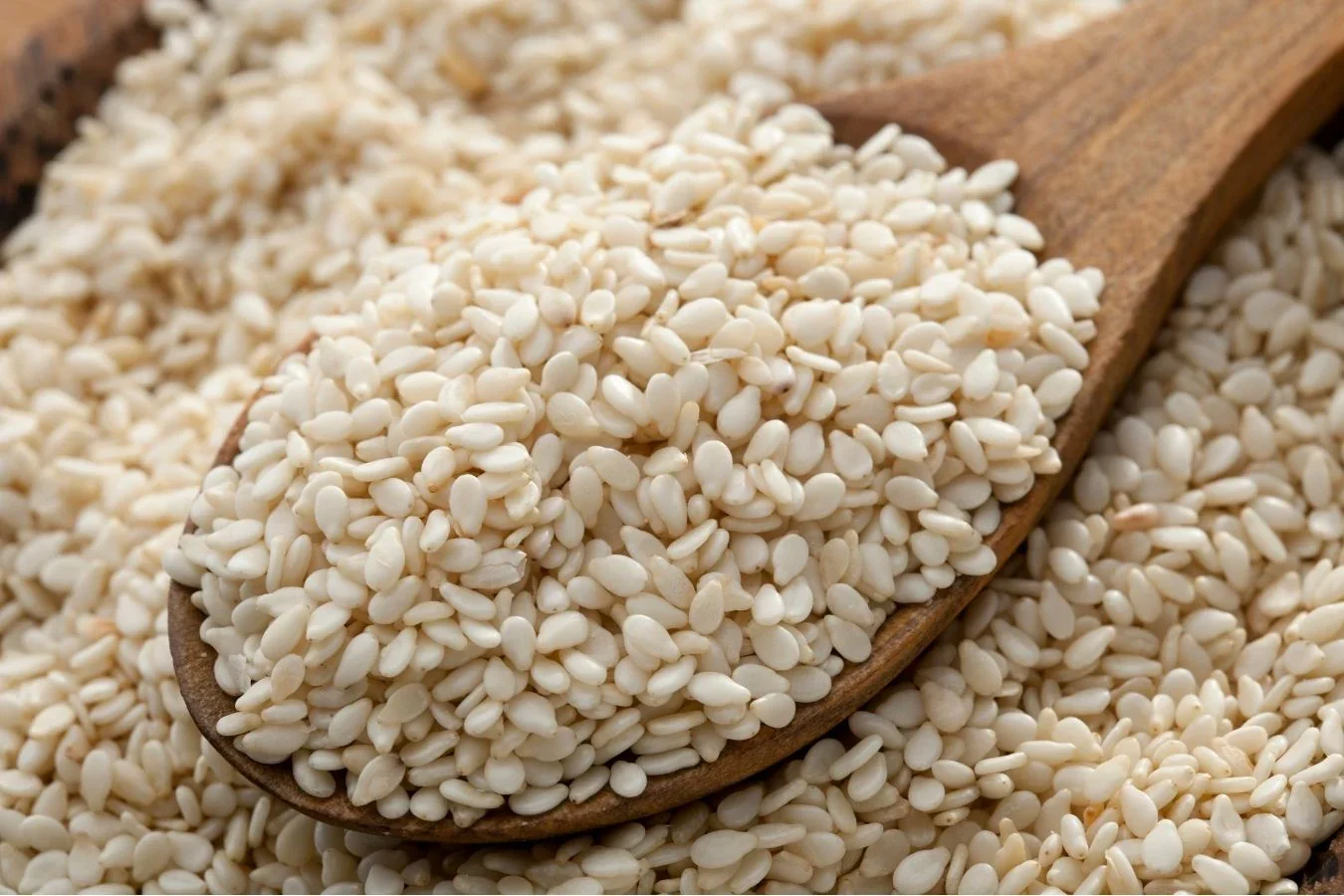
The bhog offered to her is til, sesame, and it is the most quietly extraordinary of all nine offerings. The sesame seed is almost invisible, small beyond reckoning, easily overlooked. Press it and it yields an oil of extraordinary density, used in Ayurveda as the primary vehicle for ojas, the subtle essence that underlies vitality, immunity, and spiritual luminosity, the substance that carries healing where nothing else can reach. Til is also the seed most present in pitru ceremonies, the rites for the departed, because it is understood to carry concentrated prana across the threshold between states of being. To offer sesame to the Goddess who bestows every siddhi is to offer the ultimate teaching of the entire sequence in a single small seed: the greatest potential is the most compressed. The infinite, as Sanatan philosophy has always known, does not announce itself. It waits, coiled and quiet, to be recognised by the being who has genuinely understood what this map is pointing toward.
The bud that was half-unfurled on the first day holds within it the potential to bloom into a thousand-petalled lotus. The Kundalini that lay coiled at the root carries within her the knowing of where she was always meant to rise.
The map does not end here. What it points toward is the work of a lifetime, perhaps many.
The Recognition
No civilisation in recorded human history has achieved what Sanatan Dharma has: the transmission of its most profound understanding of consciousness, of nature, of the feminine principle, of the architecture of human transformation.... not only through texts, but through living practice, through festival, through ritual, through the bhog placed before the Goddess in the quietest corner of the most ordinary household, across an unbroken continuity of thousands of years.
Nine nights of colour, song, and offering.... celebrated across the subcontinent, regardless of how much philosophy one knows.... carry within them a complete science of inner evolution that much of the world is only now beginning to find language for.
This is not mythology.
This is not superstition.
This is one of the most sophisticated acts of civilisational preservation ever devised.
And there is something more.... something that distinguishes Sanatan Dharma from nearly every other major tradition. The feminine here is not an afterthought. She is not a consort, not a support, not relegated to the background.
She is the source.
The universe, in this worldview, does not merely contain the feminine as one element among many. It arises from her. Adi Shakti, the primordial energy, precedes everything… including Brahma, Vishnu, and Mahesh… who themselves bow to her.
What the Navdurga reveals, at the end of these nine forms, is not a force outside us. It is the awareness that has moved through each of them all along.... burning away what is false, uncovering what is luminous, and finally recognising itself in the stillness of the thousand-petalled crown.
That awareness is not separate from us.
It has never been separate from us.
The seers knew this.
They did not confine it to the Vedas or the Upanishads, accessible only to scholars. They ground it into til, stirred it into kheer, softened it into gur… and placed it into the hands of every ordinary householder… trusting that what they encoded would guide the soul toward its own recognition, even across lifetimes.
In a world still learning how to truly honour the feminine, we are fortunate to be born into a tradition that stands as the oldest, living expression of her sovereignty.
Sri Matre Namah. 🌺