The Thirteenth Jyotirlinga
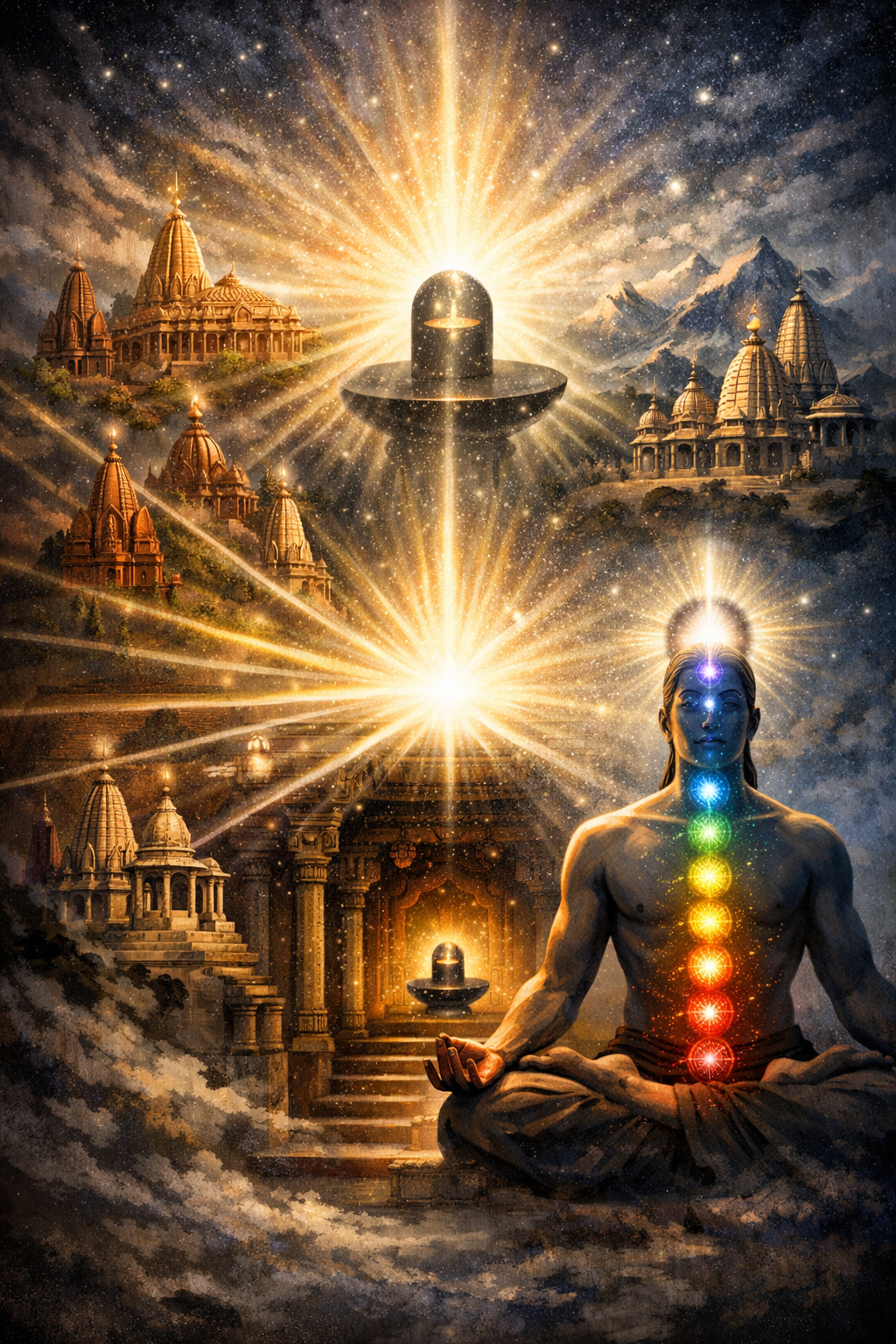
What if I told you there is a Jyotirlinga you have never heard of.
It is not in any scripture's list. There's no temple, no priest, no pradakshina path. And yet every single one of the twelve Jyotirlingas you know... from Somnath to Kedarnath... have been pointing toward it, and only it, since the day they first revealed themselves.
Our tradition does something that I have come to regard as its most sophisticated and most intriguing quality... it hides its deepest truths inside its most familiar forms.
Not to be cryptic. Not to exclude. But because certain truths can only be received by those who have done enough living, enough reading, enough honest sitting-with-themselves to recognise what they are looking at when it finally appears. Our seers understood that a truth handed to someone who is not yet ready for it does not illuminate... it merely becomes another piece of information, filed away and forgotten. So they embedded the most radical things inside the most ordinary vessels. The Gita was delivered on a battlefield. The Upanishads were spoken in forests, in whispers, to those who had walked far enough to earn the hearing. And the truth at the heart of the Jyotirlinga tradition... perhaps the most intimate truth... was handed hidden in a code.
What if I told you... the twelve Jyotirlingas you have been hearing about so far, are not on this earth at all?
Not primarily. Not in the way that truly matters.
Can you imagine... our seers, those extraordinary, precise, uncompromising minds who built one of the most sophisticated knowledge systems the world has ever known... may have encoded within the geography of twelve sacred sites a map so intimate, so personal, so shockingly specific to you, that the moment you truly understand it, every pilgrimage you have ever made might rearrange itself in your memory into something completely different from what you thought it was.
I am a seeker, not a scholar. I carry no authority except the years I have spent sitting with these texts... being humbled by them, being periodically stopped in my tracks by them, and occasionally catching a glimpse of something so quietly extraordinary that I feel an almost urgent need to share it. I have been reading the Maha Shiva Purana, the Vijnana Bhairava Tantra, the Taittiriya Upanishad... not because I understand them, but because I cannot stop.
It took me one year and three months just to read the MahaShiva Purana. Only to read it. Understanding it, I have come to believe, is the work of many more lifetimes than the one I am currently living.
Sometimes, in that reading, something surfaces that feels too important to keep to myself.
This is one of those times. And it begins, as all the best things in our tradition do, not with an answer... but with a question you may never have thought to ask. What is a Jyotirlinga... not geographically, not symbolically, but esoterically? What is it pointing toward? And within whom is that pointing meant to land?
Let's go in. Layer by layer. I promise you... what waits at the centre is nothing like what you may expect to find. Because what waits at the centre has no address. No coordinates. No darshan queue. And yet you have been carrying it with you since the moment you were born.
The thirteenth Jyotirlinga. Let's find out.
∼ ∼ ∼
But before we embark on this journey, let me share why the timing of this essay felt urgent to me in a way I couldn't quite ignore.
Something genuinely beautiful is happening in this country, and I mean that without a trace of irony or condescension. Our young generation is turning back toward its roots... waking at Brahma-muhurta, that luminous hour before dawn, to sit in sadhana or perform yagnas. Learning Sanskrit. Reading the Vedas and Puranas. Volunteering at dharmic gatherings with a selflessness that makes me feel a quiet guilt that I came to all of this so late in my own life. Their bhav is real. The longing is genuine. And witnessing it... young, alive, searching... is the most hopeful thing I have encountered in a long time.
Right in the middle of this reawakening, one particular current is gaining enormous momentum. Hindus... in extraordinary and growing numbers... are making it their mission to complete the circuit of all twelve Jyotirlingas. For the more devoted, the more daring, the horizon extends further still… Kailash Mansarovar, Panch Kedar, Panch Kailash, the great high-altitude pilgrimages of our tradition. Those who have completed the twelve Jyotirlingas are now turning toward the fifty-two Shakti Peethas. The commitment these journeys demand is real. The devotion underneath them is genuine. I do not doubt it for a single moment.
I too was one of these people.
Somewhere in my first year of reading the Maha Shiva Purana, a belief had quietly taken root in me... that I must visit all twelve Jyotirlingas. I would earnestly pray to Shiva to give me the strength and agility to do parikrama of Kailash Mansarovar, my Isht's abode. I genuinely believed that those who made these journeys were somehow the ones upon whom Shiva had truly bestowed His grace... that to be called toward these sites, in some deep and personal sense, was to be chosen by Him. It felt like complete devotion. I did not question it.
My first Jyotirlinga visit happened on Makar Sankranti in Jan 2024... to Kashi Vishwanath... a calling so strong I simply could not ignore it. Almost two years later, in December 2025, to Shri Mahakaal... another calling arrived, unmistakable, from somewhere so deep inside that there was no question of not going. Two Jyotirlinga darshans in two years, each one arriving on its own terms, in its own time.
And then came Omkareshwar. Visited not because of any inner calling but because it was conveniently located near Mahakaal, and the geography made sense. The darshan happened. The pradakshina was made. Back home, I began making plans... Somnatha next, and the nearby Nageshwar Jyotirlinga that could be covered in the same trip. Three done, two on the itinerary. I opened the map. I looked at the logistics.
And somewhere in that mapping out of routes and dates, a question arose that I had not expected and could not put back down once it had surfaced.
Is this how our scriptures specified the Jyotirlinga pilgrimage to be done, or had I absorbed an idea floating in the air around me and, in my earnestness, quietly cloaked it in the robes of ancient wisdom? I went back to the texts to find out and eventually turned to my sadhana to seek answers. And what I found there did not answer the question I was carrying. It dissolved the question entirely... and replaced it with something far more interesting. Something that has been sitting in our scriptures all along, patient and unhurried, waiting for someone to come looking.
Are you ready to go further?
∼ ∼ ∼
So where do we go from here? Let me walk you through the Maha Shiva Purana. Not to the verses most people quote. Not to the familiar stories. But to the part that most people who rush to complete the circuit have, perhaps, never actually read.
The Shiva Purana does not speak of twelve Jyotirlingas.
It speaks of sixty-four.
Sixty-four sites across the breadth of this land where Shiva's presence... jyoti, the light that has no source outside itself, linga, that which points... pierced through the surface of the ordinary world and became perceptible. From those sixty-four, twelve were identified as the most luminous, the Maha Jyotirlingas, the ones we seek today. But the twelve did not arrive in isolation. They were the most radiant expression of a far larger sacred geography, one designed, as I began to understand, with an intention far deeper than any circuit.
Why sixty-four?
In the Shaiva-Tantric tradition, numbers are never arbitrary. They are cosmological declarations. And sixty-four, in this tradition, is the number of complete, total, undivided divine manifestation... the way 108 functions in other streams of our dharma. There are sixty-four Tantras. Sixty-four aspects of Shiva. Sixty-four Yoginis through whom Shakti operates in the cosmos. Sixty-four is not a quantity. It is a statement about wholeness.
Now look at where the twelve most luminous among those sixty-four are placed... from the westernmost shore of Gujarat to the southernmost tip of the subcontinent, from the high Himalayas of Uttarakhand to the forests of Jharkhand... and the intention behind that geography becomes impossible to ignore. In an age without roads or railways, when most people lived and died within a small radius of where they were born, why would a living tradition place its most sacred sites at the four cardinal extremities of this land?
Not so that everyone would journey to all of them. But…
So that no one, wherever they were born in this vast land, would ever be without one.
Each Jyotirlinga was the complete sacred centre of its region. Not a fragment requiring eleven others to be whole. A full, self-sufficient field of Shiva's presence... placed precisely where it was placed so that the infinite would be, in every sense of that word, local.
Within our Jyotisha tradition... our ancient integrated science of astronomy and inner planetary influence... there is a living understanding that each sacred Kshetra carries a specific cosmic correspondence, and that a seeker with a particular planetary condition or karmic configuration might once have been guided toward a specific Jyotirlinga rather than toward all of them indiscriminately. This does not appear as a neat universal table in the Puranas... it lives in the practitioner lineages, passed from Jyotishi to student across generations. But it is real, ancient, and it deepens the understanding that each site was never a generic stop on a generic route.
The most breathtaking documented example is Mahakaleshwara at Ujjain. Ujjain was India's ancient Prime Meridian... not as metaphor, but in the most literal astronomical sense. The Surya Siddhanta, one of the world's earliest astronomical treatises, identifies Ujjain as the reference point from which all Indian astronomical calculation flows. Every traditional Panchang computed to this day uses Ujjain time as its basis. Aryabhatta, Varahamihira, Brahmagupta, Bhaskara II... five centuries of the greatest astronomical minds the ancient world produced... all oriented their work from Ujjain.
And at the precise intersection of India's Prime Meridian and the Tropic of Cancer... the cosmic crossroads of Space and Time itself... our tradition placed Mahakala. The Great Lord of Time. In Jyotisha, Shani governs Kaal, time itself. The Bhasma Aarti performed at Mahakaleshwara before dawn every single day... the Linga anointed with sacred ash, the very symbol of what all time ultimately reduces everything to... is not ritual for its own sake. It is astronomy and spirituality making one precise, unified statement about the nature of existence.
One site. One truth. Complete in itself.
What Ujjain reveals is perhaps the clearest window into how our seers thought about these sites... and similar living understandings exist within the Jyotisha lineage for others as well. Tryambakeshwara at Nashik... seated at the origin of the Godavari, one of the four Kumbh Mela sites... carries a specific understanding connected to Rahu and Ketu, the shadow planets that govern karma and its resolution. The Nashik Kumbh cycle itself is determined by the astronomical configuration of Jupiter in relation to these planets. The site and the sky above it were always understood together. Ancient. Precise. Alive.
What this tells me... and I offer it as a considered inference, not a citation... is that each Jyotirlinga was specific medicine for a specific need. Not a circuit. A pharmacopoeia.
The division into twelve was never meant to create an obligation. It was an act of extraordinary generosity... ensuring that the grace of Shiva was accessible, completely and without diminishment, to every soul on this land who sought Him. And the tradition took that generosity even further. Because what if even travelling to the nearest site was beyond you? What if age, or illness, or the circumstances of your life held you exactly where you were?
The Shiva Purana had an answer for that as well. And it placed that answer inside a four-verse Stotra so universally recited yet most people failed to notice it. The Dvadasha Jyotirlinga Stotra from the Shatarudra Samhita…
सौराष्ट्रे सोमनाथं च श्रीशैले मल्लिकार्जुनम् ।
उज्जयिन्यां महाकालम् ओंकारममलेश्वरम् ॥१॥
परल्यां वैद्यनाथं च डाकिन्यां भीमशङ्करम् ।
सेतुबन्धे तु रामेशं नागेशं दारुकावने ॥२॥
वाराणस्यां तु विश्वेशं त्र्यम्बकं गौतमीतटे ।
हिमालये तु केदारं घुश्मेशं च शिवालये ॥३॥
एतानि ज्योतिर्लिङ्गानि सायं प्रातः पठेन्नरः ।
सप्तजन्मकृतं पापं स्मरणेन विनश्यति ॥४॥
Etāni jyotirliṅgāni sāyaṃ prātaḥ paṭhen naraḥ |
Saptajanmakṛtaṃ pāpaṃ smaraṇena vinaśyati ||
"One who remembers the names of these Jyotirlingas in the evening and morning are absolved of their sins accumulated over seven births."
— Shiva Purana, Shatarudra Samhita
Smaranena. By remembrance alone.
Not by darshan. Not by physical presence at any site. Not by completing any circuit. But by the sincere, conscious, daily act of holding these twelve names in awareness... morning and evening... with genuine understanding of what each name points toward. That, and only that, the Shiva Purana says, is sufficient to dissolve the accumulated karma of seven lifetimes.
Sit with that for a moment. The same tradition that placed twelve sacred sites of extraordinary power and cosmic precision across the four extremities of this land... turned around in the very same breath and made the grace of all twelve available to every soul through remembrance alone. Not as a concession to those who could not travel. As a declaration about where the real journey was always meant to take place. Regardless of age, health, wealth, or the geography of one's birth... the grace of all twelve Jyotirlingas was never withheld from any seeker for a single day of their life. It was always there. Waiting. For the awareness to turn inward.
This is the tradition at its most quietly radical. And it tells us something fundamental about what a Jyotirlinga actually is... not a place that dispenses grace when the feet touch sacred ground, but a name, a form, a pointer... whose real work begins not at the site but within the seeker. The moment genuine understanding takes hold and awareness turns, however briefly, from the outer world toward the inner one.
∼ ∼ ∼
And it was while sitting with exactly that question... turning it over, taking it back to the texts... that something arrived from an entirely different corner of the world. Not from the Shiva Purana this time. From a tradition older, quieter, and in some ways even more precise in the language it uses to describe what lives within us. A text from the Shaiva world… the Thirumandiram... one of the most revered scriptures of the Tamil tradition, composed by Thirumoolar, one of the eighteen Siddhas... a text of such precision and depth that it continues to humble scholars centuries after it was composed... contains a verse in its scholarly translations that I was entirely unprepared for.
“Sixty and four are the instruments that tempt the individual soul.
Sixty and four are the divisions within the soul.
Sixty and four are the chambers of the soul’s chakras.
Sixty and four... where Shiva–Shakti reside.”
... Thirumandiram, Thirumoolar
Sixty-four are the chambers of the soul's chakras.
The inner subtle architecture of the human being... the map of consciousness within us... is described in this Siddha tradition as containing sixty-four energy chambers. The same number that several Shaiva traditions associate with the fuller landscape of Jyotirlinga manifestations described in the Shiva Purana, far beyond the twelve that later became widely established in popular worship.
The number itself is not unfamiliar within Shaiva cosmology. Across Tantric and Siddha traditions the universe is often articulated through sets of sixty-four... sixty-four Yoginis, sixty-four Kalaas, sixty-four arts, sixty-four forms of divine expression... a symbolic language through which completeness and total manifestation are expressed.
And here it appears again... once in the sacred geography of the outer world, and once in the subtle geography of the human being.
I sat with this for a long time. Because if sixty-four is the number through which Shiva's presence unfolds across the sacred landscape, and sixty-four is also the number through which the subtle body expresses its inner chambers of energy... then the map of Shiva outside and the map of Shiva within are not two different maps. They are the same maps, drawn at different scales.
And now notice something further.
The sixty-four Jyotirlinga manifestations, as preserved in certain Shaiva traditions, are said to be spread across the entire breadth of the sacred land... north, south, east, west, and everywhere between. In precisely the same way, the sixty-four energy chambers of the subtle body are distributed throughout the entire human form... not confined to a single axis but woven across the whole field of being.
But the twelve Maha Jyotirlingas... the twelve that became the central axis of pilgrimage... appear to mirror something different.
They resemble the twelve principal chakras described in certain yogic and Tantric traditions along the Sushumna Nadi... the central channel of the subtle body. A single vertical line of ascent from the base of the spine toward the crown and beyond. The most direct inner pathway.
The spine of the inner journey.
Seen this way, the seers appear to have mapped two things simultaneously. They mapped the completeness of Shiva's presence across the entire manifest world onto the completeness of the subtle body in all its breadth. And then they distilled that vastness into a more direct inner ascent.
Sixty-four for the whole. Twelve for the path.
And then something stopped me entirely.
Sitting with the Taittiriya Upanishad... one of the most ancient of the principal Upanishads, belonging to the Krishna Yajurveda... I encountered another pattern that I had never consciously placed beside the Jyotirlingas before.
The text described the layered principles through which human existence unfolds... Brahman, Maya, the jiva... the individual soul... the mind, the intellect, the subconscious, the ego, and the five Panchamahabhutas... earth, water, fire, air, and ether.
Twelve in all.
And suddenly something became impossible for me to ignore.
There are also twelve Jyotirlingas.
I had never seen the two placed side by side before. Yet the moment the thought appeared, it felt less like a discovery and more like a recognition... as though something that had always been whole had simply waited until I was ready to stop seeing it as two separate things.
The complete philosophical anatomy of a human being... every layer of existence, from the cosmic to the elemental... each one reflected in a Jyotirlinga.
The twelve sacred sites distributed across this land are not only a map of Bharat.
They are a map of what you are.
The outer pilgrimage and the inner journey were never two different journeys. They were always one... drawn on two different surfaces so that every seeker, at whatever level of readiness they arrived, would find a way in.
To visit a Jyotirlinga without knowing this is to stand before a mirror and look only at the frame.
∼ ∼ ∼
Now here is what the Taittiriya Upanishad says...
It describes the human being as five concentric sheaths... the Pancha Koshas... each subtler than the last, each containing the next the way a flame contains its own light.
The outermost is the Annamaya Kosha... the physical body, the flesh and bone you were born into. Within it, the Pranamaya Kosha... the vital breath, the animating force that makes the body alive rather than merely matter. Subtler still, the Manomaya Kosha... the mind, the restless world of thought and emotion that most of us spend our entire lives mistaking for who we actually are. Deeper, the Vijnanamaya Kosha... the intellect, the discriminating intelligence that can begin to perceive what is real from what is merely appearing... and within it, lodged at its very core, the ahamkara... the ego, the intellect's deepest contraction, the fixed sense of I that the mind has spent an entire lifetime building and now, at this threshold, is being asked to relinquish. And at the innermost threshold... the Anandamaya Kosha... the bliss body, the last and most subtle veil before the Self itself stands unveiled.
Five sheaths. Each one a layer you must pass through to reach what lies at the centre.
Think of the last time you walked into a large, ancient temple. You did not walk from the street directly into the presence of the divine. The temple does not permit it. You passed first through the outer gopuram... the great gateway, the threshold between the world you had come from and the world you were entering. The open courtyard followed, where the noise of ordinary life began to recede. The mandapam next, the pillared hall, where the light changed and the air carried the residue of countless archanas. And then the antarala... the narrow vestibule, a passage so deliberately constricted that the ordinary world simply cannot fit through it. You had to leave it all outside. And only then could you finally enter... the innermost sanctum... the garbha griha. The womb chamber. Small, dark, absolute. Where the Jyotirlinga burns in near-darkness and you stood, stripped of everything the journey in had asked you to relinquish, before the light.
Now see what you just walked through.
The gopuram is the Annamaya Kosha... the body arriving, crossing from the ordinary world into the sacred one. The courtyard is the Pranamaya... where breath begins to slow, the vital energy shifts register as the noise of ordinary life recedes. The mandapam is the Manomaya Kosha... the mind releases its grip on the everyday, the noise, the chaotic thoughts, all of it beginning to quieten. The antarala is the Vijnanamaya Kosha... and at its core, the ahamkara, the ego... that most ancient and most stubborn sense of I, which has survived every outer threshold intact, which has understood everything the journey has offered, and which now stands at this deliberately constricted passageway facing the one demand it was never built to meet: to step forward and dissolve even itself. Free of the aham, the I, you step into the garbha griha... stripped of all that was you in a small, womb-dark chamber... the Anandamaya Kosha. The last veil. The threshold beyond which nothing remains between you and the light. The absolute.
I have walked into these temples my entire life. Just as you too must have. And I wonder if you noticed... because I certainly did not... that every single time we cross those thresholds, we are walking the map of our own inner being. That the architects who built these spaces and the seers who mapped the human being in the Taittiriya were not working in separate disciplines. They were encoding the same understanding in two different languages... philosophy and stone... so that the teaching would be impossible to miss. So that the body itself would learn it, threshold by threshold, long before the mind grasped the meaning of the verses.
∼ ∼ ∼
The Mandukya Upanishad... that most concentrated of all our scriptural texts, which Shankaracharya held to be sufficient for liberation on its own, and which contains, with a precision that feels almost deliberate, exactly twelve verses... names this awareness directly. It describes four states through which every human being moves without exception: Jagrat, the waking state. Swapna, the dream state. Sushupti, dreamless sleep. And then Turiya... the fourth... which the Upanishad refuses to define except in negatives. Not waking. Not dreaming. Not sleeping. Not conscious of objects. Not unconscious. Tranquil. Auspicious. Without a second.
That is the Self. That is the awareness the entire tradition has been pointing toward... since the very first seeker sat before the very first flame and asked what it was.
Now hold both maps together. The Pancha Koshas move inward... from body to breath to mind to intellect to bliss... layer by layer, threshold by threshold, the way you move through a temple. The four states move deeper... from waking to dreaming to the stillness beyond dreaming... until Turiya is all that remains. Two maps. Two directions of the same journey. And where they arrive... where the innermost Kosha dissolves and Turiya stands... is not a place. It is the awareness that was present through every state, holding every layer, unchanged through every threshold. The garbha griha of your own being. The light you cannot see because you are it. The light that has never once... not for a single breath of your life... been absent.
∼ ∼ ∼
And then there is the Vijnana Bhairava Tantra.
Described by Abhinavagupta... perhaps the greatest philosophical mind in the entire history of Kashmir Shaivism... as the Shiva-Jnana-Upanishad, the esoteric doctrine for the direct knowledge of Shiva. This is among the most carefully protected and most precisely constructed texts in the entire Shaiva canon. And in verses 28 and 29, it describes something that stopped me entirely the first time I encountered it.
A twelve-chakra system within the human subtle body. Kundalini Shakti... the divine energy our tradition says lies dormant at the base of every human being's spine... rises through each of the twelve chakras in succession. Not gradually. Not partially. The text uses one specific image: lightning.
उद्गच्छन्तीं तडित्रूपां प्रतिचक्रं क्रमात्क्रमम् ।
ऊर्ध्वं मुष्टित्रयं यावत्तावदन्ते महोदयः ॥२९॥
Udgacchantīṃ taḍitrūpāṃ praticakraṃ kramātkramam |
Ūrdhvaṃ muṣṭitrayaṃ yāvat tāvad ante mahodayaḥ ||
"Rising like lightning through each chakra in succession... twelve finger-widths above, at the culmination: the Great Dawn." — Vijnana Bhairava Tantra, Verse 29
The culmination... twelve finger-widths above the crown of the physical head... is called the dvadashanta. Literally: the end of the twelve. The point beyond which there are no more layers, no more sheaths, no more stations on the inner journey. Only the Maha Udaya. The Great Dawn. What the Mandukya calls Turiya. What the Shiva Purana calls Jyoti.
I want to be honest about what I am offering here and what I am not. I have not found a scripture that draws a direct one-to-one map between each of the twelve Jyotirlingas and each of the twelve chakras within the subtle body. I will not present what I have not found. What I can say is that the same tradition, across multiple texts written across multiple centuries, consistently uses the same numbers, the same frameworks, the same cosmological language to describe the outer sacred geography and the inner subtle geography simultaneously. Sixty-four chambers within the subtle body. Sixty-four sites across the sacred geography of this land. Twelve principles of existence mapped inside the human being. Twelve Maha Jyotirlingas distributed across the breadth of Bharat. Twelve chakras culminating at the dvadashanta within the spine of the seeker. Twelve sites pointing toward the same self-luminous light across the spine of this civilisation.
The outer sacred landscape and the inner subtle landscape were always mirrors of each other. Any sacred geography our seers established was never only about the earth. It was always, simultaneously, about the human being standing on it.
And where these two geographies converge... where the innermost Kosha dissolves and the final chakra is transcended... what remains is not an achievement. It is a recognition. The falling away of the one who was seeking into the light that was always already here. Not the absolution of karma. Liberation. What every Jyotirlinga, from the first to the twelfth, was always and only pointing toward.
∼ ∼ ∼
And so we arrive... finally, at the title our essay has been holding since its inception.
The thirteenth Jyotirlinga.
There is no thirteenth. Every person who knows anything about this tradition knows this with complete certainty. Twelve constitute the shloka. Twelve are established. Twelve are, by the reckoning of the Shiva Purana itself, the most luminous expressions of Shiva's self-revealing presence on this earth. The number is whole. The number is complete.
And yet.
Each of those twelve bears the name Jyotirlinga... jyoti, the self-luminous light, and linga, that which points. Whatever form of Shiva a site enshrines, the category to which all twelve belong declares, in its very Sanskrit, that each one is not a destination but a pointer. Something that by its nature gestures beyond itself, toward something it cannot contain, something it is not itself but only reflects.
Twelve pointers. All twelve... from Somnatha to Kedarnath, from the sea to the summit... pointing in the same direction.
Inward.
Toward the twelve principles of existence that the Taittiriya Upanishad maps inside the human being. Toward the twelve chakras that the Vijnana Bhairava Tantra traces along the inner subtle body. Toward the dvadashanta... the end of the twelve... where the Great Dawn breaks. Toward Turiya, the self-luminous fourth that the Mandukya Upanishad names as the Self: tranquil, auspicious, without a second.
The thirteenth Jyotirlinga is the one all twelve are pointing toward.
It has no temple. It has no geography. It cannot be reached by road or rail or air or altitude. It does not require a permit or a Panchang muhurta or a pradakshina path. It has never... not for a single breath of your life... been absent from you.
It is the awareness within you. The self-luminous light by which you are reading these very words right now. The one that illuminates every thought, every feeling, every perception... present before your first awareness each morning, present after your last thought each night, unchanged through waking and dreaming and deep sleep and every moment in between. The one you have been looking through, at everything and everyone and every sacred site you have ever stood before, your entire life.
The Mandukya Upanishad calls it Turiya. The Vijnana Bhairava Tantra calls the moment of its recognition the Maha Udaya... the Great Dawn. The Shiva Purana calls it Jyoti. And the twelve sacred sites distributed across this land with such deliberate, loving, geographic precision have been saying something else entirely... in the only language that never lies: Come. Come closer. Come inside.
This is what a Jyotirlinga actually is. Not a temple. Not a coordinate on a map. A mirror. And what every single one of the twelve has always been reflecting... since the tradition first placed them where it placed them... is not the deity on the altar.
It is you. The seeker standing before it. The awareness looking through the eyes performing the darshan.
∼ ∼ ∼
None of this is a discouragement from pilgrimage. I want to say that with complete clarity and complete warmth. If the calling is real... go. Go with everything you have. But go knowing what you are actually walking toward. Read about each site before you arrive. Understand what layer of existence it illuminates. Arrive prepared not merely to collect an experience but to allow something in you to be seen... by what you are standing before.
And if you cannot travel... if health, or age, or the honest demands of this life hold you exactly where you are... know that the Shiva Purana's own prescription is already in your hands. The Dvadasha Jyotirlinga Stotra, recited morning and evening with awareness. The practice the tradition placed at the very heart of this entire yatra... inner remembrance, done daily, with consciousness and sincerity. Because what all twelve have been pointing toward is accessible from wherever you are sitting right now. It always has been.
I am still reading. Hopefully, I always will be. One year and three months only to read the Shiva Purana... and that was only to read it. The more I understand, the more I recognise how much further this tradition extends than I can even fathom, and how little I actually know. Our seers left nothing hidden from those willing to look. They placed the most intimate map inside the most public pilgrimage. Everything is there. Everything has always been there. We simply got busy visiting the pilgrimages, completing the circuit, rather than pausing and looking at what they were always pointing at.
All I ask... of you and of myself... is that we bring to our scriptures the same sincerity we bring to our journeys. That we read before we follow. That we sit with what we find. That we arrive at our own understanding... not borrowed, not inherited, not absorbed from the air around us, but genuinely, irreversibly, ours.
For when that understanding arrives... you will have already done darshana of the Thirteenth.
The only one that was ever calling your soul.
Sources & References
Shiva Purana — Shatarudra Samhita and Kotirudra Samhita: Primary source for the sixty-four Jyotirlingas, the twelve Maha Jyotirlingas, and the Dvadasha Jyotirlinga Stotra with its concluding verse on smaranena.
Taittiriya Upanishad (2.1–5), Krishna Yajurveda: Source for the Pancha Kosha framework and the twelve principles of existence traditionally associated with the twelve Jyotirlingas.
Mandukya Upanishad (12 verses), Atharvaveda: The four states of consciousness and Turiya as the self-luminous, non-dual fourth. Shankaracharya's Mandukya Karika consulted.
Vijnana Bhairava Tantra (c. 850 CE), Verses 28–29: The twelve-chakra system, the dvadashanta, and the Maha Udaya. Trika school of Kashmir Shaivism. Translations by Christopher Hareesh Wallis (Tantra Illuminated, 2013) and Jaideva Singh (Motilal Banarsidass, 1979) consulted.
Thirumandiram by Thirumoolar, Verse 1418: The sixty-four chambers of the soul's chakras. Shaiva Siddhanta tradition, Tamil Nadu.
Surya Siddhanta (4th–5th century CE): Ujjain as India's astronomical Prime Meridian and the basis for all traditional Panchang calculation.
Aryabhattiya (Aryabhatta, 499 CE); Brihat Samhita (Varahamihira); Siddhanta Shiromani (Bhaskara II, 1150 CE): Five centuries of Indian astronomical tradition oriented from Ujjain.
Nashik-Trimbak Kumbh Mela and Tryambakeshwara's Jyotisha associations with Rahu-Ketu: Living practitioner lineage tradition.