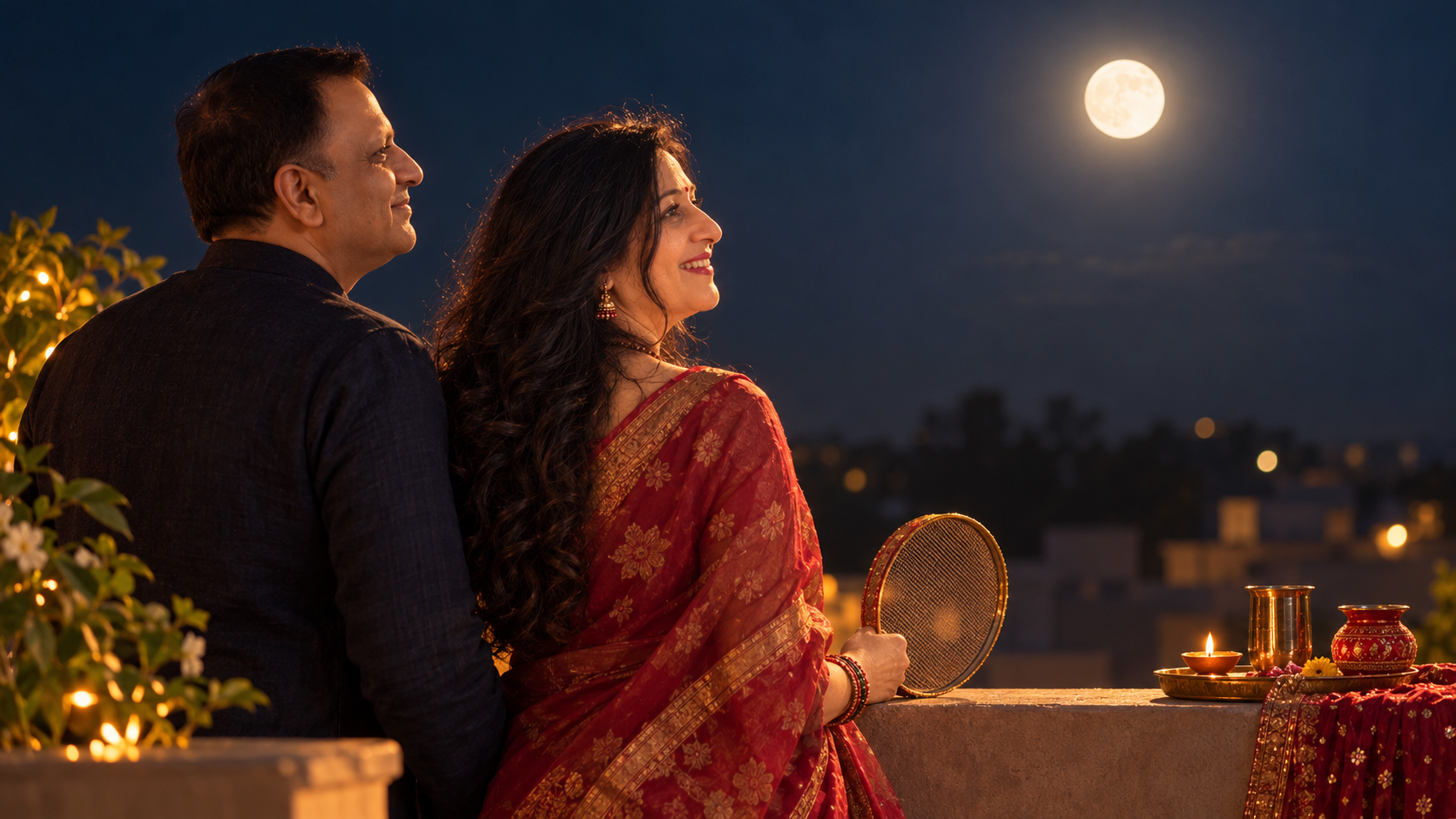
What Has the Moon Got to Do with Love?
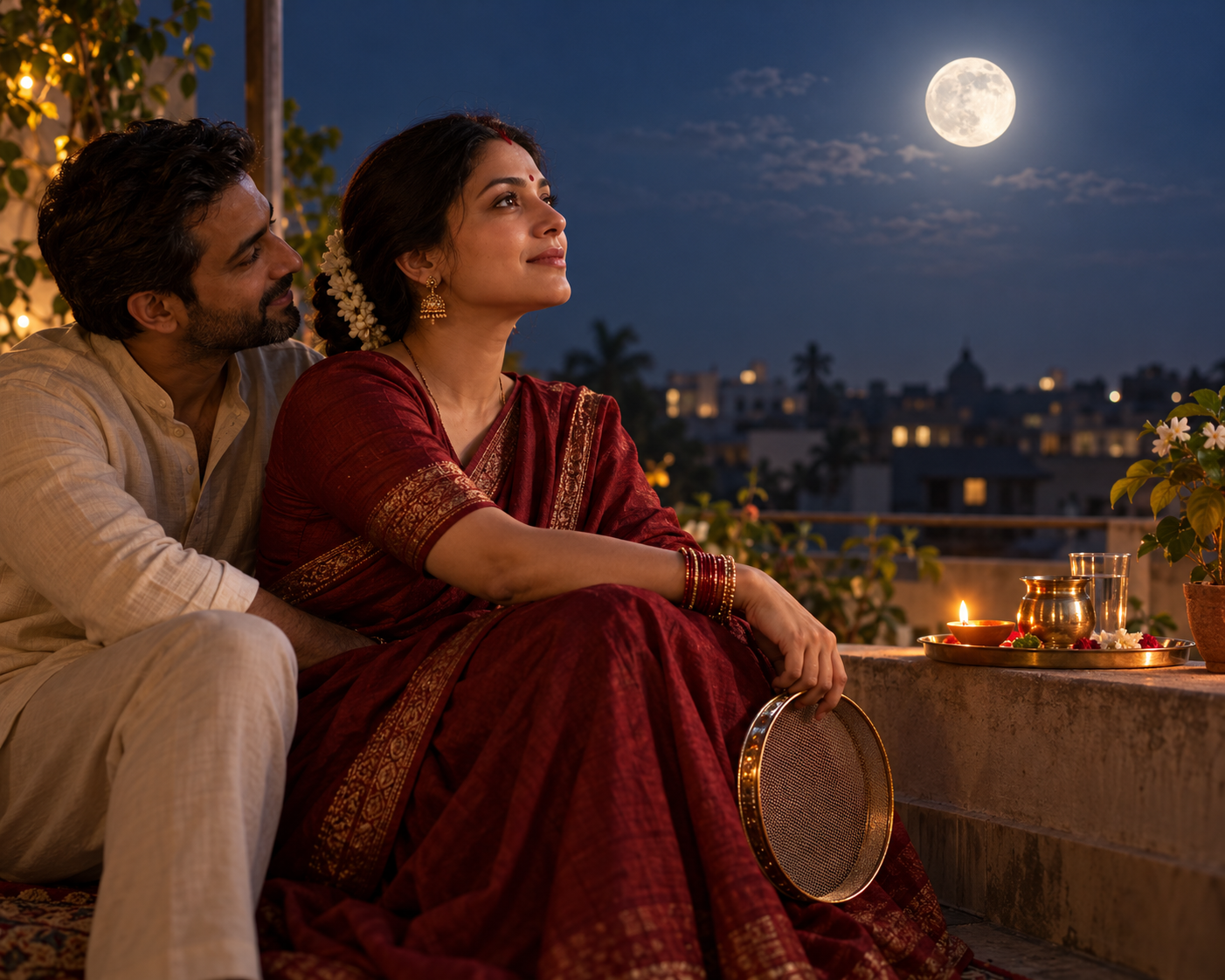
Somewhere between devotion and tradition, did we teach women to fear for the lives of the men they love?
A young woman named Veeravati had been fasting since sunrise. As hunger and thirst weakened her, her seven brothers, unable to bear her suffering, contrived a moon where there was none. A lamp placed behind the branches of a tree was made to resemble the rising moon, and Veeravati, believing what she saw, broke her fast. The consequence was devastating: her husband died.
The story, familiar to generations of women celebrating Karwa Chauth, eventually ends with prayers, penance, divine intervention and the restoration of her husband's life. Different regions tell it differently, but the warning remains remarkably consistent: a woman's failure to complete her fast could cost her husband his life.
Imagine the weight of that thought upon a young bride's heart, tucked beneath the silk of her sari, hidden amongst clinking bangles and the fragrance of freshly applied mehndi. Now imagine generations of women carrying it without ever quite recognising its weight.
I wonder how many of us have.
For years, Karwa Chauth felt like a scene straight out of a Bollywood romance, except that the heroine had to do considerably more work than simply look beautiful. There was the predawn sargi, the sleepy heads around the table, the excitement of choosing what to wear, and the women gathering with decorated thalis, their voices rising together in songs their mothers had sung before them.
Veero kudiye karwara...
There was laughter, companionship and that interminable wait for the moon, punctuated by repeated visits to the terrace and hopeful inspections of the sky. By evening, even the most devoted among us had begun treating the moon like an exceptionally inconsiderate guest who knew everyone was waiting but was in no particular hurry to arrive. When someone finally announced, Chand nikal aaya hai, the relief was almost as palpable as the excitement.
I would lift the sieve, find the moon through its delicate mesh and then turn towards the man I had married. After a day's fast, that first sip of water from his hands, the familiar eyes meeting mine, held an undeniable tenderness. I remember describing the moment years ago as drinking the love in his eyes along with the water, and I meant every word.
Yet somewhere beneath that affection lingered a question I had learned to ignore: Could my hunger really lengthen his life, or was it simply one of the many beautiful ways we had learned to express our love?
I began wondering why a prayer for a husband's well-being had come to be associated so closely with a wife's willingness to endure hunger and thirst. Surely a marriage draws its strength from the care two people extend to one another throughout the year, not merely from an observance performed on a particular day. And what of the countless loving marriages in communities where Karwa Chauth has never been celebrated? Could love, or the blessings of married life, really be measured by a ritual that was never universal to begin with?
Traditions have a peculiar way of making enquiry feel like disloyalty, as though questioning a ritual somehow diminishes the affection with which our mothers performed it. But faith, I have come to believe, should possess enough strength to endure a question.
So I went looking, not to dismiss Karwa Chauth, but to understand it.
In the Narada Purana, Purva Bhaga, there is a description of Karaka Vrata, observed on the fourth day of the waning moon in Kartika. The observance involves bathing, adornment, worship of Ganesha, offerings of food and gifts, followed by an offering of water to the moon before the fast concludes. It is associated with saubhagya, the blessings of married life.
What intrigued me was not merely what the passage prescribed, but what it did not. There was no Veeravati, no husband standing behind a sieve, and no elaborate moonlit ceremony resembling the one I had grown up celebrating. The text also describes the possibility of formally concluding the observance after twelve or sixteen years, although lifelong observance is mentioned.
This did not invalidate the Karwa Chauth I knew. Living traditions are rarely frozen inside a single text; they gather stories, gestures, songs and local customs as rivers gather tributaries. But it did suggest that the tradition we have inherited is not one indivisible, unalterable command descending unchanged from antiquity. It is a tapestry woven over time, with scripture providing some threads and generations of women adding countless others.
And we are entitled to explore those threads.
I found myself returning to Veeravati, this time less interested in the miracle that restores her husband than in the emotional architecture of the story itself. A woman is suffering, her loving brothers are distressed by her ordeal, and when they intervene through deception, she bears the consequences. Her hunger becomes her responsibility, her husband's life becomes her responsibility, and even the consequences of someone else's actions become hers to endure.
Certainly, the tale celebrates perseverance and faith. But beneath its devotional surface lies a more troubling suggestion: that a woman's smallest lapse might endanger the person she loves most.
And fear, when wrapped in sacred language, can survive for centuries without being recognised as fear.
This is why it troubles me when a woman apologetically says she cannot fast because she is unwell, or when an elderly woman worries that taking medication with water might invalidate her observance. When a pregnant woman feels compelled to seek permission to nourish herself, surely something deserves reconsideration. Who taught us that devotion must sometimes be demonstrated by disregarding the very body through which we offer it?
The irony is difficult to ignore. We invoke Parvati, the great Shakti, the feminine principle without which Shiva himself is incomplete, yet risk teaching ordinary women that their own well-being is negotiable while their husband's is sacred. Surely Shakti signifies not merely the strength to endure suffering, but also the wisdom to recognise when suffering serves no purpose.
There is, after all, a profound difference between tapas, austerity consciously undertaken, and an ordeal endured because one fears the consequences of refusing it. One may deepen awareness; the other may merely deepen anxiety.
I do not believe every woman who fasts is motivated by fear. Many undertake the day joyfully and willingly, and I have been one of them. There is tenderness in setting aside a day to honour someone you love, just as there is an extraordinary sense of belonging in women's rituals. Those circles of women have preserved far more than religious observances; they have carried friendships, memories, humour and an entire vocabulary of feminine companionship through generations. I would be deeply saddened to lose them.
But must preserving a tradition require preserving every fear that has become attached to it?
I think of my mother and the women of her generation, and those who came before them. For many, marriage was not simply companionship; it was their social identity, economic security and place in the world. Widowhood could mean the loss of far more than a husband. Seen against that reality, the promise of his long life acquires an urgency that is deeply understandable. It was a prayer for love, certainly, but perhaps also a prayer for protection against a world that offered women precious little protection of their own.
Understanding that history makes me more compassionate towards the tradition, though not necessarily more accepting of every belief associated with it.
It is also worth remembering that Karwa Chauth, however familiar it may appear on television screens and social media, is predominantly a North Indian tradition rather than a universal Hindu observance. Its growing popularity across regions is a reminder of how customs travel, evolve and acquire new meanings. Cinema has certainly done its bit; few things can make a ritual appear universally indispensable quite like a beautifully dressed heroine gazing at the moon while the background music swells.
I have been married for nearly thirty-five years, long enough for romance to change its clothes many times over. Marriage, I have discovered, is not one continuous love story but a collection of seasons, some drenched in sunshine, others overcast. There have been disagreements, disappointments, silences and struggles; days when we understood each other without a word and others when a thousand words failed us. There are things I would change and dreams life has asked us to postpone, but there are also our children, our shared history, our private jokes and the habits that have become part of the architecture of our home.
There is the instinct to turn towards him when something happens, the familiarity of his voice, and the strange intimacy of knowing someone so well that even his irritating habits become recognisable signs of his presence. After all these years, romance is sometimes less about gazing into each other's eyes and more about understanding each others’ silences.
Of course I want him to live a long, healthy life. I want more conversations, more arguments, more ordinary evenings when nothing remarkable happens, and more opportunities to say, "Listen, I have to tell you something..." and have him look up, preferably before I have said it three times.
But somewhere along this journey, I have begun to understand that love does not acquire greater truth because the body is denied water, nor does a marriage become less sacred because a woman chooses to care for herself.
If my husband's life is precious, surely mine must be precious too. Not merely because I am his wife, but because I am a human being in my own right.
That distinction has taken me longer to articulate than I would like to admit. Perhaps we women have been so thoroughly schooled in expressing love through giving that receiving, resting or simply saying no can feel almost unnatural.
And this is what I wish we could change about Karwa Chauth without surrendering its beauty.
Let a woman who wishes to fast do so with all the devotion in her heart, while one who cannot or chooses not to fast participates without guilt or explanation. Let her wear her favourite sari, sit amongst her friends, sing the familiar songs and welcome the moon without being made to feel that her love is somehow less complete.
But perhaps this conversation needs to include the men as well. For generations, a wife's fast has been regarded as a touching testament to her devotion, while a husband's role has largely been to receive that devotion, preferably looking suitably romantic through a sieve. Times have changed, and surely our expectations of men must evolve too. A husband need not undertake a matching fast to demonstrate his love, but he should recognise that his wife's health, happiness and freedom of choice are every bit as sacred as his own. More importantly, he must be willing to question an expectation simply because it benefits him. For what meaning does a celebration of love hold if one partner's sacrifice is honoured while the other's responsibility remains unquestioned?
And the change need not begin with our children alone. It can begin with husbands who respect their wives' choices without making them feel that something is missing, with families that celebrate a woman whether she fasts or not, and with women who allow one another the freedom to believe and practise differently. Let our sons understand that devotion is not measured by deprivation, and our daughters grow up knowing that sincerity does not require suffering.
Would that diminish the festival? I think it might make it more beautiful.
There is something profoundly Indian about questioning an inheritance rather than abandoning it. Our philosophical traditions have long made room for fearless enquiry. Gargi challenges Yajnavalkya; Nachiketa questions Yama himself about death. How extraordinary that a civilisation which gave us such conversations should sometimes make a woman hesitate to ask whether a day's fasting can determine her husband's lifespan.
The women before us preserved these rituals according to the understanding and circumstances of their time. We honour them not only by repeating their actions, but also by bringing our own understanding to what they entrusted to us.
I have no desire to abandon the mehndi, the music, the rustle of silk or the anticipation of the moon. I may even choose to fast again, but I want that choice to arise from gratitude rather than dread, from love rather than the fear that an unfinished fast might invite catastrophe.
For the moon has never promised us another tomorrow. It simply returns, moving through its phases, reminding us that fullness and absence belong to the same celestial journey. Perhaps marriage is something like that too, changing its light through the years, sometimes luminous, sometimes obscured, yet capable of enduring both.
Perhaps Veeravati's false moon has something to teach us after all: that what we have always believed deserves, occasionally, a second look.
This Karwa Chauth, I want to look at the moon without the veil of inherited fear and turn towards the man who has shared nearly thirty-five years of my life with the same clarity. I cannot promise him another year by refusing myself a glass of water, but perhaps we can promise each other something far more meaningful: to listen when we disagree, to care for one another without forgetting ourselves, to acknowledge where we have fallen short, and to continue choosing kindness even on days when love feels less effortless than it once did. After nearly thirty-five years together, surely these are the promises that matter more than any we make to the moon.
For love was never meant to be held hostage by the moon. And surely, neither was a woman's faith.