When Did Enough Stop Being Enough?
A journey back to a time when life was simpler, yet felt fuller.
When did we begin to measure wealth by the bag on someone's arm, the car they drive, or the address they live at?
It is a question that has been nagging me for some time, sharpened by something I have noticed increasingly of late. Watch young reality-show winners or influencers who have suddenly found success, and listen to the things that so often come to represent having “made it”… their first designer handbag, branded clothes, the luxury car, the expensive watch, the home in the right neighbourhood. There is something poignant about it. The things once associated with a more affluent life have become, almost inevitably, the first visible expressions of one's own success.
I do not say this in judgement. The desire is entirely understandable. Prosperity has always found expression in the way people live and in the things they choose to own. What interests me is something subtler… when did having certain things become so closely entwined with our idea of having done well in life? And it is not particular to those experiencing success for the first time. In one form or another, the association between what we possess and how successful we appear has quietly found its way into much of contemporary life.
Sometimes, the distinctions are surprisingly subtle. The bag on your arm can speak before you do; the car you arrive in carries its own social currency; even where you live can confer status. South Delhi commands a certain cachet, South Bombay another, while an address in North or East Delhi can, however unfairly, place you a little lower in the perceived social hierarchy.
Looking back, I do not remember anyone checking what brand another woman's handbag was. Clearly, we had not yet learnt to carry our identities on our shoulders.
And somewhere beneath all these outward measures lies a far more fundamental question - what, truly, is a rich life?
To answer it, I find myself travelling backwards, to the world of the 1970s and 80s, to a childhood in which we possessed considerably less, yet I cannot remember ever thinking that our lives were poor.
I grew up in a middle-class Jain family, in a colony established by families uprooted during Partition. My father was a scientist at DRDO; my mother taught English in a government school. Like many service-class households of that generation, ours was built around education, stability and quiet respectability. Money was earned honestly, spent carefully and saved prudently. What one knew, how one conducted oneself and what one made of one's life mattered far more than what one owned.
We lived in a joint family. My father was one of five brothers, and my grandparents lived with us too. Each brother and his family had just one room to call their own. It is almost startling to write that today, when homes are described in square footage, en-suite bathrooms and walk-in wardrobes. Yet I do not remember feeling cramped.
Perhaps the house felt larger because life was never expected to remain inside one's allotted room. It spilled into the courtyard and across thresholds, into one another's lives. Cousins wandered in and out, food travelled between kitchens, clothes were borrowed, and quarrels and laughter moved just as freely through the house. There was little sense of my space; what we had instead was our home. We had less space to ourselves, but so many more people to belong to.
Things, too, were expected to stay. There was a Kelvinator refrigerator in our house for as far back as memory will take me. I suspect it arrived around the time my parents married, and there it remained through my childhood, my adolescence and, quite extraordinarily, well beyond my own marriage. By then it had witnessed children grow up, weddings take place and one generation make way for another. Nobody bothered if it looked dated. It cooled, and that was reason enough for it to stay. Things were allowed to grow old with us then.
Most things were granted that kind of longevity. If the mixer faltered, somebody repaired it. If the television went blank, a mechanic arrived with his box of tools and opened its mysterious innards on the floor while we hovered nearby. Clothes were altered as bodies changed, handed down as children grew, and retired only when they had truly been worn out. We did not know that one day this would acquire an elegant name like sustainable living. There was nothing fashionable or virtuous about it then. Waste simply made little sense.
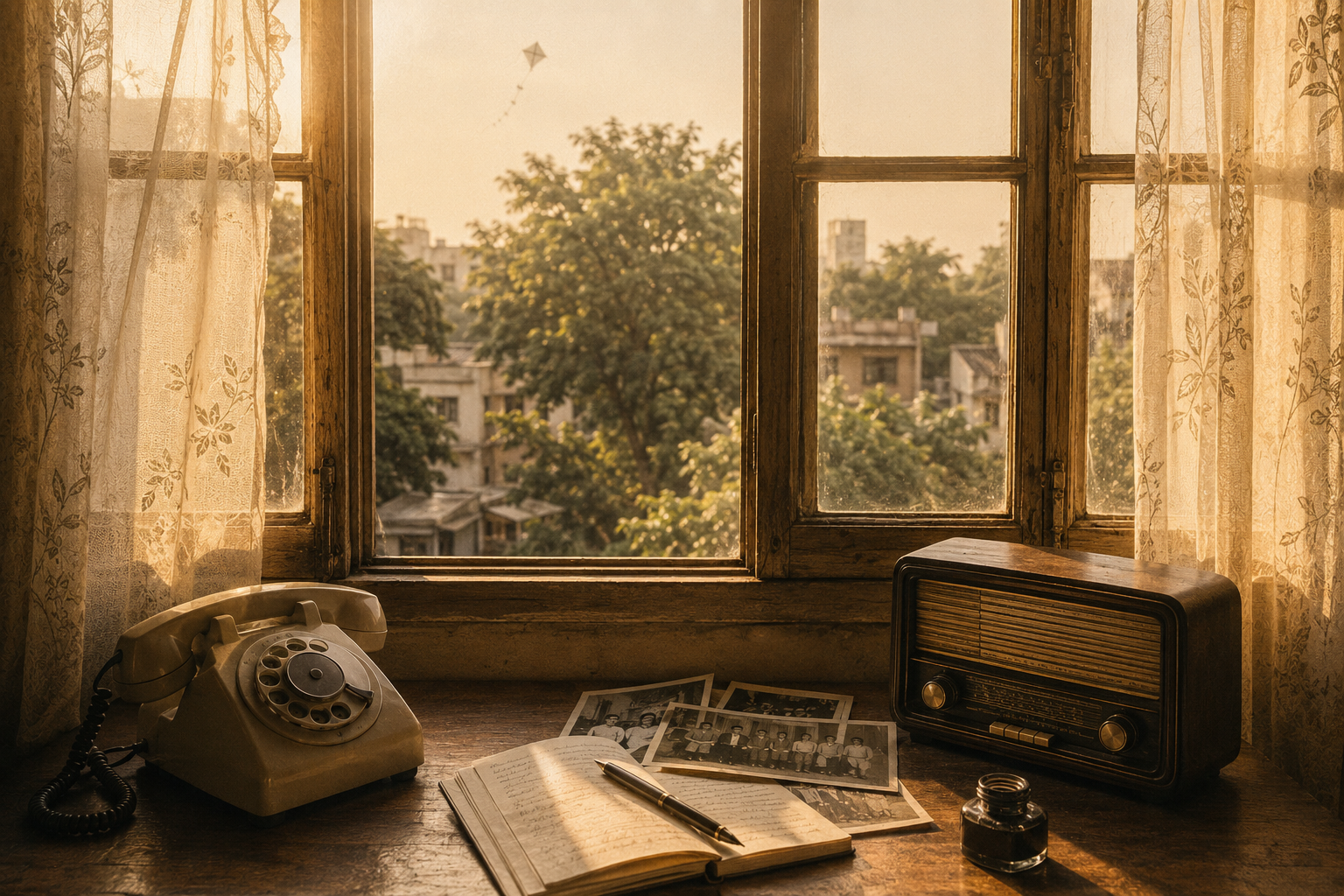
Perhaps because new possessions were fewer and farther between, their arrival became an event. I can still picture our first telephone. I must have been in Grade Nine or Ten when it was installed… sage green, solid, with a rotary dial that made its slow, deliberate journey back after each digit was dialled.
One telephone served the entire household, sometimes the entire neighbourhood. If a call came for someone next door, a child was sent running to fetch them while the caller waited patiently at the other end. Within the house, whoever was nearest answered, someone's name was called loudly through the house, and by the time you reached the receiver, half the family usually knew who was calling. If you were out, there were no missed calls awaiting explanation, no anxious messages asking where you were. The caller simply tried again later. Plans were made in advance, a time and place agreed upon, and people were simply expected to turn up.
People, too, arrived with less ceremony. An unexpected knock at the door was not automatically treated as an intrusion. Tea acquired another cup, food stretched to another plate and everyone adjusted. Looking back, that may have been one of our quietest forms of abundance… we made room… in our homes, in our days and in our lives, for people.
There is a curious paradox in that crowded existence which I only understood much later. We had far less privacy from the people we loved, yet far more privacy from the world. Telephone conversations could be overheard, cousins wandered in without knocking and somebody usually knew where you had gone. But beyond the people who actually formed our lives, we were largely unknown.
A picnic remained a picnic. A meal could be enjoyed without first being arranged for a photograph, though I confess I am guilty on that count myself. A new sari or something my father brought home needed no audience to make it special. Life was lived among those who were there, not displayed for those who were not.
We could also disappear for a while. Once you left the house, you were simply out. Someone might telephone and fail to reach you; a friend might come by and find you absent. Neither required an explanation. There was a freedom in not being perpetually reachable that we did not know was freedom then.
How different that seems now. A family of four can sit together in the same room, each absorbed in a separate screen, a separate conversation, a separate world. We are instantly reachable from almost anywhere, by almost anyone, and yet sometimes strangely unreachable to the people sitting closest to us. Technology has made it possible to remain connected across continents; yet, somewhere along the way, it has also become possible to lose touch with someone sitting across the room.
And we knew how to wait. For letters, for relatives arriving by train, for a favourite song on the radio, for Sunday evening television, for someone to come home. The waiting was part of the pleasure; longing had its own sweetness then.
Even photographs taught us patience.
A roll of film gave us thirty-six exposures. Thirty-six photographs might have to contain a birthday, a holiday and several months of ordinary family life. Every click mattered. There was no screen to tell you whether the picture was good enough and no possibility of taking twenty more until everybody looked just right. The film went to the studio and returned days later in a paper envelope, accompanied by those brown strips of negatives we carefully preserved and occasionally held up against the light.
Some photographs were beautiful. Others were blurred. Someone had blinked, a head was cut off, a thumb had wandered into a corner.
We kept them anyway.
We did not curate memory into perfection. We accepted the photograph we had because it was the moment we had. There were no filters to improve the sky and no hundred nearly identical images from which to select the one that made our lives look happiest. The photograph did not have to prove that the moment had been beautiful. We already knew whether it had been.
Today, a child may accumulate thousands of photographs before she is old enough to remember any of them. I have comparatively few from my own childhood, yet if I close my eyes, entire rooms return: the arrangement of beds, cousins talking after the lights were out, the heat of a Delhi afternoon, my grandmother's voice, the smell of food coming from another part of the house.
Much of it was never photographed at all.
Nothing brings that world back more vividly than the summer holidays. They lasted a full two months, but the excitement began weeks before they did with one increasingly urgent question: When are we going to Nani’s house? Nani, as we called our maternal grandmother, was at the very heart of those summers.
We did not go for lunch or a carefully rationed weekend. We went for an entire month. Sometimes two. Cousins arrived from different parts of India and, within hours, became one unruly tribe. Mattresses were spread on floors, mangoes disappeared by the dozen, quarrels were forgotten by teatime. We invented games whose rules changed whenever somebody began to lose, eavesdropped on adult conversations we were not supposed to hear, and discovered that boredom, when adults did not rush in to cure it, could produce the wildest flights of imagination.
At night, we slept on the terrace. Water was splashed across the sun-baked floor to cool it and beds laid beneath the open sky. All of us children jostled to sleep closest to our grandmother because she told the best ghost stories. We frightened ourselves thoroughly and then edged closer to one another beneath the sheets.
Some of the finest nights were those when the electricity failed, which it often did. Candles were lit, dinner became a candlelight affair long before such things acquired romantic pretensions, and eventually we drifted out into the lane in search of cooler air, where other families had done exactly the same. What began as a power cut became an impromptu gathering, filled with neighbours talking, children running about and laughter carrying through the darkness. Today, ten minutes without the internet can make a household restless; back then, the loss of electricity could bring an entire neighbourhood together.
Days belonged largely to us. We ran from one friend's house to another, played in the street and chased stray kites as though possession of one might materially alter our fortunes. We knew the time not from a screen, but from the sun, somebody's mother calling from a balcony, and the one deadline that mattered… to be home before Papa returned from office.
Rain had its own ritual. If the skies opened, my father would return carrying hot samosas, moong dal laddoos and jalebis from Apni Dukaan. Even today, the smell of rain can take me there faster than any photograph.
Our pleasures cost remarkably little and felt like a great deal. A rupee given for a school picnic made me feel rich. Twelve golgappas cost that rupee; an entire loaf of bread cost ninety-five paise. I mention the prices not to perform the familiar arithmetic of inflation, but because I remember the feeling of that coin in my hand.
It felt like possibility.
Perhaps children do not measure abundance by how much they possess, but by how much delight they can draw from what they have.
My father demonstrated this rather spectacularly on the days he managed to take not merely my brother and me but four or five cousins as well on his Bajaj scooter for an outing around Delhi. By every contemporary principle of transport, geometry and parenting, I am not entirely sure how this was achieved. In memory, however, six children simply belonged to one scooter, one father and one adventure.
Winter brought the more ceremonious family picnics… India Gate, Lodhi Garden, Nehru Park. My father ferried us on his Bajaj; my mother seemed to bring half the house with her, having cooked everything at home. There was a sheet to spread on the grass, a basket laden with food, oranges and apples, crisp winter carrots and radishes, badminton racquets, a cricket set and board games. Lunch slipped easily into evening, punctuated by balloons, popcorn and little treats bought from passing hawkers. Sometimes, on the way home, we stopped for a South Indian dinner at the local Vikrant Café; on other evenings, we returned home to the comfort of my mother's freshly made khichdi or pulao.
There were no restaurant reservations, no curated hampers and, more importantly, no photographs being taken for people who were not there.
The people for whom the afternoon mattered were already sitting on the sheet.
Decades later, I cannot remember what any of us wore to those picnics, or whether another family had a car. I remember my mother's food, my father's Bajaj, the winter sun.
Most of all, I remember how much fun we had.
And this, I think, is where my childhood begins to answer the question with which I started. We had fewer things with which to demonstrate that we were rich, but an astonishing number of ways to feel that we were.
Memory is a flattering editor, and the world of my childhood was hardly an idyll. Opportunities were fewer, conventions more restrictive, particularly for women, and access to knowledge depended greatly upon where one lived and what one could reach. Technology has dismantled many of those boundaries, and we are immeasurably richer for it. A phone in one's palm can now give us access to more knowledge than all the libraries I could reach in my childhood. A student in Delhi can enter an Oxford library without crossing a continent. Families separated by oceans can see one another every evening. A woman can build a profession from her home. Artificial intelligence can place before an ordinary person, in seconds, knowledge that once required extraordinary access.
I would not exchange 2026 for 1976. But progress deserves a more demanding question than how much easier life has become. We must also ask what ease has altered in us.
The world of my childhood was smaller. We knew fewer people, saw fewer places, owned fewer things and had fewer choices. Yet because life moved at a slower pace, we had time to absorb it. Today, almost everything is within reach, and almost everything arrives at once. We have conquered distance, waiting and, to a remarkable extent, inconvenience. But in removing so many limits from our lives, we may also have weakened some of the conditions that taught us patience, anticipation and contentment.
More significantly, the boundaries of comparison have expanded beyond recognition. When we were children, we measured our lives largely against people we actually knew: a cousin, a classmate, a neighbour, perhaps the occasional film star glimpsed in a magazine. Today, before breakfast is over, we may already have looked into hundreds of other lives, many of them belonging to complete strangers: somebody's immaculate home, another person's exotic holiday, a younger face, a thinner body, a coveted handbag, a more prestigious address, a larger car. We are no longer merely living among other people; we are living amid a continuous exhibition of how other people appear to live.
Aspiration has always existed, and there is nothing inherently wrong with wanting a more comfortable or beautiful life. What has changed, perhaps, is not our capacity to desire, but the number of things we are invited to desire and how frequently we encounter them. When other people's lives are continually before us, it becomes increasingly difficult not to measure our own against them. Somewhere in that constant looking outward, we begin, almost imperceptibly, to lose sight of the value of what we already have.
That, I think, is what the world of my childhood is trying to teach me. Not that everything old was better, because it certainly was not, nor that wanting more is somehow wrong. Only that there seemed to be a greater sense of proportion, and with it, a certain contentment. Beautiful things were still beautiful, success was still desired, and people still dreamt of better lives. But what we possessed did not seem to carry quite so much responsibility for proving that we had lived well.
I would not return to the world of the rotary telephone and the power cuts. But there are things from that world I would gladly carry forward… the unhurried visit, the cousin who could stay without anyone consulting a calendar, the patience to wait, the instinct to mend before replacing, and the freedom to enjoy something without wondering how it might appear to anyone else.
Perhaps what I miss most is not the simplicity of that life at all, but the ease with which we seemed to inhabit it. We wanted things, certainly. We looked forward to things. We dreamt of things. But wanting what came next did not always prevent us from enjoying what was already there.
And maybe that is why, when I travel back to those years, they feel so full.
Not because we had everything we wanted, but because we enjoyed what we had, and that felt like enough.